

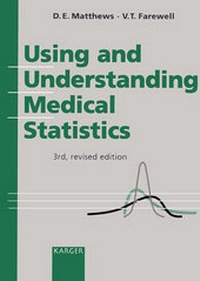
Using and Understanding Medical Statistics
3rd Edition
Published in March 1996
Book
Hardback
XIV, 246 pages
978-3-8055-6276-8 (ISBN)
Description
Since the last edition of this book was published, major developments in computer technology have affected both the practice of medicine and the methods of analyzing medical data. These advances make the focus on this revised edition - understanding many of the statistical methods that are used in modern medical studies - all the more important. Two new chapters have been added by the authors. One provides readers with an introduction to the analysis of longitudinal data. The other augments previous material concerning the design of clinical trials, exploring topics such as the use of surrogate markers, multiple outcomes, equivalence trials and the planning of efficacy-toxicity studies. In addition to providing new information and fine-tuning the rest of the book, the authors have reorganized the final six chapters so that the topics build, naturally, on each other. This latest edition is recommended both as an introduction to medical statistics and as a valuable tool in explaining the more complex statistical methods and techniques used today.
More details
Edition
3., rev. ed.
Language
English
Place of publication
Basel
Switzerland
Target group
College/higher education
Professional and scholarly
Edition type
Revised edition
Illustrations
31 figs., 86 tab.
Dimensions
Height: 24 cm
Width: 17 cm
Weight
684 gr
ISBN-13
978-3-8055-6276-8 (9783805562768)
Schweitzer Classification
Other editions
New editions
D.E. Matthews | V.T. Farewell
Using and Understanding Medical Statistics
Now available: 5th, revised and extended edition Using and Understanding Medical Statistics
Book
01/2007
4th Edition
S. Karger
€37.45
Article is exhausted; no reprint
Content
Basic concepts; tests of significance; Fisher's test for 2x2 contingency tables; approximate significance tests for contingency tables; some warnings concerning 2x2 tables; Kaplan-Meier or "actuarial" survival curves; the log-rank or Mantel-Haenszel test for the comparison of survival curves; an introduction to the normal distribution; analyzing normally distributed data; linear regression models for medical data; binary logistic regression; proportional hazards regression; the analysis of longitudinal data; data analysis; the question of sample size; the design of clinical trials; further comments regarding clinical trials; epidemiological applications.