

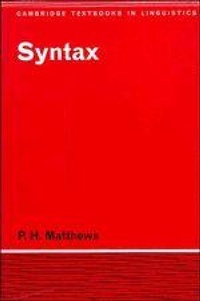
Syntax
Published on 30. July 1981
Book
Paperback/Softback
328 pages
978-0-521-29709-7 (ISBN)
Description
This is a textbook of a fundamental kind, designed to introduce students to the basic concepts of syntax. Professor Matthews does not expound the model of any one theoretical school; nor does he attempt a straightforward synthesis of already published work. He believes that students have much to gain from the descriptive traditions of individual languages as well as from theorists. His approach is therefore thematic, dealing with the nature of syntactic relations and all the main types of construction (predication, attribution, coordination etc.). There is much that is original, and every chapter manifests Professor Matthews' characteristic good sense and scholarly discernment. Students will find this volume a challenging one, for Professor Matthews draws attention to the weakness of much current syntactic theory and, in particular, considers the problem of indeterminacy, which theorists have not been able to treat in any systematic way. However the exposition is always lucid and helpfully exemplified, mainly by English. Each chapter ends with a detailed bibliographical survey, which includes notes on terminology and other points of difficulty. Syntax clearly bridges the gap between the teaching of English grammar and that of more theoretical models. Students of English language and linguistics generally will find it a textbook of lasting value.
More details
Language
English
Place of publication
Cambridge
United Kingdom
Target group
College/higher education
Product notice
Paperback (trade)
Dimensions
Height: 229 mm
Width: 152 mm
Thickness: 19 mm
Weight
534 gr
ISBN-13
978-0-521-29709-7 (9780521297097)
Copyright in bibliographic data and cover images is held by Nielsen Book Services Limited or by the publishers or by their respective licensors: all rights reserved.
Schweitzer Classification
Other editions
Content
Preface; Principal references; Notice to the reader; 1. Constructions; 2. Sentences; 3. Words; 4. Constituency and dependency; 5. Predication; 6. Objects and adverbs; 7. Phrases; 8. Clauses; 9. Conclusion; 10. Juxtaposition; 11. Realisation; 12. Syntactic paradigms; Index of names; Subject index.