

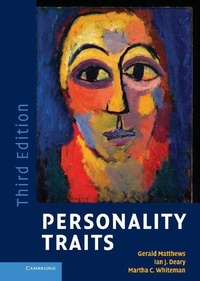
Personality Traits
3rd Edition
Published on 29. October 2009
Book
Hardback
602 pages
978-0-521-88778-6 (ISBN)
Description
Now in its third edition, this dynamic textbook analyses the traits fundamental to human personality: what they are, why they matter, their biological and social foundations, how they play out in human life and their consequences for cognition, stress and physical and mental health. The text also considers the applications of personality assessment in clinical, educational and occupational settings, providing the reader with a detailed understanding of the whole field of personality traits. This edition, now with improved student features, includes the latest research from behavioural genetics, neuroscience, social psychology and cognitive science, assesses the impact of new research techniques like brain imagery, and provides additional content on positive aspects of traits and practical uses of personality assessment. This is an essential textbook for students taking courses in personality and individual differences and also provides researchers and practitioners with a coherent, up-to-date survey of this significant area.
More details
Edition
3rd Revised edition
Language
English
Place of publication
Cambridge
United Kingdom
Target group
College/higher education
Professional and scholarly
Edition type
Revised edition
Illustrations
63 Tables, unspecified; 3 Halftones, unspecified
Dimensions
Height: 250 mm
Width: 175 mm
Thickness: 37 mm
Weight
1203 gr
ISBN-13
978-0-521-88778-6 (9780521887786)
Copyright in bibliographic data and cover images is held by Nielsen Book Services Limited or by the publishers or by their respective licensors: all rights reserved.
Schweitzer Classification
Other editions
Additional editions
Gerald Matthews | Ian J. Deary | Martha C. Whiteman
Personality Traits
E-Book
01/2010
3rd Edition
Cambridge University Press
€52.99
Available for download
Gerald Matthews
Personality Traits
E-Book
10/2009
1st Edition
Cambridge University Press
€45.49
Available for download
Previous edition
Gerald Matthews | Ian J. Deary | Martha C. Whiteman
Personality Traits
Book
12/2003
2nd Edition
Cambridge University Press
€81.84
Article exhausted; check for reprint
Persons
Gerald Matthews is Professor of Psychology at the University of Cincinnati and has previously held faculty positions at the Universities of Aston and Dundee. He has co-authored several volumes, including Attention and Emotion: a Clinical Perspective (1994) which won the 1998 British Psychological Society Book Award, and has published many articles in the area of personality research. Ian J. Deary is Professor of Differential Psychology at the University of Edinburgh, and Director of the University of Edinburgh Centre for Cognitive Ageing and Cognitive Epidemiology. He is a Fellow of the Royal College of Psychiatrists, has written extensively on personality and intelligence and won the 2002 British Psychological Society Book Award for Looking Down on Human Intelligence (2000). Martha C. Whiteman is a Senior Lecturer in Psychology at the University of Edinburgh. Her research and teaching are directed towards interpersonal aspects of personality, health and well-being, and the circumstances which may affect upward-moving or downward-moving health trajectories. She has contributed chapters to personality and health texbooks, while journal publications include articles in The Lancet and Psychosomatic Medicine.
Content
Part I. The Nature of Personality Traits: 1. The trait concept and personality theory; 2. Persons, situations and interactionism; 3. Personality across the life span; 4. Stable traits and transient states; 5. Alternative views of personality: challenges to trait theory; Part II. Causes of Personality Traits: 6. Genes, environments and personality traits; 7. The psychobiology of traits; 8. The social psychology of traits; Part III. Consequences and Applications: 9. Stress; 10. Traits and health; 11. Abnormal personality traits?; 12. Personality, performance and information-processing; 13. Applications of personality assessment; 14. Conclusions.