

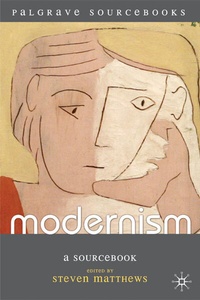
Modernism
A Sourcebook
Published on 17. June 2008
Book
Hardback
320 pages
978-1-4039-9829-3 (ISBN)
Description
This Sourcebook provides a substantial anthology of documents for contextualising texts from the Modernist period of Anglo-American literature. The documents are supported by substantial editorial, including an authoritative introduction which outlines key historical events, movements, and literary and cultural issues of the time.
Reviews / Votes
'I'd be a much better teacher with it, and modernism, potentially, would make a great deal more sense to my students.' - Kevin J. H. Dettmar, Professor of English and Cultural Studies, Southern Illinois University Carbondale, USA 'A rich, well-organised collection, one of whose strengths is the editorial matter supporting the selections.' - Derek Attridge, Professor of English and Head of Department, University of York, UK 'This book belongs on any undergraduate Modernism course...order it for your students.' - Gary Day, Times Higher Education Textbook GuideMore details
Series
Edition
2008
Language
English
Place of publication
London
United Kingdom
Publishing group
Bloomsbury Publishing PLC
Target group
College/higher education
Dimensions
Height: 235 mm
Width: 157 mm
Thickness: 23 mm
Weight
669 gr
ISBN-13
978-1-4039-9829-3 (9781403998293)
DOI
10.1007/978-1-137-06879-8
Schweitzer Classification
Other editions
Additional editions
Person
STEVEN MATTHEWS is Professor of English Literature at Reading University. His publications include Irish Poetry: Politics, History, Negotiation (Palgrave Macmillan 1997), Yeats as Precursor (Palgrave Macmillan 2001) and Les Murray (MUP 2002). He is co-editor of Rewriting the Thirties (Longman 1997) and series editor of Contexts (Arnold).
Content
FULL CONTENTS- INTRODUCTION.- TIMELINE- CHRONOLOGICAL LIST OF MAJOR MODERNIST TEXTS.- SECTION ONE: KEY HISTORICAL EVENTS.- Introduction- WORLD WAR ONE- Editorial on the Military Service Bill, which brought universal conscription to the UK, The Daily News and Leader, Thursday, January 6, 1916.- Documents relating to the first day of the Battle of the Somme.- The U.S. enters the War. IRISH RISING, EASTER 1916. SECTION TWO: SOCIETY, POLITICS, AND CLASS- Introduction- 1. Émile Durkheim, The Division of Labour.- 2. Max Weber The Protestant Ethic and the Spirit of Capitalism.- 3. A.R. Orage, 'Towards Socialism V. The Meaning of Civilisation'.- 4. L.T. Hobhouse, Liberalism.- 5. Georges Sorel, Reflections on Violence.- 6. John Maynard Keynes, The Economic Consequences of the Peace.- 7. John Dewey, Reconstruction in Philosophy.- 8. Charles F. G. Masterman, England After War.- 9. C.H. Douglas, Social Credit.- SECTION THREE: GENDER AND SEXUALITY- Introduction- 1. Otto Weininger, Sex and Character.- 2. Two articles from The Suffragette:- a) Christabel Pankhurst,'The Women's Insurrection'.- b) Sylvia Pankhurst, 'They Tortured Me'.- 3. Two articles from The Woman's Dreadnought:- a) Ennis Richmond, 'What the War Means to Us'.- b) Sylvia Pankhurst, 'The War Cure'.- 4. Alice Stone Blackwell, 'Jane Addams Testifies'.- 5. Margaret H. Sanger, Family Limitation.- 6. Havelock Ellis, The Erotic Rights of Women and The Objects of Marriage.- 7. F. Stella Browne, 'Studies in Feminine Inversion'.- SECTION FOUR: RELIGION AND BELIEF- Introduction- 1. J.G. Frazer, The Golden Bough.- 2. Arthur Symons, The Symbolist Movement in Literature. - 3. William James, The Varieties of Religious Experience.- 4. Émile Durkheim, The Elementary Forms of Religious Life.- 5. Jessie L. Weston, From Ritual to Romance.- 6. Jane Harrison, Epilogomena to the Study of Greek Religion.- SECTION FIVE: PHILOSOPHY AND IDEAS- Introduction- 1. Friedrich Nietzsche, Thus Spake Zarathustra.- 2. Max Nordau, Degeneration.- 3. William James, Pragmatism: A New Name For Some Old Ways of Thinking.- 4. Henri Bergson, Creative Evolution.- 5. T.E. Hulme, 'Romanticism and Classicism'.- 6. Oswald Spengler, The Decline of the West.- SECTION SIX: 'HIGH' CULTURE- Introduction- 1. Marinetti in London, 1912 and 1913.- 2. The Ballets Russes.- 3. Classical Music.- 4. Fine Art.- The Post-Impressionist Exhibitions in London, 1910-11 and 1912.- The 'Armory Show', New York, 17 February - 15th March, 1913.- 5. Photography.- 6. Theatre.- SECTION SEVEN: 'POPULAR' CULTURE- Introduction- 1. ''I Am Here To-day': Charlie Chaplin. - 2. 'Toujours Jazz'.- 3. Music Hall.- 4. Vaudeville.- - SECTION EIGHT: LITERARY PRODUCTION AND RECEPTION- Introduction- 1. Walter Dill Scott, The Psychology of Advertising. - 2. Two editorial notes from The Egoist.- 3. John Gould Fletcher, 'Vers Libre and Advertisements'.- 4. Jane Heap, 'Art and the Law'.- SECTION NINE: EMPIRE, RACE, AND POSTCOLONIALISM- Introduction- 1. John M. Robertson, Patriotism and Empire.- 2. J.A. Hobson, Imperialism: A Study.- 3. W.E.B. Du Bois, The Souls of Black Folk. - 4. A. G. Crafter, ''England's Day of Reckoning'.- 5. Benjamin Brawley, A Social History of the American Negro. - 6. Annie Besant, Theosophy and World-Problems.- 7. Two documents relating to Ireland, Easter 1916.- 8. Alain Locke, Preface to The New Negro: An Interpretation.- SECTION TEN: SCIENCE AND TECHNOLOGY- Introduction- 1. Sigmund Freud, The Interpretation of Dreams. - 2. Alfred North Whitehead, An Introduction to Mathematics.- 3. Raymond Pearl, Modes of Research in Genetics- 4. Anthony Freiling, 'Loss of Personality from 'Shell Shock''.- 5. W.H.R. Rivers, 'An Address on the Repression of War Experience'.- 6. A.S. Eddington Space Time and Gravitation.- 7. Albert Einstein, The Meaning of Relativity.- 8. Bertrand Russell, ABC of Relativity.- BIBLIOGRAPHY.- ILLUSTRATIONS- Marcel Duchamp, Nude Descending A Staircase, No. 2- Henri Gaudier-Brzeska, Red Stone Dancer- Alfred Stieglitz, The Steerage 1907.