

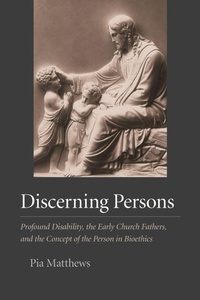
Discerning Persons
Profound Disability, the Early Church Fathers, and the Concept of the Person in Bioethics
Will be published approx. on 30. March 2020
Book
Hardback
368 pages
978-1-7339889-2-6 (ISBN)
Description
Drawing on rich insights from the early Church Fathers, Discerning Persons addresses the neglected issue of disablism and how discriminatory attitudes fail to treat people with profound disabilities as persons. This discrimination can be found in the field of bioethics, where the stakes are often high and a matter of life or death. Whereas views that give priority to human beings whatever their capacities are seen as speciesist and so discriminatory, bioethical approaches that are disablist are rarely acknowledged as prejudiced. Many bioethicists do not even realize there is an issue. Current bioethical thinking appears uncritical and unreflective in the way it accepts a separation of the human being from the person and downgrades certain individuals who do not fulfill arbitrarily defined and insubstantial criteria for being persons.
Using neglected Patristic thinking and its analogies with the human person, abled and disabled, found in reflection on the image of God and in the Trinitarian and Christological disputes of the early centuries where person language originated, the book makes patristic thinking do important work. It establishes that there are no early historical, philosophical, or theological grounds for calling or treating human beings as anything less than persons. Nor is there foundation for defining the person purely in terms of individuality, rationality, autonomy, or self-consciousness. Patristic insights conclusively call us to be discerning persons: to realize that persons are not so much defined as discerned, and to discern that all human beings, whatever their situations or capacities, are unique and unrepeatable persons.
Using neglected Patristic thinking and its analogies with the human person, abled and disabled, found in reflection on the image of God and in the Trinitarian and Christological disputes of the early centuries where person language originated, the book makes patristic thinking do important work. It establishes that there are no early historical, philosophical, or theological grounds for calling or treating human beings as anything less than persons. Nor is there foundation for defining the person purely in terms of individuality, rationality, autonomy, or self-consciousness. Patristic insights conclusively call us to be discerning persons: to realize that persons are not so much defined as discerned, and to discern that all human beings, whatever their situations or capacities, are unique and unrepeatable persons.
More details
Language
English
Place of publication
Steubenville
United States
Target group
Professional and scholarly
Product notice
sewn/stitched
Cloth over boards
Dimensions
Height: 234 mm
Width: 163 mm
Thickness: 28 mm
Weight
726 gr
ISBN-13
978-1-7339889-2-6 (9781733988926)
Copyright in bibliographic data and cover images is held by Nielsen Book Services Limited or by the publishers or by their respective licensors: all rights reserved.
Schweitzer Classification
Person
Pia Matthews is senior lecturer in healthcare ethics at St. Mary's University, Twickenham, UK.