

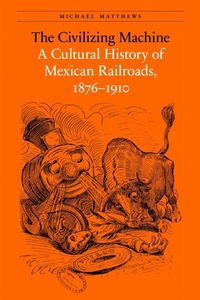
The Civilizing Machine
A Cultural History of Mexican Railroads, 1876-1910
Published on 1. January 2014
Book
Paperback/Softback
340 pages
978-0-8032-4380-4 (ISBN)
Description
In late nineteenth-century Mexico the Mexican populace was fascinated with the country's booming railroad network. Newspapers and periodicals were filled with art, poetry, literature, and social commentaries exploring the symbolic power of the railroad. As a symbol of economic, political, and industrial modernization, the locomotive served to demarcate a nation's status in the world. However, the dangers of locomotive travel, complicated by the fact that Mexico's railroads were foreign owned and operated, meant that the railroad could also symbolize disorder, death, and foreign domination.
In The Civilizing Machine Michael Matthews explores the ideological and cultural milieu that shaped the Mexican people's understanding of technology. Intrinsically tied to the Porfiriato, the thirty-five-year dictatorship of Gen. Porfirio Diaz, the booming railroad network represented material progress in a country seeking its place in the modern world. Matthews discloses how the railroad's development represented the crowning achievement of the regime and the material incarnation of its mantra, "order and progress." The Porfirian administration evoked the railroad in legitimizing and justifying its own reign, while political opponents employed the same rhetorical themes embodied by the railroads to challenge the manner in which that regime achieved economic development and modernization. As Matthews illustrates, the multiple symbols of the locomotive reflected deepening social divisions and foreshadowed the conflicts that eventually brought about the Mexican Revolution.
In The Civilizing Machine Michael Matthews explores the ideological and cultural milieu that shaped the Mexican people's understanding of technology. Intrinsically tied to the Porfiriato, the thirty-five-year dictatorship of Gen. Porfirio Diaz, the booming railroad network represented material progress in a country seeking its place in the modern world. Matthews discloses how the railroad's development represented the crowning achievement of the regime and the material incarnation of its mantra, "order and progress." The Porfirian administration evoked the railroad in legitimizing and justifying its own reign, while political opponents employed the same rhetorical themes embodied by the railroads to challenge the manner in which that regime achieved economic development and modernization. As Matthews illustrates, the multiple symbols of the locomotive reflected deepening social divisions and foreshadowed the conflicts that eventually brought about the Mexican Revolution.
Reviews / Votes
"This is an original and valuable study that deepens our understanding of Porfirian modernity."-Robert F. Alegre, American Historical Review -- Robert F. Alegre American Historical Review "Matthews's work makes a solid contribution to the growing literature on the Porfiriato."-William Schell, Jr., Americas -- William Schell, Jr. Americas "Matthews supplies overwhelming evidence to show how the railroad engine became a cultural lightning rod. It is difficult to think of a contemporary corollary with such cultural significance, which only underscores the value of this book to understanding the late nineteenth century in Mexico."-Andrew Offenburger, Western Historical Quarterly -- Andrew Offenburger Western Historical Quarterly "This is a fine contribution to the scholarship of nineteenth century Mexico. Very well researched and extremely engaging, the book analyses the significance of railways in the consciousness and outputs of different social groups in Mexico during the three and a half decades of the Porfiriato."-Samantha McDermott, Journal of Transport History -- Samantha McDermott Journal of Transport History "Matthews's insistence on the value of the visual as well as the written and his fluency with many media make for an enjoyable and accessible read."-Casey Lurtz, Hispanic American Historical Review -- Casey Lurtz Hispanic American Historical Review "The first cultural study of railroads in Mexico. Matthews's study is timely ... with lively accounts and interesting analysis."-James A. Garza, associate professor of history and ethnic studies, University of Nebraska-Lincoln -- James A. GarzaMore details
Series
Language
English
Place of publication
Lincoln
United States
Target group
Professional and scholarly
Product notice
Paperback (trade)
Illustrations
25 illustrations. 2 tables
Dimensions
Height: 229 mm
Width: 154 mm
Thickness: 23 mm
Weight
473 gr
ISBN-13
978-0-8032-4380-4 (9780803243804)
Copyright in bibliographic data and cover images is held by Nielsen Book Services Limited or by the publishers or by their respective licensors: all rights reserved.
Schweitzer Classification
Other editions
Additional editions
E-Book
02/2020
1st Edition
University of Nebraska Press
€49.49
Available for download
Person
Michael Matthews is an assistant professor of history at Elon University.
Content
Introduction Chapter 1. The Discourse of Development: The Railway Debate of the Early Porfiriato Chapter 2. De Viaje: Elite Views of Modernity and the Railway Boom Chapter 3. Festivals of Progress: The Railway Ceremony Chapter 4. The Price of Progress: Popular Perceptions of the Railway Accident Chapter 5. La Loco-Matona: The Railway in the Popular and Opposition Press Conclusion