

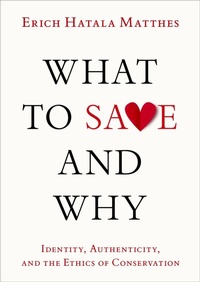
What to Save and Why
Identity, Authenticity, and the Ethics of Conservation
Published on 23. January 2025
Book
Hardback
240 pages
978-0-19-774455-0 (ISBN)
Description
What does a sanctuary for Hawaiian crows have in common with a troop of robots programmed to perform the Maori haka, or recreations of World Heritage Sites built in Minecraft?
A family heirloom. An endangered species. An ancient piece of pottery. A threatened language. These things differ in myriad ways, but they are tied together by a common thread: they are all examples of things that call out to be saved. The world is brimming with things worth saving, and we have limited time and resources. How do we decide what to save? Why do we make these choices?
Philosopher Erich Hatala Matthes explores these questions as they surface in radically diverse contexts--from museums to TikTok, and from National Parks to the corner of your attic. Matthes illustrates the deep relationship between the things we might save and our sense of self. If our cares and concerns are a fundamental part of our identity, then what we care for and preserve will play a significant role in shaping and maintaining our understanding of who we are. In a world in which everything that we care about is subject to powerful forces of change--from climate disturbance and armed conflict, to social transformation and the wear and tear of time--the terms on which we confront change will be key to whether and how we can save the things we care about in the ways that really matter to us. Will change be foisted upon us? Or is there a role for us to play in rejecting, influencing, or managing change? As he explores these questions, Matthes tackles related themes such as authenticity, agency, and appropriation: Who exactly should be responsible for saving things, and on whose behalf should such efforts be pursued? These are all essential elements to a fuller understanding of what to save and why.
A family heirloom. An endangered species. An ancient piece of pottery. A threatened language. These things differ in myriad ways, but they are tied together by a common thread: they are all examples of things that call out to be saved. The world is brimming with things worth saving, and we have limited time and resources. How do we decide what to save? Why do we make these choices?
Philosopher Erich Hatala Matthes explores these questions as they surface in radically diverse contexts--from museums to TikTok, and from National Parks to the corner of your attic. Matthes illustrates the deep relationship between the things we might save and our sense of self. If our cares and concerns are a fundamental part of our identity, then what we care for and preserve will play a significant role in shaping and maintaining our understanding of who we are. In a world in which everything that we care about is subject to powerful forces of change--from climate disturbance and armed conflict, to social transformation and the wear and tear of time--the terms on which we confront change will be key to whether and how we can save the things we care about in the ways that really matter to us. Will change be foisted upon us? Or is there a role for us to play in rejecting, influencing, or managing change? As he explores these questions, Matthes tackles related themes such as authenticity, agency, and appropriation: Who exactly should be responsible for saving things, and on whose behalf should such efforts be pursued? These are all essential elements to a fuller understanding of what to save and why.
Reviews / Votes
Whether you're cleaning out a closet or rethinking your city's public monuments, decisions about what to keep and what to toss are hard. Matthes' calm, clear book leads us around entrenched positions to point out new, creative, and generous paths forward in discussions about preservation. As we prepare to tackle our national attics, stuffed with oppressive symbols and unethically collected artifacts, we are lucky to have Matthes as a guide. * Erin L. Thompson, Author of Smashing Statues: The Rise and Fall of America's Public Monuments * In this lively and engaging book, Erich Hatala Matthes examines how we navigate loss in the context of deep attachments, unjust power relations, and profound disagreement. Moving from Marilyn Monroe's dress to Indigenous languages to the Bamiyan Buddhas, the discussion is brisk without sacrificing depth and complexity. What to Save and Why is suitable for anyone who cares about how we cope with the fragility of our stuff --and our forms of life. * Sherri Irvin, Author of Immaterial: Rules in Contemporary Art * [Matthes] has done us the timely favor of examining the disparate fields involved [in conservation]-from art history to archaeology to conservation biology-and distilling their shared dilemmas and aspirations into a clear, accessible, thought-provoking book. Appropriately for this urgent era, it's nearly pocket-size, small enough to fit in a go bag. * New York Review of Books * It is both engaging and accessible-not only for readers unfamiliar with the issues and current debates on saving and conservation but also for those unaccustomed to philosophical texts in general ... There is, quite literally, something for everyone-which makes sense, since we all have something we care about and want to save. * Zoltan Somhegyi, Nordic Journal of Aesthetics *More details
Language
English
Place of publication
New York
United States
Target group
College/higher education
Product notice
sewn/stitched
Cloth over boards
Dimensions
Height: 185 mm
Width: 137 mm
Thickness: 28 mm
Weight
318 gr
ISBN-13
978-0-19-774455-0 (9780197744550)
Copyright in bibliographic data and cover images is held by Nielsen Book Services Limited or by the publishers or by their respective licensors: all rights reserved.
Schweitzer Classification
Other editions
Additional editions
E-Book
09/2024
OUP eBook
€20.49
Available for download
E-Book
09/2024
OUP eBook
€20.49
Available for download
Person
Erich Hatala Matthes is Associate Professor of Philosophy and Advisory Faculty for Environmental Studies at Wellesley College, where he has taught for over a decade. His research and teaching focus on the ethics, politics, and aesthetics of art, cultural heritage, and the environment. He is author of Drawing the Line: What to Do with the Work of Immoral Artists from Museums to the Movies (OUP, 2022).
Content
1. Introduction
2. From Heirlooms to Tacos: What Should We Save?
3. From Wilderness to Pottery: Why Should We Save Things?
4. From Climate Change to Colonialism: From What Should We Save Things?
5. From Language Revitalization to Digital Replication: How Should We Save Things?
6. From Appropriation to Participation: By Whom Should Things Be Saved?
7. From Ourselves to Future Generations: For Whom Should We Save Things?
Index
2. From Heirlooms to Tacos: What Should We Save?
3. From Wilderness to Pottery: Why Should We Save Things?
4. From Climate Change to Colonialism: From What Should We Save Things?
5. From Language Revitalization to Digital Replication: How Should We Save Things?
6. From Appropriation to Participation: By Whom Should Things Be Saved?
7. From Ourselves to Future Generations: For Whom Should We Save Things?
Index