

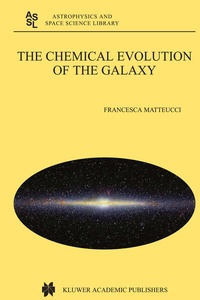
The Chemical Evolution of the Galaxy
Published on 30. June 2001
Book
Hardback
XIV, 285 pages
978-0-7923-6552-5 (ISBN)
Description
This book is based partly on a. lecture course given at the University of Tri este, but mostly on my own research experience in the field of galactic chemical evolution. The subject of galactic chemical evolution was started and developed by Beat rice Tinsley in the seventies and now is a flourishing subject. This book is dedi cated to the chemical evolution of our Galaxy and aims at giving an up-to-date review of what we have learned since Tinsley's pioneering efforts. At the time of writing, in fact, books of this kind were not available with the exception of the excellent book by Bernard Pagel on "Nucleosynthesis and Chemical Evolution of Galaxies" (Cambridge University Press, 1997), and the subject of galactic chem ical evolution has appeared only as short chapters in books devoted to other subjects. Therefore, I felt that a book of this kind could be useful. The book summarizes the observational facts which allow us to reconstruct the chemical history of our Galaxy, in particular the abundances in stars and in terstellar medium; in the last decade, a great deal of observational work, mostly abundance determinations in stars in the solar vicinity, has shed light on the pro duction and distribution of chemical elements. Even more recently more abun dance data have accumulated for external galaxies at both low and high redshift, thus providing precious information on the chemical evolution of different types of galaxies and on the early stages of galaxy evolution.
Reviews / Votes
"The development of the field (of galactic chemical evolution) in the past two decades is impressive, Matteucci herself having made significant contributions. As a planetary geochemist, I found her clear and precise treatment very useful... the book is an example of straightforward writing...it is easy to find one's way around."(Stuart Ross Taylor, Dept. of Geology, Australian National University, Canberra in Nature 414:253 (2001)
More details
Series
Edition
2003 ed.
Language
English
Place of publication
Dordrecht
Netherlands
Target group
Professional and scholarly
Research
Illustrations
XIV, 285 p.
Dimensions
Height: 241 mm
Width: 160 mm
Thickness: 21 mm
Weight
617 gr
ISBN-13
978-0-7923-6552-5 (9780792365525)
DOI
10.1007/978-94-010-0967-6
Schweitzer Classification
Other editions
Additional editions
Francesca Matteucci
The Chemical Evolution of the Galaxy
Book
10/2003
Kluwer Academic Publishers
€106.99
Shipment within 15-20 days
Person
Joss Bland-Hawthorn holds the Federation Fellow Professorship at the Institute of Astronomy, School of Physics, University of Sydney. He is doing research on near-field and far-field cosmology and is also working in instrument science. Kenneth Charles Freeman is Duffield Professor of Astronomy in the Research School of Astronomy and Astrophysics at the Mount Stromlo Observatory of the Australian National University in Canberra. His research interests are in the formation and dynamics of galaxies and globular clusters. He received several international awards. Francesca Matteucci is associate professor at the University of Trieste, Italy, where she teaches Stellar Physics. Her field of research is the chemical evolution of galaxies of different morphological type, supernova rates and supernova progenitors.
Content
1. Observational Evidence for Chemical Evolution.- 1.1 Overview and historical perspective.- 1.2 Abundances in stars.- 1.3 Abundances in globular clusters.- 1.4 The metallicity distribution of the local disk G-dwarfs.- 1.5 The metallicity distribution of halo stars.- 1.6 The age-metallicity relation.- 1.7 Abundances in the bulge stars.- 1.8 Abundances from planetary nebulae.- 1.9 Abundances from HII regions, B stars, open clusters.- 1.10 Isotopic ratios.- 1.11 The abundances of light elements.- 1.12 The mass distribution in the Galaxy.- 1.13 Supernovae and supernova rates.- 1.14 Nova rates.- 2. Stellar Evolution and Nucleosynthesis.- 2.1 The evolution of single stars.- 2.2 Nucleosynthesis.- 2.3 The evolution of binary systems.- 2.4 Stellar yields.- 2.5 Local abundances and nuclear processes.- 2.6 Algorithms to compute the stellar yields.- 2.7 The influence of mass loss and overshooting on the stellar yields.- 2.8 Galactic yields.- 3. The Stellar Birthrate.- 3.1 The process of star formation.- 3.2 Derivation of the stellar birthrate.- 3.3 The parametrizations of the SFR.- 4. Gas Flows.- 4.1 Infall of gas onto the Galaxy.- 4.2 Radial flows along the galactic disk.- 4.3 Galactic winds.- 5. Basic Equations of Chemical Evolution.- 5.1 Analytical models.- 5.2 Numerical models.- 5.3 Chemo-dynamical models.- 6. Formation and Evolution of the Milky Way.- 6.1 Abundances and kinematics.- 6.2 The globular clusters ages and the formation of the halo.- 6.3 Abundance ratios and galaxy formation.- 6.4 Serial formation.- 6.5 Parallel formation.- 6.6 Two-infall formation.- 6.7 The evolution of the solar neighbourhood.- 6.8 The evolution of the galactic disk.- 6.9 The evolution of light elements and their impact on cosmology.- 6.10 The chemical evolution of the galactic bulge.- 6.11 How reliable are chemical evolution models?.- 7. Nucleochronology and the Age of the Galaxy.- 7.1 Radioactive dating of elements.- 7.2 The age of the galaxy.- 8. The Milky Way and other Spiral Galaxies.- 8.1 Abundances and abundance gradients.- 8.2 Correlations between abundances and galaxy properties.- 8.3 Field and cluster spirals.- 8.4 Formation and evolution of galactic disks.- 8.5 The Milky Way at high redshift.- 9. References.- Acknowledgments.