

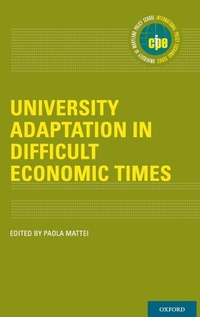
University Adaptation in Difficult Economic Times
Published on 29. May 2014
Book
Hardback
224 pages
978-0-19-998939-3 (ISBN)
Description
Financial sustainability is one of the key challenges confronting Europe's universities today. Despite the fact that universities are at the centre of knowledge creation and development, which itself is seen as one of the main engines of economic growth, public funding of higher education in most countries is not increasing or at least not increasing enough in real terms. "Democratisation of higher education" has led to the fact that the higher education budgets per student are relatively low in most European countries compared to Europe's competitors. Despite declarations of intent to increase spending on higher education and research, it is not very likely that public expenditure will grow significantly on average in Europe and therefore be able to keep up with rapidly inflating costs in the years to come. One of the reasons for this is that higher education and research have to compete with other priorities in public budgets (e.g., security, health, etc.).
Furthermore, the recent economic downturn has contributed to the decision in many European countries to decrease the levels of investment in higher education and research. Such trends are particularly worrisome for universities across Europe, whose continuing dependence on public funding puts their future sustainability under pressure. New funding schemes and incentives have been discussed and introduced in many European higher education systems, including competitive funding schemes for research under the name of "excellence" policies.
Despite the different national institutional configurations in Europe, higher education systems face similar demands of promoting sustainable funding models, maintaining high academic standards, and equality. Thus, financial sustainability is not an end in itself; it aims to ensure that the public university's goals are reached by guaranteeing that the institution produces sufficient income to enable it to invest in high quality education and produce equitable outcomes. For these reasons, this book analyses funding reforms from a multidimensional approach.
Furthermore, the recent economic downturn has contributed to the decision in many European countries to decrease the levels of investment in higher education and research. Such trends are particularly worrisome for universities across Europe, whose continuing dependence on public funding puts their future sustainability under pressure. New funding schemes and incentives have been discussed and introduced in many European higher education systems, including competitive funding schemes for research under the name of "excellence" policies.
Despite the different national institutional configurations in Europe, higher education systems face similar demands of promoting sustainable funding models, maintaining high academic standards, and equality. Thus, financial sustainability is not an end in itself; it aims to ensure that the public university's goals are reached by guaranteeing that the institution produces sufficient income to enable it to invest in high quality education and produce equitable outcomes. For these reasons, this book analyses funding reforms from a multidimensional approach.
Reviews / Votes
"A new book tries to bring academic rigour to the 'evidence-free' debates on the funding of European universities. The book was designed to test 'the claims that governments are no longer committed to public higher education.' Contributors to the book went on to explore thelinks between the [two main strands of the 'modernisation agenda.']" -Matthew Reisz, Times Higher EducationMore details
Series
Language
English
Place of publication
New York
United States
Target group
College/higher education
Professional and scholarly
Illustrations
7 B&W line drawings
Dimensions
Height: 240 mm
Width: 161 mm
Thickness: 18 mm
Weight
549 gr
ISBN-13
978-0-19-998939-3 (9780199989393)
Copyright in bibliographic data and cover images is held by Nielsen Book Services Limited or by the publishers or by their respective licensors: all rights reserved.
Schweitzer Classification
Other editions
Additional editions
Paola Mattei
University Adaptation in Difficult Economic Times
E-Book
04/2014
1st Edition
OUP eBook
€33.99
Available for download
Paola Mattei
University Adaptation in Difficult Economic Times
E-Book
04/2014
1st Edition
OUP eBook
€43.49
Available for download
Person
Paola Mattei (Ph.D. London School of Economics) is a Fellow at the European Studies Centre at St Antony's College, University of Oxford, and University Lecturer in Comparative Social Policy. Her research examines comparative welfare reforms, health care and comparative education policy reforms. She has published numerous articles on these subjects, as well as two books: Restructuring Welfare Organisations in Europe: From Democracy to Good Management? (Palgrave 2009) and Welfare Governance Reforms and Effects in the Post-Golden Age (Routledge 2010), edited with K. Voerhest. She is the Principal Investigator of an international research project on Welfare Reforms and Accountability (funded by the Norwegian Research Council).
Content
CONTENTS ; Part I. Funding: Pressures, Reforms, and Analytical Foundations ; Chapter 1 ; Public Accountability Reforms and Higher Education ; Paola Mattei ; Chapter 2 ; Dynamics of Convergence and Divergence. ; Exploring Accounts of Higher Education Policy Change ; Peter Maassen and Ase Gornitzka ; Chapter 3 ; Global pressures and national cultures: a Nordic University template? ; Tom Christensen, Ase Gornitzka, Peter Maassen ; Chapter 4 ; Financially Sustainable Universities: Challenges and Strategies in Times of Austerity ; Thomas Estermann and Enora Pruvot ; Chapter 5 ; Reforming Under Pressure. Higher Education Reforms in France (2006-2010) ; Corine Eyraud ; Part II. Internationalisation and Europeanization ; Chapter 6 ; The Value of Temporary Study Abroad: The ERASMUS Experience ; Ulrich Teichler ; Chapter 7 ; Europeanization and Higher Education: Comfortable Bedfellows? ; Jeroen Huisman ; Chapter 8 ; University Rankings: The Manifestation and Driver of Competition for Excellence ; Within the New Higher Education Landscape ; Jan Sadlak ; Part III. Massification of Higher Education: Strategies of Equality or Privatisation? ; Chapter 9 ; Privatisation of Higher Education in Central and Eastern Europe ; Jadwiga Koralewicz ; Chapter 10 ; Class and Ethnic Inequality in Educational Outcomes in an International Perspective ; Jan O. Jonsson ; Bibliography ; Index