

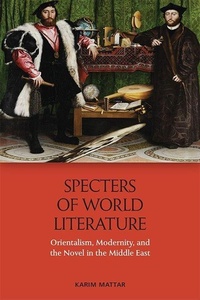
Specters of World Literature
Orientalism, Modernity, and the Novel in the Middle East
Published on 30. May 2022
Book
Paperback/Softback
360 pages
978-1-4744-6704-9 (ISBN)
Description
At the heart of this book is a spectral theory of world literature that draws on Edward Said, Aamir Mufti, Jacques Derrida and world-systems theory to assess how the field produces local literature as an "other" that haunts its universalising, assimilative imperative with the force of the uncanny. It takes the Middle Eastern novel as both metonym and metaphor of a spectral world literature. It explores the worlding of novels from the Middle East in recent years, and, focusing on the pivotal sites of Middle Eastern modernity (Egypt, Turkey, Iran), argues that lost to their global production, circulation and reception is their constitution in the logic of spectrality. With the intention of redressing this imbalance, it critically restores their engagements with the others of Middle Eastern modernity and shows, through a new reading of the Middle Eastern novel, that world literature is always-already haunted by its others, the ghosts of modernity.
Reviews / Votes
[...] contains some brilliant insights and syntheses. It is thus essential reading for both world literature and Middle Eastern literature students. -- Haifa Saud Alfaisal, King Saud University, Riyadh * Journal of Arabic Literature 53 * A work of scholarship should promise new knowledge as well as new interpretations, and this is a work that does just that, and in more than one way. It will enrich and inspire the discourse on world literature. There is nothing out there that is quite like it. -- Bruce Robbins, Columbia University This is a strong book in all the important ways. It is learned, conceptually sophisticated, critically sensitive, judicious and thoughtful throughout, lucidly presented, and well written. One only occasionally finds this combination. It definitely makes a contribution to the contemporary discussion of world literature. This is an outstanding piece of work. -- Walter Cohen, University of Michigan A welcome intervention in definitions, theories and practices of world literature that engages seriously with the 'local' in the Middle Eastern novel in translation. -- Wen-chin Ouyang, SOAS, University of LondonMore details
Language
English
Place of publication
Edinburgh
United Kingdom
Target group
Professional and scholarly
Product notice
Paperback (trade)
Unsewn / adhesive bound
Dimensions
Height: 234 mm
Width: 156 mm
Thickness: 19 mm
Weight
508 gr
ISBN-13
978-1-4744-6704-9 (9781474467049)
Copyright in bibliographic data and cover images is held by Nielsen Book Services Limited or by the publishers or by their respective licensors: all rights reserved.
Schweitzer Classification
Person
Karim Mattar is an Assistant Professor of English at the University of Colorado at Boulder. He is a transdisciplinary humanist, and his research and teaching interests are focused around world literature, the history of the novel, the Middle East, the Israel / Palestine conflict, and critical theory. With Anna Ball, he is the co-editor of The Edinburgh Companion to the Postcolonial Middle East (Edinburgh University Press, 2019).
Content
Preface
Introduction: Towards a Spectral Theory of World Literature
Part I: The Worlding of "Literature" in the Middle East
1. The Shaba? of Modernity: World-Systems, the Petro-Imperium, and the Indigenous Trace
2. A Genealogy of Adab in the Comparative Middle East
Part II: The Middle Eastern Novel and the Spectral Life-World of Modernity
3. The Revolution of Form: Naguib Mahfouz from the Suez Crisis to the Arab Spring
4. Islam and the Limits of Translation: Orhan Pamuk and the Ottoman Revival
5. Women in the Literary Marketplace: The Anglophone Iranian Novel and the Feminist Subject
Conclusion: Futures of Spectrality
BibliographyIndex
Introduction: Towards a Spectral Theory of World Literature
Part I: The Worlding of "Literature" in the Middle East
1. The Shaba? of Modernity: World-Systems, the Petro-Imperium, and the Indigenous Trace
2. A Genealogy of Adab in the Comparative Middle East
Part II: The Middle Eastern Novel and the Spectral Life-World of Modernity
3. The Revolution of Form: Naguib Mahfouz from the Suez Crisis to the Arab Spring
4. Islam and the Limits of Translation: Orhan Pamuk and the Ottoman Revival
5. Women in the Literary Marketplace: The Anglophone Iranian Novel and the Feminist Subject
Conclusion: Futures of Spectrality
BibliographyIndex