

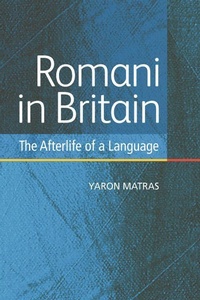
Romani in Britain
The Afterlife of a Language
Published on 5. October 2010
Book
Hardback
272 pages
978-0-7486-3904-5 (ISBN)
Description
Romani is one of Britain's oldest and most established minority languages. Brought to the country by Romani immigrants from continental Europe in the sixteenth century or even earlier, it was spoken in its old, inflected form as a family and community language until the second half of the nineteenth century, when it yielded to English. But even after its decline as the everyday language of English and Welsh Gypsies, Romani continues to survive in the form of a vocabulary that is used to express an 'emotive mode' of communication among group members. This book examines British Romani in its historical context and in its present-day form, drawing on recordings and interviews with speakers. It documents the Romani vocabulary and its usage patterns in conversation, offering insight into the processes of language death and language revitalization. The volume includes an extensive lexicon of Angloromani as a helpful reference.
More details
Language
English
Place of publication
Edinburgh
United Kingdom
Target group
Professional and scholarly
Product notice
sewn/stitched
Cloth over boards
Dimensions
Height: 234 mm
Width: 163 mm
Thickness: 23 mm
Weight
558 gr
ISBN-13
978-0-7486-3904-5 (9780748639045)
Copyright in bibliographic data and cover images is held by Nielsen Book Services Limited or by the publishers or by their respective licensors: all rights reserved.
Schweitzer Classification
Other editions
Additional editions
E-Book
10/2010
Edinburgh University Press
€0.00
Available for download
Person
Yaron Matras is a Professor in Linguistics at the University of Manchester. Major publications include Romani: A Linguistic Introduction (CUP, 2002), (a study of Romani grammatical categories from a discourse perspective), a volume (co-edited with Peter Bakker) on The Mixed Language Debate (Mouton, 2004), a forthcoming volume (co-edited with April McMahon and Nigel Vincent) on Linguistic Areas (to appear with Palgrave), and several edited and co-edited volumes on Romani linguistics.
Content
Chapter 1: Angloromani: A different kind of language?; 1.1. Gypsies and Travellers in Britain; 1.2. Language contact, language change and dialects; 1.3. 'Mixed' Romani dialects and Para-Romani; 1.4. Creoles and pidgins; 1.5. Mixed Languages; 1.6. In-group lexicons, argots and 'secret' languages; 1.7. Language shift and language loss; 1.8. Toward an integrated scenario: The functional turnover model; Chapter 2: The roots of Romani; 2.1. Pre-European origins; 2.2. Innovations acquired outside the Indian Subcontinent; 2.3. The impact of Greek; 2.4. Toward a chronology of Romani migrations; 2.5. Dialect differentiation in Romani; 2.5.1. The period of dialect formation; 2.5.2. Variation within Early Romani; 2.5.3. Local and regional changes; 2.5.4. Territorial developments and major isoglosses; Chapter 3: The historical position of British Romani; 3.1. The sources; 3.2. A structural overview of British Romani; 3.2.1. Lexicon and word formation; 3.2.2. Phonology; 3.2.3. Nominal inflection; 3.2.4. Verbs; 3.2.5. Grammatical vocabulary and morphosyntax; 3.2.6. The impact of English; 3.3. The position of British Romani among Romani dialects; 3.4. The decline of inflected Romani in Britain; Chapter 4: The structural composition of Angloromani; 4.1. The data corpus; 4.2. Phonology and phonological variation; 4.3. Word formation and word classes; 4.3.1. Word derivation; 4.3.2. Grammatical vocabulary; 4.3.3. Retention of grammatical inflection; 4.4. Morpho-syntactic characteristics; 4.5. Lexical composition and lexical distribution; Chapter 5: The conversational functions of Angloromani; 5.1. Back to 'languageness'; 5.2. Angloromani as a speech-act device; 5.3. Angloromani in narration; 5.4. Speakers' perspectives on language loss and revitalisation; 5.5. The prospects of a 'language revival'; Chapter 6: Conclusions: The decline, death, and afterlife of a language; 6.1. The historical decline of inflected Romani; 6.2. Bilingualism after language shift; References; Appendix I: Lexicon of Angloromani; Appendix II: Predecessor expressions by origin