

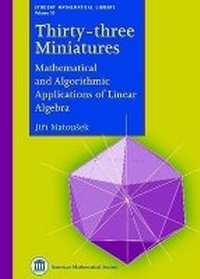
Thirty-three Miniatures
Mathematical and Algorithmic Applications of Linear Algebra
Published on 30. June 2010
Book
Paperback/Softback
182 pages
978-0-8218-4977-4 (ISBN)
Description
This volume contains a collection of clever mathematical applications of linear algebra, mainly in combinatorics, geometry, and algorithms. Each chapter covers a single main result with motivation and full proof in at most ten pages and can be read independently of all other chapters (with minor exceptions), assuming only a modest background in linear algebra. The topics include a number of well-known mathematical gems, such as Hamming codes, the matrix-tree theorem, the Lovasz bound on the Shannon capacity, and a counterexample to Borsuk's conjecture, as well as other, perhaps less popular but similarly beautiful results, e.g., fast associativity testing, a lemma of Steinitz on ordering vectors, a monotonicity result for integer partitions, or a bound for set pairs via exterior products. The simpler results in the first part of the book provide ample material to liven up an undergraduate course of linear algebra. The more advanced parts can be used for a graduate course of linear-algebraic methods or for seminar presentations. Table of Contents: Fibonacci numbers, quickly; Fibonacci numbers, the formula; The clubs of Oddtown; Same-size intersections; Error-correcting codes; Odd distances; Are these distances Euclidean?; Packing complete bipartite graphs; Equiangular lines; Where is the triangle?; Checking matrix multiplication; Tiling a rectangle by squares; Three Petersens are not enough; Petersen, Hoffman-Singleton, and maybe 57; Only two distances; Covering a cube minus one vertex; Medium-size intersection is hard to avoid; On the difficulty of reducing the diameter; The end of the small coins; Walking in the yard; Counting spanning trees; In how many ways can a man tile a board?; More bricks--more walls?; Perfect matchings and determinants; Turning a ladder over a finite field; Counting compositions; Is it associative?; The secret agent and umbrella; Shannon capacity of the union: a tale of two fields; Equilateral sets; Cutting cheaply using eigenvectors; Rotating the cube; Set pairs and exterior products; Index. (STML/53)
Reviews / Votes
Finding examples of "linear algebra in action" that are both accessible and convincing is difficult. Thirty-three Miniatures is an attempt to present some usable examples. . . . For me, the biggest impact of the book came from noticing the tools that are used. Many linear algebra textbooks, including the one I use, delay discussion of inner products and transpose matrices till later in the course, which sometimes means they don't get discussed at all. Seeing how often the transpose matrix shows up in Matousek's miniatures made me realize space must be made for it. Similarly, the theorem relating the rank of the product of two matrices to the ranks of the factors plays a big role here. Most linear algebra instructors would benefit from this kind of insight. . . . Thirty-three Miniatures would be an excellent book for an informal seminar offered to students after their first linear algebra course. It may also be the germ of many interesting undergraduate talks. And it's fun as well." - Fernando Q. Gouvea, MAA Reviews"[This book] is an excellent collection of clever applications of linear algebra to various areas of (primarily) discrete/combinatiorial mathematics. ... The style of exposition is very lively, with fairly standard usage of terminologies and notations. ... Highly recommended." - Choice
More details
Series
Language
English
Place of publication
Providence
United States
Target group
Professional and scholarly
Weight
243 gr
ISBN-13
978-0-8218-4977-4 (9780821849774)
Copyright in bibliographic data and cover images is held by Nielsen Book Services Limited or by the publishers or by their respective licensors: all rights reserved.
Schweitzer Classification
Person
Jiri Matousek, Charles University, Prague, Czech Republic
Content
Preface
Notation
Fibonacci numbers, quickly
Fibonacci numbers, the formula
The clubs of Oddtown
Same-size intersections
Error-correcting codes
Odd distances
Are these distances Euclidean?
Packing complete bipartite graphs
Equiangular lines
Where is the triangle?
Checking matrix multiplication
Tiling a rectangle by squares
Three Petersens are not enough
Petersen, Hoffman-Singleton, and maybe 57
Only two distances
Covering a cube minus one vertex
Medium-size intersection is hard to avoid
On the difficulty of reducing the diameter
The end of the small coins
Walking in the yard
Counting spanning trees
In how many ways can a man tile a board?
More bricks-more walls?
Perfect matchings and determinants
Turning a ladder over a finite field
Counting compositions
Is it associative?
The secret agent and umbrella
Shannon capacity of the union: a tale of two fields
Equilateral sets
Cutting cheaply using eigenvectors
Rotating the cube
Set pairs and exterior products
Index
Notation
Fibonacci numbers, quickly
Fibonacci numbers, the formula
The clubs of Oddtown
Same-size intersections
Error-correcting codes
Odd distances
Are these distances Euclidean?
Packing complete bipartite graphs
Equiangular lines
Where is the triangle?
Checking matrix multiplication
Tiling a rectangle by squares
Three Petersens are not enough
Petersen, Hoffman-Singleton, and maybe 57
Only two distances
Covering a cube minus one vertex
Medium-size intersection is hard to avoid
On the difficulty of reducing the diameter
The end of the small coins
Walking in the yard
Counting spanning trees
In how many ways can a man tile a board?
More bricks-more walls?
Perfect matchings and determinants
Turning a ladder over a finite field
Counting compositions
Is it associative?
The secret agent and umbrella
Shannon capacity of the union: a tale of two fields
Equilateral sets
Cutting cheaply using eigenvectors
Rotating the cube
Set pairs and exterior products
Index