

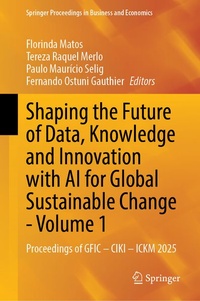
Shaping the Future of Data, Knowledge and Innovation with AI for Global Sustainable Change - Volume 1
Description
Volume I of this four-volume series focuses on AI and Digital Transformation , presenting a selection of the most relevant contributions from the GFIC-CiKi-ICKM 2025 conferences, held under the theme Shaping the Future of Data, Knowledge and Innovation with AI for Global Sustainable Change . It offers a timely and insightful perspective on the role of artificial intelligence in driving digital transformation across organisations, economies, and societies.
The remaining volumes address AI, Ethics and Governance (Volume II), Knowledge Management in a Changing World (Volume III), and Innovation Ecosystems and Knowledge Strategies in the Digital Age (Volume IV). Together, they provide a comprehensive and multidisciplinary perspective on how artificial intelligence is reshaping contemporary societies.
This volume explores the multifaceted interactions between AI and digital transformation, highlighting both opportunities and challenges, and contributing to a deeper understanding of how these forces are reshaping knowledge, organisations, and society. Drawing on global case studies and expert contributions, it delivers actionable insights across key domains-such as knowledge management, intellectual capital, data science, and innovation-positioning AI as a transformative force for sustainable impact.
More details
Persons
Florinda Matos is a Professor of General Management at ISCTE Business School, ISCTE - University Institute of Lisbon, Portugal, and an associate research fellow at DINÂMIA'CET - IUL - Centre for Socioeconomic and Territorial Studies, Portugal, where she leads several international projects, including the CoVE Future Skills Factory. As the editor of several journals and books, she has authored numerous works on knowledge and intellectual capital management, resilience, sustainability, and digital transformation. She is a distinguished conference chair for numerous conferences in the fields of intellectual capital and knowledge management, as well as innovation. Additionally, she is the Founder and President of ICAA - Intellectual Capital Association and serves as Portugal's ambassador for The New Club of Paris.
Tereza Raquel Merlo is a professor, researcher, consultant, and CEO of Merlo Management Consulting, specializing in Knowledge Management Systems. She teaches at the University of North Texas, USA, and is a postdoctoral researcher at the Federal University of Rio de Janeiro, Brazil. As the editor of the Artificial Intelligence in Organizations book series by World Scientific, she has authored several works on data, knowledge management, leadership, AI ethics, and business strategy. A keynote speaker and co-chair of the International Conference of Knowledge Management (ICKM), she serves on international advisory boards and scientific committees, including the Scientific Council for the Glossary of Innovation, Organizational Knowledge, and Scientific and Technological Information (IBICT).
Paulo Mauricio Selig, PhD in Production Engineering, was President of the Brazilian Production Engineering Association. He was a cofounder and coordinator of the Graduate Program in Knowledge Engineering and Management at the Federal University of Santa Catarina (UFSC), Brazil. Currently, he is the chairman of the International Conference on Knowledge and Innovation (ciKi) and a volunteer professor in the postgraduate program in Engineering and Knowledge Management at UFSC.
Fernando Ostuni Gauthier is a scholar in the field of Knowledge Engineering, currently serving as a Full Professor in the Department of Knowledge Engineering at the Federal University of Santa Catarina, Brazil. His research interests include knowledge engineering, ontologies, linked data, entrepreneurship and innovation, artificial intelligence, evolutionary computing, and digital education. Throughout his career, he has published extensively on these topics in prestigious international journals and conferences.
Content
Introduction.- Recognizing and Avoiding Epistemic Injustice When Using AI Tools for Reviews of Literature.- Neo-Learning and Listening to Customer Demands for Developing an Educational Solution.- LLM-Supported Method for Developing Domain-Specific Taxonomies.- Generative AI as a Knowledge Co-Creation Partner: Building Proto-Personas in Data-Driven Marketing under the KM 5.0 Paradigm.- Overview of the Impacts on 5G Networks by IoT.- Human Value Design: Bridging AI, IC, and Personalization for Sustainable Innovation.- Artificial Intelligence as a Strategic Tool in Branding Processes: Reflections from the Sete Rotas Case Study.- The ECCA Model: Adaptive Knowledge Modeling to Support Human-AI Collaboration in Dynamic Contexts.- A Large Language Model-based Model for Patent Classification.- Generative Artificial Intelligence (GAI) in Hyper-Personalized Website Production Processes: The Experience of Web Designers.- Digital Transformation in Banking: A Review of Challenges and Trends.- Generative Pre-trained Transformer (GPT) tools in the PRISMA literature review.- Swarm-Based Aerial Intelligence for Real-Time Data Integration in Digital Transformation Systems.- Automating Clinical Trial Enrollment: An AI Framework for Protocol Interpretation and Patient Matching.- A Knowledge Graph and LLM-Based Framework for Strategic Planning in Brazilian Federal Universities.- Enhancing E-Learning Interaction through Customized LLM-Based Chatbots - A Prototype Study.- The Poetics of Artificial Intelligence: An Analysis of the IAGen Adobe Firefly Tool through the Lens of Agency and Remediation.- Perspectives on Artificial Intelligence and Place Branding: Exploring Potentials and Limitations in the Case of Rio do Sul.- Smart Expert Debriefing - Potentials and Challenges of AI for Acquiring and Documenting Implicit Knowledge of Leaving Experts.- Digital Transformation of "Quantum Consciousness" of a Digital Twin with Artificial Intelligence in the System-Information Space.- Neural network-based intelligent lighting system for indoor city farms: architecture, implementation, and energy efficiency analysis.- Unlocking the Black Box: Machine Learning Explainability for Financial Crises Prediction.- LexiCube: Multidimensional News Generation and Analysis with OLAP.- AI-Driven Optimization of Onboarding in Large Organizations: Development of the Prototype 'bAIby'.- Green Intelligence: Leveraging Knowledge to Enhance Data Center Sustainability and Efficiency.- Synergies Between Artificial Intelligence and Knowledge Management: Applications for High-Tech Enterprises and Brazil's Strategic Position.- Trends and Limitations in the Application of NLP and GenAI in Customer Experience: An Integrative Literature Review.- Beyond Banking: AI's Transformative Impact on Financial Stability and Systemic Challenges in the Financial Industry.