

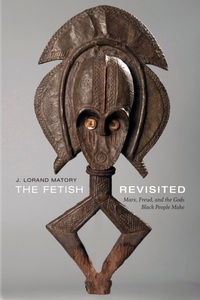
The Fetish Revisited
Marx, Freud, and the Gods Black People Make
Published on 23. November 2018
Book
Hardback
392 pages
978-1-4780-0075-4 (ISBN)
Description
Since the early-modern encounter between African and European merchants on the Guinea Coast, European social critics have invoked African gods as metaphors for misplaced value and agency, using the term "fetishism" chiefly to assert the irrationality of their fellow Europeans. Yet, as J. Lorand Matory demonstrates in The Fetish Revisited, Afro-Atlantic gods have a materially embodied social logic of their own, which is no less rational than the social theories of Marx and Freud. Drawing on thirty-six years of fieldwork in Africa, Europe, and the Americas, Matory casts an Afro-Atlantic eye on European theory to show how Marx's and Freud's conceptions of the fetish both illuminate and misrepresent Africa's human-made gods. Through this analysis, the priests, practices, and spirited things of four major Afro-Atlantic religions simultaneously call attention to the culture-specific, materially conditioned, physically embodied, and indeed fetishistic nature of Marx's and Freud's theories themselves. Challenging long-held assumptions about the nature of gods and theories, Matory offers a novel perspective on the social roots of these tandem African and European understandings of collective action, while illuminating the relationship of European social theory to the racism suffered by Africans and assimilated Jews alike.
Reviews / Votes
"J. L. Matory provides a critical and provocative account of how the concept of the fetish has been appropriated and used as a key concept in the writings of Karl Marx and Sigmund Freud. The work is especially strong in demonstrating the fantastical appropriations of the idea of the fetish, plucked from the complex and rich contexts of meaning and agency in transatlantic black religion. . . . . A fascinating, readable, and wandering book. . . . Summing Up: Highly recommended. Upper-division undergraduates through faculty." - G. E. Marcus (Choice) "Matory's The Fetish Revisited is a masterful work, stunning in its erudition, ambitious argument, and prodigious ethnographic detail." - Laura S. Grillo (Journal of the American Academy of Religion) "The Fetish Revisited is an important book and a pleasure to read." - Steven Engler (Studies in Religion) "... [Matory] offers important insights into the Afro-Atlantic origins and makings of fetishes and into the unequal relations they comprise. One of the great merits of this book is that it takes Afro-Atlantic things, practices, and voices as theory and not merely as something to be described and analyzed." - Benedikt Pontzen (Anthropos) "Matory's The Fetish Revisited is a well-researched and provocative work that combines academic research with a deep intellectual reflection in a work mainly directed to the disciples of Freud and Marx, but amazingly insightful into the fields of religious studies, anthropology, ethnology and meta-theory." - Cyril-Mary Pius Olatunji and Fracis Kayode Fabidun (Marx and Philosophy Review of Books)More details
Language
English
Place of publication
North Carolina
United States
Target group
Professional and scholarly
Product notice
Cloth over boards
Illustrations
51 photographs, incl. 9 in col
Dimensions
Height: 236 mm
Width: 157 mm
Thickness: 30 mm
Weight
703 gr
ISBN-13
978-1-4780-0075-4 (9781478000754)
Copyright in bibliographic data and cover images is held by Nielsen Book Services Limited or by the publishers or by their respective licensors: all rights reserved.
Schweitzer Classification
Other editions
Additional editions
E-Book
10/2018
1st Edition
De Gruyter
€218.99
Available for download
Person
J. Lorand Matory is Lawrence Richardson Professor of Cultural Anthropology and Director of the Sacred Arts of the Black Atlantic Project at Duke University. He is the author of Stigma and Culture: Last-Place Anxiety in Black America; Black Atlantic Religion: Tradition, Transnationalism, and Matriarchy in the Afro-Brazilian CandomblE; and Sex and the Empire That Is No More: Gender and the Politics of Metaphor in Oyo Yoruba Religion.
Content
A Note on Orthography ix
Preface xi
Introduction 1
Part I. The Factory, the Coat, the Piano, and the "Negro Slave": On the Afro-Atlantic Sources of Marx's Fetish 41
1. The Afro-Atlantic Context of Historical Materialism 45
2. The "Negro-Slave" in Marx's Labor Theory of Value 60
3. Marx's Fetishization of People and Things 78
Conclusion to Part I 91
Part II. The Acropolis, the Couch, the Fur Hat, and the "Savage": On Freud's Ambivalent Fetish 97
4. The Fetishes That Assimilated Jewish Men Make 103
5. The Fetish as an Architecture of Solidarity and Conflict 117
6. The Castrator and the Castrated in the Fetishes of Psychoanalysis 145
Conclusion to Part II 165
Part III. Pots, Packets, Beads, and Foreigners: The Making and the Meaning of the Real-Life "Fetish" 171
7. The Contrary Ontologies of Two Revolutions 175
8. Commodities and Gods 191
9. The Madeness of Gods and Other People 249
Conclusion to Part III 285
Conclusion. Eshu's Hat, or An Afro-Atlantic Theory of Theory 289
Acknowledgments 325
Notes 331
References 339
Index 349
Preface xi
Introduction 1
Part I. The Factory, the Coat, the Piano, and the "Negro Slave": On the Afro-Atlantic Sources of Marx's Fetish 41
1. The Afro-Atlantic Context of Historical Materialism 45
2. The "Negro-Slave" in Marx's Labor Theory of Value 60
3. Marx's Fetishization of People and Things 78
Conclusion to Part I 91
Part II. The Acropolis, the Couch, the Fur Hat, and the "Savage": On Freud's Ambivalent Fetish 97
4. The Fetishes That Assimilated Jewish Men Make 103
5. The Fetish as an Architecture of Solidarity and Conflict 117
6. The Castrator and the Castrated in the Fetishes of Psychoanalysis 145
Conclusion to Part II 165
Part III. Pots, Packets, Beads, and Foreigners: The Making and the Meaning of the Real-Life "Fetish" 171
7. The Contrary Ontologies of Two Revolutions 175
8. Commodities and Gods 191
9. The Madeness of Gods and Other People 249
Conclusion to Part III 285
Conclusion. Eshu's Hat, or An Afro-Atlantic Theory of Theory 289
Acknowledgments 325
Notes 331
References 339
Index 349