

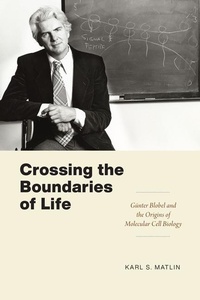
Crossing the Boundaries of Life
Guenter Blobel and the Origins of Molecular Cell Biology
Published on 10. May 2022
Book
Paperback/Softback
368 pages
978-0-226-81934-1 (ISBN)
Description
A close look at Guenter Blobel's transformative contributions to molecular cell biology.
The difficulty of reconciling chemical mechanisms with the functions of whole living systems has plagued biologists since the development of cell theory in the nineteenth century. As Karl S. Matlin argues in Crossing the Boundaries of Life, it is no coincidence that this longstanding knot of scientific inquiry was loosened most meaningfully by the work of a cell biologist, the Nobel laureate Guenter Blobel. In 1975, using an experimental setup that did not contain any cells at all, Blobel was able to target newly made proteins to cell membrane vesicles, enabling him to theorize how proteins in the cell distribute spatially, an idea he called the signal hypothesis. Over the next twenty years, Blobel and other scientists were able to dissect this mechanism into its precise molecular details. For elaborating his signal concept into a process he termed membrane topogenesis-the idea that each protein in the cell is synthesized with an "address" that directs the protein to its correct destination within the cell-Blobel was awarded the Nobel Prize in Physiology or Medicine in 1999.
Matlin argues that Blobel's investigative strategy and its subsequent application addressed a fundamental unresolved dilemma that had bedeviled biology from its very beginning-the relationship between structure and function-allowing biology to achieve mechanistic molecular explanations of biological phenomena. Crossing the Boundaries of Life thus uses Blobel's research and life story to shed light on the importance of cell biology for twentieth-century science, illustrating how it propelled the development of adjacent disciplines like biochemistry and molecular biology.
The difficulty of reconciling chemical mechanisms with the functions of whole living systems has plagued biologists since the development of cell theory in the nineteenth century. As Karl S. Matlin argues in Crossing the Boundaries of Life, it is no coincidence that this longstanding knot of scientific inquiry was loosened most meaningfully by the work of a cell biologist, the Nobel laureate Guenter Blobel. In 1975, using an experimental setup that did not contain any cells at all, Blobel was able to target newly made proteins to cell membrane vesicles, enabling him to theorize how proteins in the cell distribute spatially, an idea he called the signal hypothesis. Over the next twenty years, Blobel and other scientists were able to dissect this mechanism into its precise molecular details. For elaborating his signal concept into a process he termed membrane topogenesis-the idea that each protein in the cell is synthesized with an "address" that directs the protein to its correct destination within the cell-Blobel was awarded the Nobel Prize in Physiology or Medicine in 1999.
Matlin argues that Blobel's investigative strategy and its subsequent application addressed a fundamental unresolved dilemma that had bedeviled biology from its very beginning-the relationship between structure and function-allowing biology to achieve mechanistic molecular explanations of biological phenomena. Crossing the Boundaries of Life thus uses Blobel's research and life story to shed light on the importance of cell biology for twentieth-century science, illustrating how it propelled the development of adjacent disciplines like biochemistry and molecular biology.
Reviews / Votes
"Based solely on its originality, wealth of detail, and subject matter, Crossing the Boundaries of Life deserves to be on the must-read list of every historian of the twentieth-century life sciences." * Journal of the History of Biology * "Those interested in strategies by which biologists relate cellular phenomena to spatially organized subcellular molecular processes will read Crossing the Boundaries of Life with great benefit." * Isis * "Based on personal contact and archival research, including an epilogue addressing contending epistemic debates (cellular context vs. molecular processes), this book provides an excellent account of how paradigm shifts actually occur in science. The text is readable for a general audience and provides a host of primary resources. . . . Highly recommended." * Choice * "Over the course of the century, many biological sciences become extremely complex, and following these fields often results in highly technical and dense narratives. Crossing the Boundaries of Life does not shy away from this reality, though Matlin, who spent most of his career as a practicing cell biologist, and in fact did his postdoctoral work across the hall from Blobel's laboratory, does a laudable job in unpacking and explicating where the crucial moments of innovation occur. Matlin's narrative also adeptly ties together many strands of thetwentieth-century biosciences, most of which have only previously been outlined in disciplinary histories. Though molecular cell biology may sound like it only concerns a small slice of biological problems, Crossing the Boundaries of Life features an array of work from protein chemists, embryologists, molecular biologists, physiologists and, of course, cytologists. Matlin underpins his philosophical analysis using Hans-Joerg Rheinberger's concept of epistemic things and readers who found Rheinberger's work informative will find Crossing the Boundaries of Life to be an exceptional example of how it can be used to understand the work of modern biological sciences." * British Journal for the History of Science * "Those who are willing to be guided through the rough and tumble of a long experimental research trajectory and its details will be richly rewarded in the end. To the reviewer's knowledge, this book is the first to provide a comprehensive overview of what it means to do cell biology at the molecular level, and to trace historically how it came to be done." -- Hans-Joerg Rheinberger * Frankfurter Allgemeine Zeitung (translated from German) * "This complexity of the cell, and equally-if not more so-the complexity of the history of the scientific study of the cell, is something that struck me most forcibly as I wended my way through the pages of Karl Matlin's Crossing the Boundaries of Life. . . . there is a rich vein of information as well as ideas for entire historical projects to be mined in this book." * Metascience * "Matlin charts new terrain in the history of the life sciences. His book is original, relevant, and provides a wealth of new stories and conceptual problems for the history and philosophy of cell and molecular biology. This exciting piece of scholarship covers a crucial episode of these sciences which merits scholarly attention. Matlin moves the field a step forward." -- Mathias Grote, author of Membranes to Molecular Machines
More details
Series
Language
English
Place of publication
Chicago
United States
Publishing group
The University of Chicago Press
Target group
Professional and scholarly
Illustrations
38 halftones, 2 line drawings
Dimensions
Height: 225 mm
Width: 151 mm
Thickness: 21 mm
Weight
566 gr
ISBN-13
978-0-226-81934-1 (9780226819341)
Copyright in bibliographic data and cover images is held by Nielsen Book Services Limited or by the publishers or by their respective licensors: all rights reserved.
Schweitzer Classification
Other editions
Additional editions
Matlin Karl S. Matlin
Crossing the Boundaries of Life
Günter Blobel and the Origins of Molecular Cell Biology
E-Book
05/2022
1st Edition
University of Chicago Press
€42.99
Available for download
Person
Karl S. Matlin is professor emeritus of biological sciences and conceptual and historical studies of science at the University of Chicago. He is the coeditor of several books, most recently Why Study Biology by the Sea?, also published by the University of Chicago Press.
Content
Preface
Prologue. A Very Small Difference . . .
Part I. The Cytologist's Dilemma
1. The Living Substance
2. The Membrane Boundary
3. Breakthroughs
Part II. From Cells to Molecules
4. The Endoplasmic Reticulum
5. The Signal Hypothesis
6. The Strange Case of the Signal Recognition Particle
7. Enemies, Real and Imagined
8. The Light at the End of the Tunnel
Part III. Form Redux
9. Topogenesis and Spatial Information
10. In Vitro Veritas?
11. Form, Context, and the Epistemic Strategy of Cell Biology
Epilogue. 1975 and All That
A Note on Sources
References
Prologue. A Very Small Difference . . .
Part I. The Cytologist's Dilemma
1. The Living Substance
2. The Membrane Boundary
3. Breakthroughs
Part II. From Cells to Molecules
4. The Endoplasmic Reticulum
5. The Signal Hypothesis
6. The Strange Case of the Signal Recognition Particle
7. Enemies, Real and Imagined
8. The Light at the End of the Tunnel
Part III. Form Redux
9. Topogenesis and Spatial Information
10. In Vitro Veritas?
11. Form, Context, and the Epistemic Strategy of Cell Biology
Epilogue. 1975 and All That
A Note on Sources
References