

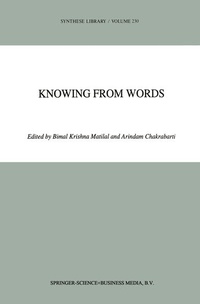
Knowing from Words
Western and Indian Philosophical Analysis of Understanding and Testimony
Published on 31. December 1993
Book
Hardback
X, 390 pages
978-0-7923-2345-7 (ISBN)
Description
Never before, in any anthology, have contemporary epistemologists and philosophers of language come together to address the single most neglected important issue at the confluence of these two branches of philosophy, namely: Can we
know
facts from reliable reports? Besides Hume's subversive discussion of miracles and the literature thereon, testimony has been bypassed by most Western philosophers; whereas in classical Indian (Pramana) theories of evidence and knowledge philosophical debates have raged for centuries about the status of word-generated knowledge.
`Is the response "I was told by an expert on the subject" as respectable as "I saw" or "I inferred" in answer to "How do you know?"' is a question answered in diverse and subtle ways by Buddhists, Vaisesikas and Naiyayikas. For the first time this book makes available the riches of those debates, translating from Sanskrit some contemporary Indian Pandits' reactions to Western analytic accounts of meaning and knowledge.
For advanced undergraduates in philosophy, for researchers - in Australia, Asia, Europe or America - on epistemology, theory of meaning, Indian or comparative philosophy, as well as for specialists interested in this relatively fresh topic of knowledge transmission and epistemic dependence this book will be a feast.
After its publication analytic philosophy and Indian philosophy will have no excuse for shunning each other.
`Is the response "I was told by an expert on the subject" as respectable as "I saw" or "I inferred" in answer to "How do you know?"' is a question answered in diverse and subtle ways by Buddhists, Vaisesikas and Naiyayikas. For the first time this book makes available the riches of those debates, translating from Sanskrit some contemporary Indian Pandits' reactions to Western analytic accounts of meaning and knowledge.
For advanced undergraduates in philosophy, for researchers - in Australia, Asia, Europe or America - on epistemology, theory of meaning, Indian or comparative philosophy, as well as for specialists interested in this relatively fresh topic of knowledge transmission and epistemic dependence this book will be a feast.
After its publication analytic philosophy and Indian philosophy will have no excuse for shunning each other.
More details
Series
Edition
1994 ed.
Language
English
Place of publication
Dordrecht
Netherlands
Target group
Professional and scholarly
Research
Illustrations
X, 390 p.
Dimensions
Height: 241 mm
Width: 160 mm
Thickness: 27 mm
Weight
770 gr
ISBN-13
978-0-7923-2345-7 (9780792323457)
DOI
10.1007/978-94-017-2018-2
Schweitzer Classification
Other editions
Additional editions
Bimal K. Matilal | A. Chakrabarti
Knowing from Words
Western and Indian Philosophical Analysis of Understanding and Testimony
E-Book
06/2013
Springer
€213.99
Available for download
Bimal K. Matilal | A. Chakrabarti
Knowing from Words
Western and Indian Philosophical Analysis of Understanding and Testimony
Book
12/2010
Springer
€213.99
Shipment within 15-20 days
Content
Table of Content.- Knowing From Words.- Is There an Irreducible Mode of Word-Generated Knowledge?.- Testimony, Justification and Coherence.- Testimony and Coherence.- Epistemology of Testimony and Authority: Some Indian Themes and Theories.- Telling as Letting Know.- Against Gullibility.- The Role of Comprehension.- Knowledge by Hearsay.- Testimony, Observation and "Autonomous Knowledge".- Testimony and Memory.- History, Testimony, and Two Kinds of Scepticism.- Testimony, Knowledge and Belief.- On Propositions: A Naiy?yika Response to a Russellian Theory.- Proper Names and Individuals.- Understanding, Knowing and Justification.- Gange?a on Self-Mentioning Words.