

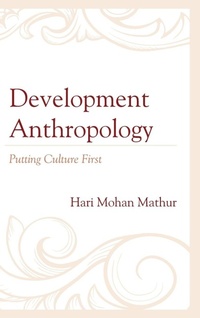
Development Anthropology
Putting Culture First
Published on 13. May 2019
Book
Hardback
186 pages
978-1-4985-8908-6 (ISBN)
Description
In Development Anthropology: Putting Culture First, Hari Mohan Mathur highlights the role of culture-and anthropological work more broadly-in development outcomes. Anthropologists' contributions in this area have traditionally received little attention, but this changed when the World Bank released the 2015 World Development Report. This report focused on the social, cultural, and psychological influences which affect the development process, and like Mathur, stressed the criticality of anthropological and other social sciences' knowledge for the success of development efforts. A major contribution to development anthropology, this book will interest anthropologists, economists, sociologists, other social scientists, policy makers, planners, development practitioners, researchers and trainers, and will be particularly useful for graduate students planning their career in the field of development.
Reviews / Votes
Mathur?s book on development anthropology is remarkable for providing an excellent overview of development dilemmas and the challenges and opportunities of fomenting change in societies for human betterment, while simultaneously grounding those insights in a sophisticated analysis of the ongoing struggle -- intellectual as well as within institutionalized bureaucracies -- between anthropologists, economists, and planners over the ways in which we understand cultural change and act upon those understandings. Mathur?s candid and constructive reflections on the strengths and weaknesses of anthropological approaches to development interventions, and how these account for many of the profession?s successes as well as its failures, will be instructive for students and young professionals who are considering a specialization as development scholars or practitioners or both. -- William L. Partridge, formerly at Vanderbilt University and the World Bank Development Anthropology documents how greater use of social assessment enhances development investments for local communities. It provides a panoramic chronicle of past, present, and potential future use of social factors in development planning that will be of interest to the concerned citizen as well as to the development practitioner. -- Gordon Appleby, Consultant and former Senior Social Scientist, World Bank Institute Development Anthropology documents how long-neglected social and cultural factors are increasingly gaining recognition in development agencies. Even the World Bank, the stronghold of economists, now appears willing to concede their role in development decision-making. It is a valuable contribution, and all those involved in the planning and implementation of development projects will find this book immensely useful. -- Vinay Kumar Srivastava, Director, Anthropological Survey of IndiaMore details
Language
English
Place of publication
United States
Publishing group
Bloomsbury Publishing Plc
Target group
Professional and scholarly
Product notice
sewn/stitched
Cloth over boards
With dust jacket
Dimensions
Height: 235 mm
Width: 157 mm
Thickness: 15 mm
Weight
431 gr
ISBN-13
978-1-4985-8908-6 (9781498589086)
Copyright in bibliographic data and cover images is held by Nielsen Book Services Limited or by the publishers or by their respective licensors: all rights reserved.
Schweitzer Classification
Other editions
Additional editions

E-Book
05/2019
1st Edition
Lexington Books
€40.49
Available for download
Person
Hari Mohan Mathur is distinguished professor on the Council for Social Development, New Delhi.
Content
Introduction: Culture in the Development Process
Chapter 1: From Applied Anthropology to Development Anthropology
Chapter 2: Some Uses of Anthropology
Chapter 3: Anthropology and Development in India
Chapter 4: Characteristics of Traditional Societies
Chapter 5: Social and Cultural Dimensions of Development:
Chapter 6: Culture can Act as a Brake on Development
Chapter 7: Culture can Act as a Driver of Development
Chapter 8: A Socio-Culturally Appropriate Development
Chapter 9: Implementing a Socio-Culturally Sensitive Development
Chapter 10: Anthropologists in Development Organizations
Chapter 1: From Applied Anthropology to Development Anthropology
Chapter 2: Some Uses of Anthropology
Chapter 3: Anthropology and Development in India
Chapter 4: Characteristics of Traditional Societies
Chapter 5: Social and Cultural Dimensions of Development:
Chapter 6: Culture can Act as a Brake on Development
Chapter 7: Culture can Act as a Driver of Development
Chapter 8: A Socio-Culturally Appropriate Development
Chapter 9: Implementing a Socio-Culturally Sensitive Development
Chapter 10: Anthropologists in Development Organizations