

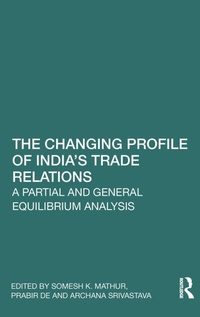
The Changing Profile of India's Trade Relations
A Partial and General Equilibrium Analysis
1st Edition
Published on 7. August 2025
Book
Hardback
416 pages
978-1-041-03317-2 (ISBN)
Description
This book unravels the complex spectrum of trade policy in India with the help of partial and general equilibrium models. It evaluates India's recent trade deals with the UAE, Australia, European Free Trade Area (EFTA), and Mauritius, among others.
Using applied general equilibrium methods to analyse recent debates about the conduct of India's trade policy, this book aims to present how the barriers to trade have been affecting trade flows. It further presents a set of large-scale computable general equilibrium simulations of the effects of changes in trade barriers. It also explores India's need to deal strategically with China and provide different economic solutions, despite the conflicts along their international borders. Moreover, it focuses on how India, through its trade orientation, needs to manage its natural resources and deal with land scarcity.
The volume will be of interest to scholars and researchers of international trade and finance, business economics, and econometrics. It will also be of interest to foreign trade experts, researchers, policy makers and government officials, among others.
Using applied general equilibrium methods to analyse recent debates about the conduct of India's trade policy, this book aims to present how the barriers to trade have been affecting trade flows. It further presents a set of large-scale computable general equilibrium simulations of the effects of changes in trade barriers. It also explores India's need to deal strategically with China and provide different economic solutions, despite the conflicts along their international borders. Moreover, it focuses on how India, through its trade orientation, needs to manage its natural resources and deal with land scarcity.
The volume will be of interest to scholars and researchers of international trade and finance, business economics, and econometrics. It will also be of interest to foreign trade experts, researchers, policy makers and government officials, among others.
More details
Language
English
Place of publication
London
United Kingdom
Publishing group
Taylor & Francis Ltd
Target group
College/higher education
Postgraduate
Illustrations
40 s/w Abbildungen, 21 s/w Photographien bzw. Rasterbilder, 19 s/w Zeichnungen, 89 s/w Tabellen
89 Tables, black and white; 19 Line drawings, black and white; 21 Halftones, black and white; 40 Illustrations, black and white
Dimensions
Height: 240 mm
Width: 161 mm
Thickness: 28 mm
Weight
828 gr
ISBN-13
978-1-041-03317-2 (9781041033172)
Copyright in bibliographic data and cover images is held by Nielsen Book Services Limited or by the publishers or by their respective licensors: all rights reserved.
Schweitzer Classification
Other editions
Additional editions
Somesh K. Mathur | Prabir De | Archana Srivastava
The Changing Profile of India's Trade Relations
A Partial and General Equilibrium Analysis
E-Book
08/2025
Routledge
€73.99
Available for download
Somesh K. Mathur | Prabir De | Archana Srivastava
The Changing Profile of India's Trade Relations
A Partial and General Equilibrium Analysis
E-Book
08/2025
Routledge
€73.99
Available for download
Persons
Somesh K. Mathur is Professor of Economics at the Indian Institute of Technology (IIT) Kanpur.
Prabir De is Professor at Research and Information System for Developing Countries (RIS), New Delhi.
Archana Srivastava is Associate Professor at BITS Pilani Hyderabad Campus, Hyderabad.
Prabir De is Professor at Research and Information System for Developing Countries (RIS), New Delhi.
Archana Srivastava is Associate Professor at BITS Pilani Hyderabad Campus, Hyderabad.
Content
1. Introduction 2. Gravity Models: Overview and Chronological Developments 3. Computable General Equilibrium Models: Origin, Development, and Current Scenario 4. Applied Computable General Equilibrium Models and Its Applications 5. Gains from Free Trade Agreements and the Role of Tradable Commodity Baskets: A Theoretical Analysis 6. Revitalizing APTA: Evaluating Japan's Inclusion and India's Omission 7. Evaluation of ASEAN-India Free Trade Regime: A General Equilibrium Approach 8. An Ex-Ante Evaluation of India's Recent Trade Agreements with the UAE: A Computable General Equilibrium Analysis9. An Ex-Ante Evaluation of Indo-Pacific Economic Framework: A General Equilibrium Analysis 10. Ex-Ante Evaluation of India's Trade Alliance with Indo-Pacific Region: A General Equilibrium Analysis 11. India's Alignment with RCEP and CPTPP: Gains and Losses through General Equilibrium Analysis 12. Assessment of Possible Economic Alignment between G20 Nations with Special Focus on India, G7 and G12: A General Equilibrium Analysis 13. Impact of Input and Output Oriented Technological Progress with Structural Transformation in India, China and Japan: A General Equilibrium Analysis 14. Re-imagining ASEAN: Analyzing the Trade Effects of India and Japan's Participation in the ASEAN Framework using a Structural Gravity Model 15. Conclusions and Policy Implications