

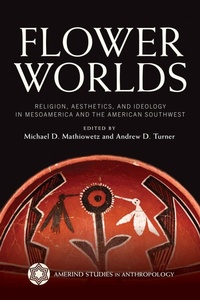
Flower Worlds
Religion, Aesthetics, and Ideology in Mesoamerica and the American Southwest
Will be published approx. on 31. May 2022
Book
Paperback/Softback
368 pages
978-0-8165-4847-7 (ISBN)
Description
The recognition of Flower Worlds is one of the most significant breakthroughs in the study of Indigenous spirituality in the Americas. These worlds are solar and floral spiritual domains that are widely shared among both pre-Hispanic and contemporary Native cultures in Mesoamerica and the American Southwest. Flower Worldsis the first volume to bring together a diverse range of scholars to create a truly multidisciplinary understanding of Flower Worlds. During the last thirty years, archaeologists, art historians, ethnologists, Indigenous scholars, and linguists have emphasized the antiquity and geographical extent of similar Flower World beliefs among ethnic and linguistic groups in the New World.
Flower Worlds are not simply ethereal, otherworldly domains, but rather they are embodied in lived experience, activated, invoked, and materialized through ritual practices, expressed in verbal and visual metaphors, and embedded in the use of material objects and ritual spaces. This comprehensive book illuminates the origins of Flower Worlds as a key aspect of religions and histories among societies in Mesoamerica and the American Southwest. It also explores the role of Flower Worlds in shaping ritual economies, politics, and cross-cultural interaction among Indigenous peoples.
Flower Worlds reaches into multisensory realms that extend back at least 2,500 years, offering many different disciplines, perspectives, and collaborations to understand these domains. Today, Flower Worlds are expressed in everyday work and lived experiences, embedded in sacred geographies, and ritually practiced both individually and in communities. This volume stresses the importance of contemporary perspectives and experiences by opening with living traditions before delving into the historical trajectories of Flower Worlds, creating a book that melds scientific and humanistic research and emphasizes Indigenous voices.
Contributors: Oswaldo Chinchilla Mazariegos, James M. COrdova, Davide Domenici, Angel GonzAlez LOpez, Kelley Hays-Gilpin, Michael D. Mathiowetz, Cameron L. McNeil, Felipe S. Molina, Johannes Neurath, John M. D. Pohl, Alan R. Sandstrom, David Delgado Shorter, Karl A. Taube, Andrew D. Turner, Lorena VAzquez VallIn, Dorothy Washburn
Flower Worlds are not simply ethereal, otherworldly domains, but rather they are embodied in lived experience, activated, invoked, and materialized through ritual practices, expressed in verbal and visual metaphors, and embedded in the use of material objects and ritual spaces. This comprehensive book illuminates the origins of Flower Worlds as a key aspect of religions and histories among societies in Mesoamerica and the American Southwest. It also explores the role of Flower Worlds in shaping ritual economies, politics, and cross-cultural interaction among Indigenous peoples.
Flower Worlds reaches into multisensory realms that extend back at least 2,500 years, offering many different disciplines, perspectives, and collaborations to understand these domains. Today, Flower Worlds are expressed in everyday work and lived experiences, embedded in sacred geographies, and ritually practiced both individually and in communities. This volume stresses the importance of contemporary perspectives and experiences by opening with living traditions before delving into the historical trajectories of Flower Worlds, creating a book that melds scientific and humanistic research and emphasizes Indigenous voices.
Contributors: Oswaldo Chinchilla Mazariegos, James M. COrdova, Davide Domenici, Angel GonzAlez LOpez, Kelley Hays-Gilpin, Michael D. Mathiowetz, Cameron L. McNeil, Felipe S. Molina, Johannes Neurath, John M. D. Pohl, Alan R. Sandstrom, David Delgado Shorter, Karl A. Taube, Andrew D. Turner, Lorena VAzquez VallIn, Dorothy Washburn
Reviews / Votes
The authors are coming at Flower World concepts from different directions and perspectives, and these different ideas and perspectives speak together in a way that helps further the conversation. This volume is not about concluding ideas but about continuing the conversation. I was impressed by the multitude of strong voices-both past and present-representing elements of the Flower World. This volume will be of lasting importance in the cross-cultural study of Flower Worlds."-John G. Douglass, co-editor of The Global Spanish Empire: Five Hundred Years of Place Making and Pluralism"The editors have succeeded in assembling a diverse lineup of scholars who address the underlying Flower Worlds of Mesoamerica and the American Southwest from the perspectives of ethnography, ethnohistory, archaeology, literature, and art history. This volume is a valuable contribution that breaks the false boundaries between those regions and will drive home the need for more study of the arts in precolonial contexts."-Christopher S. Beekman, co-editor of Shaft Tombs and Figures in West Mexican Society: A Reassessment
More details
Series
Language
English
Place of publication
Tucson
United States
Target group
Professional and scholarly
Product notice
Paperback (trade)
Unsewn / adhesive bound
Illustrations
60 b&w illustrations, 16 color illustrations,
Dimensions
Height: 228 mm
Width: 150 mm
Thickness: 22 mm
Weight
590 gr
ISBN-13
978-0-8165-4847-7 (9780816548477)
Copyright in bibliographic data and cover images is held by Nielsen Book Services Limited or by the publishers or by their respective licensors: all rights reserved.
Schweitzer Classification
Persons
Andrew D. Turner is a senior research specialist at the Getty Research Institute. He is trained as an archaeologist and art historian. His research focuses on art, identity, and cross-cultural interaction in ancient Central Mexico, and he has also written articles on the Classic Maya and the ancient Andes. Turner previously held positions at the Yale University Art Gallery and the University of Cambridge in the Museum of Archaeology and Anthropology and the McDonald Institute for Archaeological Research.
Michael D. Mathiowetz is a lecturer at University of California, Riverside. His research is focused on the archaeology, ethnohistory, and ethnology of Indigenous societies in the southwestern United States and northwestern Mexico, including the art, religion/ritual, and nature of pre-Hispanic interregional interaction.
Michael D. Mathiowetz is a lecturer at University of California, Riverside. His research is focused on the archaeology, ethnohistory, and ethnology of Indigenous societies in the southwestern United States and northwestern Mexico, including the art, religion/ritual, and nature of pre-Hispanic interregional interaction.