

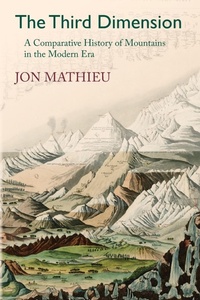
The Third Dimension
A Comparative History of Mountains in the Modern Era
Published on 17. September 2013
Book
Paperback/Softback
220 pages
978-1-874267-78-2 (ISBN)
Description
A pioneering examination of the three-dimensionality of the earth from the perspective of history and the humanities. This book considers the variegated world of mountains and their development during the last 500 years. It takes as its starting point the United Nations environmental conference of 1992 in Rio de Janeiro, where the mountains were officially recognised as a topic of the world community. Important precedents for this new agenda were built in the early modern period and in the nineteenth century, as European societies began to exceed their traditional limitations. The book begins with an investigation of this long-term process with respect to science, culture and politics, each of which has transformed our attitudes toward mountainous regions. It then takes up historical problems that have been debated in the latest research, placing them in a comparative framework. At the book's heart stands the question of whether and in what way the 'three-dimensional history' of mountain people may reveal distinctive forms of development.
Reviews / Votes
'Mathieu's book sharpens the view of differences and changes - even in the mountains that look so immovable.' Caroline Schnyder on the German edition, in Neue Zurcher Zeitung, 6 April 2011More details
Language
English
Place of publication
Knapwell
United Kingdom
Target group
College/higher education
Dimensions
Height: 229 mm
Width: 152 mm
Thickness: 12 mm
Weight
332 gr
ISBN-13
978-1-874267-78-2 (9781874267782)
Copyright in bibliographic data and cover images is held by Nielsen Book Services Limited or by the publishers or by their respective licensors: all rights reserved.
Schweitzer Classification
Other editions
Additional editions
E-Book
08/2011
The White Horse Press
€73.99
Available for download
Persons
Jon Mathieu is professor of history at the University of Lucerne and at the Swiss Federal Institute of Technology in Zurich. He was the founding director of the Instituto di Storia delle Alpi at the Universita della Svizzera italiana and has organized several international conferences about the history of mountains. In 2008 he received the King Albert I Mountain Award for his research.
Content
Foreword 1. THE GLOBALISATION OF PERCEPTION 1992: A Constitution for the Mountains 1492: Expansion and Change in Perception Alexander von Humboldt Scientific Departure The Politicisation of the Environment 2. POPULATION AND URBANISATION Upland Demography Asynchrony of Settlement Urbanisation Two Theories 3. AGRICULTURE, FAMILY, MOBILITY Agriculture Animal Husbandry Family and Mobility 4. CULTURAL DIVERSITY AND MODERNITY Western Modernisation The Spiritual Empowerment of the Landscape North-South Conflict Community 5. RESULTS AND OUTLOOK