

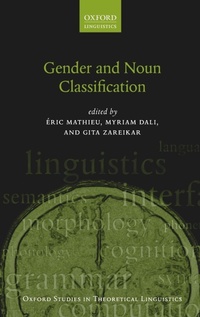
Gender and Noun Classification
Published on 19. November 2018
Book
Hardback
332 pages
978-0-19-882810-5 (ISBN)
Description
This volume explores the many ways by which natural languages categorize nouns into genders or classes. A noun may belong to a given class because of its logical or symbolic similarities with other nouns, because it shares a similar morphological form with other nouns, or simply through an arbitrary convention. The aim of this book is to establish which functional or lexical categories are responsible for this type of classification, especially along the nominal syntactic spine.
The book's contributors draw on data from a wide range of languages, including Amharic, French, Gitksan, Haro, Lithuanian, Japanese, Mi'kmaw, Persian, and Shona. Chapters examine where in the nominal structure gender is able to function as a classifying device, and how in the absence of gender, other functional elements in the nominal spine come to fill that gap. Other chapters focus on how gender participates in grammatical concord and agreement phenomena. The volume also discusses semantic agreement: hybrid agreement sometimes arises due to a distinction that grammars encode between natural gender on the one hand and grammatical gender on the other. The findings in the volume have significant implications for syntactic theory and theories of interpretation, and contribute to a greater understanding of the interplay between inflection and derivation. The volume will be of interest to theoretical linguists and typologists from advanced undergraduate level upwards.
The book's contributors draw on data from a wide range of languages, including Amharic, French, Gitksan, Haro, Lithuanian, Japanese, Mi'kmaw, Persian, and Shona. Chapters examine where in the nominal structure gender is able to function as a classifying device, and how in the absence of gender, other functional elements in the nominal spine come to fill that gap. Other chapters focus on how gender participates in grammatical concord and agreement phenomena. The volume also discusses semantic agreement: hybrid agreement sometimes arises due to a distinction that grammars encode between natural gender on the one hand and grammatical gender on the other. The findings in the volume have significant implications for syntactic theory and theories of interpretation, and contribute to a greater understanding of the interplay between inflection and derivation. The volume will be of interest to theoretical linguists and typologists from advanced undergraduate level upwards.
More details
Series
Language
English
Place of publication
Oxford
United Kingdom
Target group
Professional and scholarly
Dimensions
Height: 240 mm
Width: 161 mm
Thickness: 23 mm
Weight
669 gr
ISBN-13
978-0-19-882810-5 (9780198828105)
Copyright in bibliographic data and cover images is held by Nielsen Book Services Limited or by the publishers or by their respective licensors: all rights reserved.
Schweitzer Classification
Other editions
Additional editions
Eric Mathieu | Myriam Dali | Gita Zareikar
Gender and Noun Classification
Book
11/2018
Oxford University Press
€72.60
Shipment within 15-20 days
Éric Mathieu | Myriam Dali | Gita Zareikar
Gender and Noun Classification
E-Book
11/2018
OUP eBook
€31.99
Available for download
Persons
Eric Mathieu is Professor in the Department of Linguistics at the University of Ottawa. His research focuses on French (Modern and Old) and the Algonquian language Ojibwe. His work has appeared in journals such as Linguistic Inquiry, Natural Language and Linguistic Theory, Lingua, and Probus, and he is the co-editor, with Robert Truswell, of Micro-change and Macro-change in Diachronic Syntax (OUP, 2017).
Myriam Dali is a PhD student at the University of Ottawa. Her research interests include the syntax and semantics of number and gender, the structure of the DP, the singulative, and the diachronic evolution of number marking systems. She has recently worked on the competition between plural forms in Tunisian Arabic. Her work has been published in Lingvisticae Investigationes and she has a book in preparation with John Benjamins.
Gita Zareikar is a PhD candidate at the University of Ottawa. Her research interests include the syntax and semantics of bare nominals and number interpretation in general number languages. She focuses on the syntax of noun phrases and more specifically on the evolution of classifiers in non-numeral-classifier languages. She has recently been working on telicity and viewpoint aspect and its interaction with number and specificity. Her work has been published in Linguistic Variation and in the conference proceedings of NELS 46 and CLA 2015.
Myriam Dali is a PhD student at the University of Ottawa. Her research interests include the syntax and semantics of number and gender, the structure of the DP, the singulative, and the diachronic evolution of number marking systems. She has recently worked on the competition between plural forms in Tunisian Arabic. Her work has been published in Lingvisticae Investigationes and she has a book in preparation with John Benjamins.
Gita Zareikar is a PhD candidate at the University of Ottawa. Her research interests include the syntax and semantics of bare nominals and number interpretation in general number languages. She focuses on the syntax of noun phrases and more specifically on the evolution of classifiers in non-numeral-classifier languages. She has recently been working on telicity and viewpoint aspect and its interaction with number and specificity. Her work has been published in Linguistic Variation and in the conference proceedings of NELS 46 and CLA 2015.
Editor
Full Professor, Department of LinguisticsFull Professor, Department of Linguistics, University of Ottawa
PhD student, Department of LinguisticsPhD student, Department of Linguistics, University of Ottawa
PhD student, Deparment of LinguisticsPhD student, Deparment of Linguistics, University of Ottawa
Content
1: Eric Mathieu: Humans, gods, and demons
Part I. Gender and partition
2: Rose-Marie Dechaine: Partitioning the nominal domain: The convergence of morphology, syntax, semantics, and pragmatics
3: Paolo Acquaviva: Categorization as noun construction: Gender, number, and entity types
Part II. Locus of gender
4: Abdelkader Fassi Fehri: Multiple facets of constructional Arabic Gender and 'functional universalism' in the DP
5: Christopher Hammerly: Limiting gender
6: Ivona Kucerova: The double life of gender and its structural consequences: A case study from Standard Italian
7: Danniel da Silva Carvalho: On gender and agreement in Brazilian Portuguese
8: Ruth Kramer: A novel kind of gender syncretism
9: Phoevos Panagiotidis: (Grammatical) gender troubles and the gender of pronouns
Part III. Morphosemantic noun classification
10: Clarissa Forbes: Number, names, and animacy: Nominal classes and plural interactions in Gitksan
11: Maria Kouneli: Plural marking on mass nouns: Evidence from Greek
12: Conor McDonough Quinn: Productivity vs. predictability: Evidence for the syntax and semantics of Animate gender in four Northeastern-area Algonquian languages
13: Solveiga Armoskaite: How to phraseologize nominal number
References
Index
Part I. Gender and partition
2: Rose-Marie Dechaine: Partitioning the nominal domain: The convergence of morphology, syntax, semantics, and pragmatics
3: Paolo Acquaviva: Categorization as noun construction: Gender, number, and entity types
Part II. Locus of gender
4: Abdelkader Fassi Fehri: Multiple facets of constructional Arabic Gender and 'functional universalism' in the DP
5: Christopher Hammerly: Limiting gender
6: Ivona Kucerova: The double life of gender and its structural consequences: A case study from Standard Italian
7: Danniel da Silva Carvalho: On gender and agreement in Brazilian Portuguese
8: Ruth Kramer: A novel kind of gender syncretism
9: Phoevos Panagiotidis: (Grammatical) gender troubles and the gender of pronouns
Part III. Morphosemantic noun classification
10: Clarissa Forbes: Number, names, and animacy: Nominal classes and plural interactions in Gitksan
11: Maria Kouneli: Plural marking on mass nouns: Evidence from Greek
12: Conor McDonough Quinn: Productivity vs. predictability: Evidence for the syntax and semantics of Animate gender in four Northeastern-area Algonquian languages
13: Solveiga Armoskaite: How to phraseologize nominal number
References
Index