

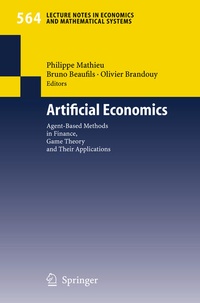
Artificial Economics
Agent-Based Methods in Finance, Game Theory and Their Applications
Published on 2. September 2005
Book
Paperback/Softback
XIV, 238 pages
978-3-540-28578-6 (ISBN)
Description
Agent-based Computational Economics (ACE) is a new discipline of economics, largely grounded on concepts like evolution, auto-organisation and emergence: it intensively uses computer simulations as well as artificial intelligence, mostly based on multi-agents systems. The purpose of this book is to give an up-to date view of the scientific production in the fields of Agent-based Computational Economics (mainly in Market Finance and Game Theory). Based on communications given at AE'2005 (Lille, USTL, France), this book offers a wide panorama of recent advances in ACE (both theoretical and methodological) that will interest academics as well as practitioners.
More details
Series
Edition
2006 ed.
Language
English
Place of publication
Berlin
Germany
Publishing group
Springer Berlin
Target group
Professional and scholarly
Research
Illustrations
XIV, 238 p.
Dimensions
Height: 235 mm
Width: 155 mm
Thickness: 16 mm
Weight
441 gr
ISBN-13
978-3-540-28578-6 (9783540285786)
DOI
10.1007/3-540-28547-4
Schweitzer Classification
Other editions
Additional editions
Philippe Mathieu | Bruno Beaufils | Olivier Brandouy
Artificial Economics
Agent-Based Methods in Finance, Game Theory and Their Applications
E-Book
12/2005
Springer
€96.29
Available for download
Content
Artificial Stock Markets.- Time Series Properties from an Artificial Stock Market with a Walrasian Auctioneer.- Market Dynamics and Agents Behaviors: a Computational Approach.- Traders Imprint Themselves by Adaptively Updating their Own Avatar.- Learning in Models.- Learning in Continuous Double Auction Market.- Firms Adaptation in Dynamic Economic Systems.- Firm Size Dynamics in a Cournot Computational Model.- Case-Studies and Applications.- Emergence of a Self-Organized Dynamic Fishery Sector: Application to Simulation of the Small-Scale Fresh Fish Supply Chain in Senegal..- Multi-Agent Model of Trust in a Human Game.- A Counterexample for the Bullwhip Effect in a Supply Chain.- Bottom-Up Approaches.- Collective Efficiency in Two-Sided Matching.- Complex Dynamics, Financial Fragility and Stylized Facts.- Noisy Trading in the Large Market Limit.- Emergence in Multi-Agent Systems: Cognitive Hierarchy, Detection, and Complexity Reduction part I: Methodological Issues.- Methodological Issues.- The Implications of Case-Based Reasoning in Strategic Contexts.- A Model of Myerson-Nash Equilibria in Networks.- Market Dynamics.- Stock Price Dynamics in Artificial Multi-Agent Stock Markets.- Market Failure Caused by Quality Uncertainty.- Learning and the Price Dynamics of a Double-Auction Financial Market with Portfolio Traders.- How Do the Differences Among Order Distributions Affect the Rate of Investment Returns and the Contract Rate.