

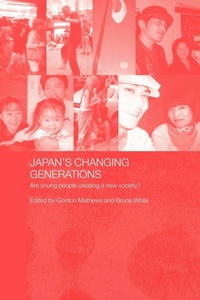
Japan's Changing Generations
Are Young People Creating a New Society?
Published on 27. March 2005
Book
Paperback/Softback
220 pages
978-0-415-38491-9 (ISBN)
Description
Japan's Changing Generations argues that 'the generation gap' in Japan is something more than young people resisting the adult social order before entering and conforming to that order. Rather, it signifies something more fundamental: the emergence of a new Japan, which may be quite different from the Japan of postwar decades.
It argues that while young people in Japan in their teens, twenties and early thirties are not engaged in overt social or political resistance, they are turning against the existing Japanese social order, whose legitimacy has been undermined by the past decade of economic downturn. The book shows how young people in Japan are thinking about their bodies and identities, their social relationships, and their employment and parenting, in new and generationally contextual ways, that may help to create a future Japan quite different from Japan of the recent past.
It argues that while young people in Japan in their teens, twenties and early thirties are not engaged in overt social or political resistance, they are turning against the existing Japanese social order, whose legitimacy has been undermined by the past decade of economic downturn. The book shows how young people in Japan are thinking about their bodies and identities, their social relationships, and their employment and parenting, in new and generationally contextual ways, that may help to create a future Japan quite different from Japan of the recent past.
More details
Series
Language
English
Place of publication
London
United Kingdom
Publishing group
Taylor & Francis Ltd
Target group
College/higher education
Professional and scholarly
Illustrations
4 s/w Zeichnungen, 4 s/w Tabellen
4 Tables, black and white; 4 Line drawings, black and white
Dimensions
Height: 234 mm
Width: 156 mm
Thickness: 12 mm
Weight
342 gr
ISBN-13
978-0-415-38491-9 (9780415384919)
Copyright in bibliographic data and cover images is held by Nielsen Book Services Limited or by the publishers or by their respective licensors: all rights reserved.
Schweitzer Classification
Other editions
Additional editions
E-Book
10/2012
Routledge
€61.99
Available for download
E-Book
10/2012
Routledge
€61.99
Available for download
Book
11/2003
Routledge
€272.10
Shipment within 15-20 days
Persons
Gordon Mathews is Associate Professor, Department of Anthropology, the Chinese University of Hong Kong. He has written What Makes Life Worth Living? How Japanese and Americans Make Sense of Their Worlds (1996), and Global Culture/Individual Identity: Searching for Home in the Cultural Supermarket (2000) and edited Consuming Hong Kong (2001).
Bruce White is Lecturer in Anthropology and Sociology at Doshisha University,
Kyoto, Japan.
Bruce White is Lecturer in Anthropology and Sociology at Doshisha University,
Kyoto, Japan.
Content
Part 1: The Japanese Generational Divide 1. The Generation Gap in Japanese Society since the 1960s 2. Why are Japanese Youth Today so Passive? 3. The Local Roots of Global Citizenship: Generational Change in a Kyushu Hamlet Part 2: How Teenagers Cope With the Adult World 4. How Japanese Teenagers Cope: Social Pressures and Personal Responses 5. Youth Fashion and Changing Beautification Practices 6. 'Guiding' Japan's University Students through the Generation Gap Part 3: How Young Adults Challenge the Social Order 7. Seeking a Career, Finding a Job: How Young People Enter and Resist the Japanese World of Work 8. Mothers and Their Unmarried Daughters: An Intimate Look at Generational Change 9. What Happens When They Come Back: How Japanese Young People with Foreign University Degrees Experience the Japanese Workplace 10. Centered Selves and Life Choices: Changing Attitudes of Young Educated Mothers Epilogue: Are Japanese Young People Creating a New Society?