

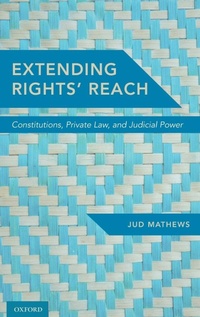
Extending Rights' Reach
Constitutions, Private Law, and Judicial Power
Published on 19. April 2018
Book
Hardback
264 pages
978-0-19-068291-0 (ISBN)
Description
Constitutional rights protect individuals against government overreaching, but that is not all they do. In different ways and to different degrees, constitutional rights also regulate legal relations among private parties in most legal systems. Rights can have not only a vertical effect, within the hierarchical relationship between citizen and state, but also a horizontal one, on the citizen-to-citizen relationships otherwise governed by private law.
In every constitutional system with judicially enforceable constitutional rights, courts must make choices about whether, when, and how to give those rights horizontal effect. This book is about how different courts make those choices, and about the consequences that they have. The doctrines that courts build to manage the horizontal effect of rights speak to the most fundamental issues that constitutional systems address, about the nature of rights and of constitutionalism itself. These doctrines can also entrench or enhance judicial power, but in very different ways depending on the legal system.
This book offers three case studies, of Germany, the United States, and Canada. For each, it offers a detailed account of the horizontal effect jurisprudence of its apex court-not in isolation, but as a central feature of a broader account of that country's constitutional development. The case studies show how the choices courts make about horizontal rights reflect existing normative and political realities and, over time, help to shape new ones.
In every constitutional system with judicially enforceable constitutional rights, courts must make choices about whether, when, and how to give those rights horizontal effect. This book is about how different courts make those choices, and about the consequences that they have. The doctrines that courts build to manage the horizontal effect of rights speak to the most fundamental issues that constitutional systems address, about the nature of rights and of constitutionalism itself. These doctrines can also entrench or enhance judicial power, but in very different ways depending on the legal system.
This book offers three case studies, of Germany, the United States, and Canada. For each, it offers a detailed account of the horizontal effect jurisprudence of its apex court-not in isolation, but as a central feature of a broader account of that country's constitutional development. The case studies show how the choices courts make about horizontal rights reflect existing normative and political realities and, over time, help to shape new ones.
Reviews / Votes
Good works produce and inspire ideas. Extending Rights' Reach meets both these standards. Mathews successfully details the development of horizontal rights practices in national courts in ways that that advance comparative and American public law scholarship. * Mark A. Graber, Perspectives *More details
Language
English
Place of publication
New York
United States
Target group
Professional and scholarly
Dimensions
Height: 240 mm
Width: 161 mm
Thickness: 20 mm
Weight
609 gr
ISBN-13
978-0-19-068291-0 (9780190682910)
Copyright in bibliographic data and cover images is held by Nielsen Book Services Limited or by the publishers or by their respective licensors: all rights reserved.
Schweitzer Classification
Other editions
Additional editions
E-Book
03/2018
1st Edition
OUP eBook
€55.49
Available for download
E-Book
03/2018
1st Edition
OUP eBook
€43.49
Available for download
Person
Jud Mathews is an Associate Professor of Law at Penn State Law and an Affiliate Professor at Penn State's School of International Affairs. He holds a J.D. from Yale Law School and a Ph.D. in political science from Yale University. This book is based on his dissertation, which received the 2016 Edward S. Corwin Prize from the American Political Science Association.
Content
Acknowledgments
Chapter One: Introduction
Chapter Two: Germany's Postwar Constitution
Chapter Three: Constitutional Cascades in the Federal Republic
Chapter Four: The American Constitution: First and Second Foundings
Chapter Five: State Action and Constitutional Containment
Chapter Six: Canada's Constitution and Courts
Chapter Seven: Horizontal Effect and Caboose Constitutionalism
Chapter Eight: Constitutional Rights, Private Law, and Judicial Power
Bibliography
Index
Chapter One: Introduction
Chapter Two: Germany's Postwar Constitution
Chapter Three: Constitutional Cascades in the Federal Republic
Chapter Four: The American Constitution: First and Second Foundings
Chapter Five: State Action and Constitutional Containment
Chapter Six: Canada's Constitution and Courts
Chapter Seven: Horizontal Effect and Caboose Constitutionalism
Chapter Eight: Constitutional Rights, Private Law, and Judicial Power
Bibliography
Index