

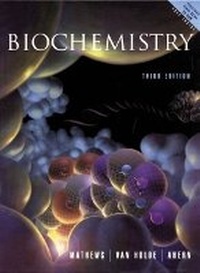
Biochemistry
International Edition
3rd Edition
Published on 9. December 1999
Book
Mixed media product
1200 pages
978-0-201-70235-4 (ISBN)
Description
Biochemistry,Third Edition merges a classical organization and presentation with contemporary insight, information, and technology, to make modern biochemistry interesting and accessible to today's students. Thoroughly updated to include the latest information, perspectives, and experimental techniques, the text is now supported by integrated media resources designed by the co-author Kevin Ahern. Together, the text and media resources provide students and instructors with a doorway to the vast world of biochemistry that is continuously evolving and which greatly exceeds what could be covered in a conventional textbook alone. As in previous editions, the authors introduce nucleic acid structure early (to clarify presentations of protein structure and function), emphasize the experimental roots of biochemistry (past and present), continually emphasize the energy relationships in biochemistry, and take a stepwise approach to complex metabolic pathways. The result is a thorough grounding in biology at the atomic/molecular level. The explosive growth of biochemistry, molecular biology, and biotechnology makes this approach particularly relevant for today's life science students.
More details
Edition
3rd edition
Language
English
Place of publication
United States
Publishing group
Pearson Education (US)
Target group
Professional and scholarly
Dimensions
Height: 214 mm
Width: 275 mm
Thickness: 44 mm
Weight
2486 gr
ISBN-13
978-0-201-70235-4 (9780201702354)
Copyright in bibliographic data and cover images is held by Nielsen Book Services Limited or by the publishers or by their respective licensors: all rights reserved.
Schweitzer Classification
Other editions
New editions
Christopher Mathews | Kensal Van Holde | Dean Appling
Biochemistry Plus Companion Website with Animations with Pearson eText -- Access Card Package
Book
03/2012
4th Edition
Pearson
€74.27
Shipment within 15-20 days
Previous edition

Christopher K. Mathews | Kensal E. van Holde | Kevin G. Ahern
Biochemistry CD-ROM
Software
12/2002
Pearson Education (US)
Unfortunately, price unknown
Article exhausted; check for reprint
Persons
Christopher K. Mathews is Distinguished Professor and Chairman of the Department of Biochemistry and Biophysics at Oregon State University. Dr. Mathews was an Eleanor Roosevelt International Cancer Fellow at the Karolinska Institute in Stockholm in 1984-85 and Tage Erlander Guest Professor at Stockholm University in 1994-95. He has published several books and more than 125 scientific papers dealing with molecular virology, metabolic regulation, nucleotide enzymology, and biochemical genetics.
K.E. van Holde is Distinguished Professor Emeritus of Biophysics and Biochemistry at Oregon State University. Dr. van Holde's major research interest is the structure of chromatin; his work resulted in theaward of an American Cancer Society Research Professorship in 1977 and hiselection to the National Academy of Sciences in 1989. He has received Guggenheim, NSF, and EMBO Fellowships and is the author of two books and more than 175 scientific papers.
Kevin Ahern is a Senior Instructor in the Department of Biochemistry and Biophysics at Oregon State University, where he pioneered the development of Web-based courses for teaching biochemistry. He is a contributing editor to Science magazine and a columnist for Genetic Engineering News. He has edited two books, Biotechnology Software Reports - Computer Applications for Molecular Biologists and The Biotechnology Software Directory, A Buyer's Guide, and is the founder of DaVinci Press Ink, a scientific software consulting firm. Dr. Ahern's teaching experience includes undergraduate and graduate biochemistry courses.
K.E. van Holde is Distinguished Professor Emeritus of Biophysics and Biochemistry at Oregon State University. Dr. van Holde's major research interest is the structure of chromatin; his work resulted in theaward of an American Cancer Society Research Professorship in 1977 and hiselection to the National Academy of Sciences in 1989. He has received Guggenheim, NSF, and EMBO Fellowships and is the author of two books and more than 175 scientific papers.
Kevin Ahern is a Senior Instructor in the Department of Biochemistry and Biophysics at Oregon State University, where he pioneered the development of Web-based courses for teaching biochemistry. He is a contributing editor to Science magazine and a columnist for Genetic Engineering News. He has edited two books, Biotechnology Software Reports - Computer Applications for Molecular Biologists and The Biotechnology Software Directory, A Buyer's Guide, and is the founder of DaVinci Press Ink, a scientific software consulting firm. Dr. Ahern's teaching experience includes undergraduate and graduate biochemistry courses.
Content
I. THE REALM OF BIOCHEMISTRY.
1. The Scope of Biochemistry.
2. The Matrix of Life: Weak Interactions in an Aqueous Environment.
3. The Energetics of Life.
II. MOLECULAR ARCHITECTURE OF LIVING MATTER.
4. Nucleic Acids.
5. Introduction to Proteins: The Primary Level of Protein Structure.
6. The Three- Dimensional Structure of Proteins.
7. Protein Function and Evolution.
8. Proteins in Motion: Contractile Systems and Molecular Motors.
9. Carbohydrates.
10. Lipids, Membranes, and Cellular Transport.
III. DYNAMICS OF LIFE: CATALYSIS AND CONTROL OF BIOCHEMICAL REACTIONS.
11. Enzymes: Biological Catalysts.
12. Introduction to Metabolism.
IV. DYNAMICS OF LIFE: ENERGY, BIOSYNTHESIS, AND UTILIZATION OF PRECURSORS.
13. Carbohydrate Metabolism I: Anaerobic Processes in Generating Metabolic Energy.
14. Oxidative Processes: Citric Acid Cycle and Pentose Phosphate Pathway.
15. Electron Transport, Oxidative Phosphorylation, and Oxygen Metabolism.
16. Carbohydrate Metabolism II: Biosynthesis.
17. Photosynthesis.
18. Lipid Metabolism I: Fatty Acids, Triacylglycerols, and Lipoproteins.
19. Lipid Metabolism II: Membrane Lipids, Steroids, Isoprenoids, and Eicosanoids.
20. Metabolism of Nitrogenous Compounds: Principles of Biosynthesis, Utilization, and Turnover.
21. Metabolism of Nitrogenous Compounds: Amino Acids, Porphyrins, and Neurotransmitters.
22. Nucleotide Metabolism.
23. Metabolic Coordination, Metabolic Control, and Signal Transduction
V. INFORMATION.
24. Information Copying: Replication.
25. Information Restructuring: Restriction, Repair, Recombination, Rearrangement, and Amplification.
26. Information Readout: Transcription.
27. Information Decoding: Translation.
28. Eukaryotic Genes and Their Expression.
Answers to Problems.
Glossary.
Index.
1. The Scope of Biochemistry.
2. The Matrix of Life: Weak Interactions in an Aqueous Environment.
3. The Energetics of Life.
II. MOLECULAR ARCHITECTURE OF LIVING MATTER.
4. Nucleic Acids.
5. Introduction to Proteins: The Primary Level of Protein Structure.
6. The Three- Dimensional Structure of Proteins.
7. Protein Function and Evolution.
8. Proteins in Motion: Contractile Systems and Molecular Motors.
9. Carbohydrates.
10. Lipids, Membranes, and Cellular Transport.
III. DYNAMICS OF LIFE: CATALYSIS AND CONTROL OF BIOCHEMICAL REACTIONS.
11. Enzymes: Biological Catalysts.
12. Introduction to Metabolism.
IV. DYNAMICS OF LIFE: ENERGY, BIOSYNTHESIS, AND UTILIZATION OF PRECURSORS.
13. Carbohydrate Metabolism I: Anaerobic Processes in Generating Metabolic Energy.
14. Oxidative Processes: Citric Acid Cycle and Pentose Phosphate Pathway.
15. Electron Transport, Oxidative Phosphorylation, and Oxygen Metabolism.
16. Carbohydrate Metabolism II: Biosynthesis.
17. Photosynthesis.
18. Lipid Metabolism I: Fatty Acids, Triacylglycerols, and Lipoproteins.
19. Lipid Metabolism II: Membrane Lipids, Steroids, Isoprenoids, and Eicosanoids.
20. Metabolism of Nitrogenous Compounds: Principles of Biosynthesis, Utilization, and Turnover.
21. Metabolism of Nitrogenous Compounds: Amino Acids, Porphyrins, and Neurotransmitters.
22. Nucleotide Metabolism.
23. Metabolic Coordination, Metabolic Control, and Signal Transduction
V. INFORMATION.
24. Information Copying: Replication.
25. Information Restructuring: Restriction, Repair, Recombination, Rearrangement, and Amplification.
26. Information Readout: Transcription.
27. Information Decoding: Translation.
28. Eukaryotic Genes and Their Expression.
Answers to Problems.
Glossary.
Index.