

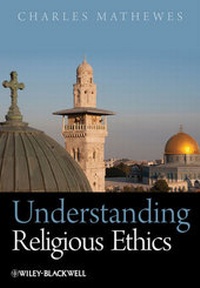
Understanding Religious Ethics
Published on 12. March 2010
Book
Paperback/Softback
286 pages
978-1-4051-3352-4 (ISBN)
Description
This accessible introduction to religious ethics focuses on the major forms of moral reasoning encompassing the three 'Abrahamic' religions: Judaism, Christianity, and Islam.
* Draws on a range of moral issues, such as examples arising from friendship, marriage, homosexuality, lying, forgiveness and its limits, the death penalty, the environment, warfare, and the meaning of work, career, and vocation
* Looks at both ethical reasoning and importantly, how that reasoning reveals insights into a religious tradition
* Investigates the resources available to address common problems confronting Abrahamic faiths, and how each faith explains and defends its moral viewpoints
* Offering concrete topics for interfaith discussions, this is a timely and insightful introduction to a fast-growing field of interest
Reviews / Votes
"At 250 pages, the volume provides thoughtful theoretical foundations for comparative religious ethics balanced by attention to both historical context and normative issues." (Religious Studies Review, 11 June 2013)More details
Other editions
Additional editions

Charles Mathewes
Understanding Religious Ethics
Book
03/2010
1st Edition
Wiley
€116.31
Shipment within 3-4 weeks
Charles Mathewes
Understanding Religious Ethics
E-Book
02/2010
1st Edition
Wiley-Blackwell
€34.99
Available for download
Person
Charles Mathewes is Associate Professor of Religious Ethics at the University of Virginia. He is the author of Evil and the Augustinian Tradition (2001), A Theology of Public Life (2007), and several edited volumes.
Content
Acknowledgments .
Introduction: Conviction and Argument.
Part I: Preliminaries.
Part II: Personal Matters.
Part III: Social Matters.
Part IV: The Last Things.
Conclusion: What's So Funny 'bout Peace, Love, and Understanding?
Index.