


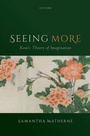
Seeing More
Kant's Theory of Imagination
Published on 7. May 2024
Book
Hardback
448 pages
978-0-19-889828-3 (ISBN)
Description
Samantha Matherne defends a systematic interpretation of the philosopher Immanuel Kants theory of imagination. In contrast with more traditional theories of imagination, as a kind of fantasy that we exercise only in relation to objects that are not real or not present, Matherne argues that Kant theorizes imagination as something that we exercise just as much in relation to objects that are real and present. In short, she attributes to Kant a view of imagining as something that pervades our lives. In order to bring out this pervasiveness, Matherne offers an account of what kind of mental capacity Kant takes imagination to be in general. She then explores Kants picture of how we exercise our imagination in perception, ordinary experience, the appreciation of beauty and sublimity, the production of art, the pursuit of happiness, and the pursuit of morality. However, she makes the case that Kants analysis of this wide range of phenomena is underwritten by a unified theory of what imagination is, as a remarkably flexible cognitive capacity that we can exercise in constrained and creative, playful and serious ways.
Reviews / Votes
Recommended. Graduate students and faculty. * Choice *More details
Language
English
Place of publication
Oxford
United Kingdom
Target group
College/higher education
Product notice
sewn/stitched
Cloth over boards
Dimensions
Height: 234 mm
Width: 161 mm
Thickness: 28 mm
Weight
768 gr
ISBN-13
978-0-19-889828-3 (9780198898283)
Copyright in bibliographic data and cover images is held by Nielsen Book Services Limited or by the publishers or by their respective licensors: all rights reserved.
Schweitzer Classification
Other editions
Additional editions
E-Book
05/2024
1st Edition
OUP eBook
€113.99
Available for download
E-Book
04/2024
1st Edition
OUP eBook
€113.99
Available for download
Person
Samantha Matherne is the Gardner Cowles Associate Professor of Humanities in the Philosophy Department at Harvard University. She is the author of Cassirer for the Routledge Philosophers Series and one of the authors of The Geography of Taste, along with Dominic McIver Lopes, Mohan Matthen, and Bence Nanay (OUP 2024). She is the editor of the first English translation of the work of the German philosopher, Edith Landmann-Kalischer: Edith Landmann-Kalischer: Essays on Art, Aesthetics, and Value, translated by Daniel Dahlstrom (in Oxford's New History of Philosophy Series, 2023). She has also published articles on Immanuel Kant, Post-Kantian traditions, and Aesthetics.
Content
Introduction
Part I Imagination in General
1: Imagination as a Cognitive Capacity
2: Imagination and the Two Stems of Cognition
3: Imagination Is Part of Sensibility
4: Three Definitions of Imagination
Part II Imagination in Perception and Experience
5: Empirical Imagination in Perception and Experience
6: A Priori Imagination and the Conditions of Experience I: The Transcendental Deduction
7: A Priori Imagination and the Conditions of Experience II: The Schematism
Part III Imagination in Aesthetics
8: Imagination and the Appreciation of Beauty
9: Artistic Imagination
10: Imagination and the Sublime
Part IV Imagination in Practical Agency and Morality
11: The Possibility of Moral Imagination
12: Imaginative Sight and the Faculty of Desire
13: Imaginative Exhibition in Morality
Conclusion
Part I Imagination in General
1: Imagination as a Cognitive Capacity
2: Imagination and the Two Stems of Cognition
3: Imagination Is Part of Sensibility
4: Three Definitions of Imagination
Part II Imagination in Perception and Experience
5: Empirical Imagination in Perception and Experience
6: A Priori Imagination and the Conditions of Experience I: The Transcendental Deduction
7: A Priori Imagination and the Conditions of Experience II: The Schematism
Part III Imagination in Aesthetics
8: Imagination and the Appreciation of Beauty
9: Artistic Imagination
10: Imagination and the Sublime
Part IV Imagination in Practical Agency and Morality
11: The Possibility of Moral Imagination
12: Imaginative Sight and the Faculty of Desire
13: Imaginative Exhibition in Morality
Conclusion