

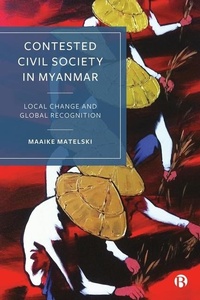
Contested Civil Society in Myanmar
Local Change and Global Recognition
1st Edition
Published on 20. May 2025
Book
Paperback/Softback
212 pages
978-1-5292-3652-1 (ISBN)
Description
Available open access digitally under CC-BY-NC-ND licence.
This book centres on various contestations in Myanmar society and illustrates the ways in which these are reflected in civil society.
The book offers a concise overview of recent political developments in the country, from the short-lived attempts at democratization to the 2021 military coup, and analyses the involvement of various civil society actors, as well as their international supporters. It incorporates multiple identities and fault lines in Myanmar society and explains how these influence diverse perceptions, framing and agenda setting as political developments unfold.
The book provides an up-to-date overview of the main identities and contestations within Myanmar's civil society and, by extension, within Myanmar society as a whole. It also gives recommendations to donors, policy makers and researchers wishing to better understand and support local civil society actors operating in repressive environments.
This book centres on various contestations in Myanmar society and illustrates the ways in which these are reflected in civil society.
The book offers a concise overview of recent political developments in the country, from the short-lived attempts at democratization to the 2021 military coup, and analyses the involvement of various civil society actors, as well as their international supporters. It incorporates multiple identities and fault lines in Myanmar society and explains how these influence diverse perceptions, framing and agenda setting as political developments unfold.
The book provides an up-to-date overview of the main identities and contestations within Myanmar's civil society and, by extension, within Myanmar society as a whole. It also gives recommendations to donors, policy makers and researchers wishing to better understand and support local civil society actors operating in repressive environments.
Reviews / Votes
"Matelski's compelling empirical and theoretical insights into Myanmar's civil society ... expand conventional understandings of 'civil society' in ways especially relevant for contexts outside of North America and Europe." Lisa Brooten, Southern Illinois University "Maaike Matelski's nuanced and sensitive account of civil society during a key political period in Myanmar helps us better understand the dynamics of public engagement during that complicated decade of 'transition'. It also provides a compelling picture of how these networks and actors have responded to the military coup, and insight into the important role they will play in a future Myanmar." Matthew J Walton, University of TorontoMore details
Edition
First Edition
Language
English
Place of publication
Bristol
United Kingdom
Target group
Professional and scholarly
Illustrations
1 s/w Tabelle
1 Tables, black and white
Dimensions
Height: 155 mm
Width: 233 mm
Thickness: 19 mm
Weight
334 gr
ISBN-13
978-1-5292-3652-1 (9781529236521)
Copyright in bibliographic data and cover images is held by Nielsen Book Services Limited or by the publishers or by their respective licensors: all rights reserved.
Schweitzer Classification
Other editions
Additional editions
E-Book
11/2023
1st Edition
Bristol University Press
€0.00
Available for download
Book
11/2023
1st Edition
Bristol University Press
€105.50
Shipment within 3-4 weeks
Person
Maaike Matelski is Assistant Professor in the Department of Social and Cultural Anthropology at Vrije Universiteit Amsterdam, the Netherlands.
Content
Introduction: Contested Representation in Burma/Myanmar
1. Conflict, Repression, and Resistance From Colonialism to Military Rule
2. Constructing Civil Society in Myanmar
3. Diversity and Fault Lines in Burmese Civil Society
4. Room To Manoeuvre Under Authoritarian Rule
5. Transnational Advocacy Strategies and Pathways To Change
6. Competing Frames Around the 2010 Elections
7. Foreign Aid and the (De)politicisation of Civil Society Assistance
8. Interrupted Transition and Post-coup Resistance
Conclusion
1. Conflict, Repression, and Resistance From Colonialism to Military Rule
2. Constructing Civil Society in Myanmar
3. Diversity and Fault Lines in Burmese Civil Society
4. Room To Manoeuvre Under Authoritarian Rule
5. Transnational Advocacy Strategies and Pathways To Change
6. Competing Frames Around the 2010 Elections
7. Foreign Aid and the (De)politicisation of Civil Society Assistance
8. Interrupted Transition and Post-coup Resistance
Conclusion