

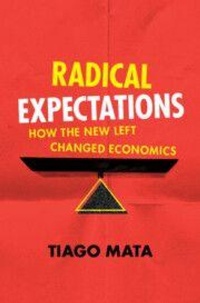
Radical Expectations
How the New Left Changed Economics
Will be published approx. on 31. August 2026
Book
Paperback/Softback
300 pages
978-1-009-78306-4 (ISBN)
Description
In the 1970s radical economists campaigned to reform their discipline and their universities. They became journalists and activists, moving beyond academia, to forge new models of public engagement and collaborative knowledge in economic life. Radical Expectations tells the story of how these economists set out to make economics more democratic. It traces their campaign to bring protest movements to the campuses, triggering the emergence of an alternative understanding of expertise directed at validating and empowering the perspectives and voices of women, Black Americans, labor activists, and the urban poor. It shows how a radical identity formed and how radicals helped reform disciplinary institutions. Furthermore, it argues that the radical economics' legacy was the development of a language and models of expert-lay collaboration that empowers direct action in economic affairs. The book is about the community of radical economists who championed the promise of change and what came of it.
More details
Series
Language
English
Place of publication
Cambridge
United Kingdom
Product notice
Paperback (trade)
Illustrations
Worked examples or Exercises
ISBN-13
978-1-009-78306-4 (9781009783064)
Copyright in bibliographic data and cover images is held by Nielsen Book Services Limited or by the publishers or by their respective licensors: all rights reserved.
Schweitzer Classification
Other editions
Additional editions
Book
approx. 08/2026
Cambridge University Press
€142.50
Not yet published
Person
Tiago Mata is Professor of Science and Technology Studies at University College London. His research focuses on the history of economics and economic journalism. He has edited The Economist as Public Intellectual (2013) and Economics as News (2023). His work has received awards from the History of Economics Society and Association for Evolutionary Economics.
Content
1. Introduction; 2. In 1968; 3. Radical vocation; 4. Campuses in struggle; 5. A discipline divided; 6. Praising convention; 7. Studies on power; 8. Surviving in academia; 9. Outreach; 10. Activist journalism; 11. Economic democracy; 12. Conclusion.