

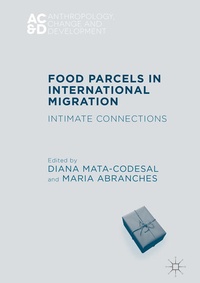
Food Parcels in International Migration
Intimate Connections
Published on 24. August 2017
Book
Hardback
XIII, 223 pages
978-3-319-40372-4 (ISBN)
Description
This book takes food parcels as a vehicle for exploring relationships, intimacy, care, consumption, exchange, and other fundamental anthropological concerns, examining them in relation to wider transnational spaces. As the contributors to this volume argue, food and its related practices offer a window through which to examine the reconciliation of people's localised intimate experiences with globalising forces. Their analyses contribute to an embodied and sensorial approach to social change by examining migrants and their families' experiences of global connectedness through familiar objects and narratives. By bringing in in-depth ethnographic insights from different social and economic contexts, this book widens the understanding of the lived experiences of mobility and goes beyond the divide between origin and destination countries, therefore contributing to new ways of thinking about migration and transnationalism that take into consideration the materiality of global connections and the way such connections are embodied and experienced at the local level.
Reviews / Votes
"This volume offers new perspective on the mobility of people and things in our world today, viewing such movements through the lens of a mundane yet ubiquitous phenomenon-the food parcel. Through rich ethnography, contributors not only reveal how "care packages" preserve connections with people and places but also how they are used in the creation of new senses of belonging. At the same time, they remind us how fraught and tenuous migration and settling into new places and social relations can be. A must read for anyone interested in mobilities, in food, and especially in the intersection of the two." (Harry G. West, Professor of Anthropology, University of Exeter, UK)"This brilliantly innovative book explores the food-migration nexus and its multiple expressions both theoretically and empirically. Present in most transnational migration corridors and spaces worldwide, 'travelling food' has a diversity of meanings ranging from material exchange and consumption to kinship reinforcement, care, belonging and nostalgia. The book contains original ethnographic case studies based on the grounded approach to the anthropology of everyday experience, and should be essential reading for students, researchers and teachers interested in the under-appreciated role of food in transnational life." (Russell King, Professor of Geography, University of Sussex, UK)
More details
Series
Edition
1st ed. 2018
Language
English
Place of publication
Cham
Switzerland
Publishing group
Springer International Publishing
Target group
Professional and scholarly
Illustrations
3 farbige Abbildungen
XIII, 223 p. 3 illus. in color.
Dimensions
Height: 216 mm
Width: 153 mm
Thickness: 18 mm
Weight
428 gr
ISBN-13
978-3-319-40372-4 (9783319403724)
DOI
10.1007/978-3-319-40373-1
Schweitzer Classification
Other editions
Additional editions
Book
08/2018
Palgrave Macmillan
€117.69
Shipment within 10-15 days
E-Book
08/2017
Palgrave Macmillan
€106.99
Available for download
Persons
Diana Mata-Codesal
is Researcher in the Humanities Department at Pompeu Fabra University in Barcelona, Spain.
Maria Abranches is Lecturer in Social Anthropology and Development at the School of International Development, University of East Anglia, UK.
Maria Abranches is Lecturer in Social Anthropology and Development at the School of International Development, University of East Anglia, UK.
Content
1. Sending, bringing, consuming and researching food parcels .- 2. Food as a matter of being: experiential continuity in transnational lives .- 3. Thank you for the cured meat, but is it grass-fed? Contested meanings of food parcels in a new nutrition transition .- 4. When objects speak louder than words: food, intimacy and power in the contemporary transnational Filipino household .- 5. A hard look at the balikbayan box: the Philippine diaspora's exported hospitality .- 6. Spaghetti with ajvar: an ethnography of migration, gender, learning and change .- 7. West African plants and prayers in the Netherlands: nourishment through visible and invisible substances .- 8. Inkumenda di téra: the informal circulation of Cabo Verdean food products .- 9. From ingredient to dish: the role of supply in the culinary practices of Mexican migrants in the United States.