

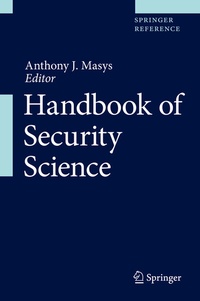
Handbook of Security Science
Description
This handbook offers insights into how science (physical, natural and social) and technology can support new developments to manage the complexity resident within the threat and risk landscape.
The security landscape can be described as dynamic and complex stemming from the emerging threats and risks that are both persistent and transborder. Globalization, climate change, terrorism, transnational crime can have significant societal impact and forces one to re-evaluate what 'national security' means. Recent global events such as mass migration, terrorist acts, pandemics and cyber threats highlight the inherent vulnerabilities in our current security posture. As an interdisciplinary body of work, the Handbook of Security Science captures concepts, theories and security science applications, thereby providing a survey of current and emerging trends in security. Through an evidence-based approach, the collection of chapters in the book delivers insightful and comprehensive articulation of the problem and solution space associated with the complex security landscape. In so doing the Handbook of Security Science introduces scientific tools and methodologies to inform security management, risk and resilience decision support systems; insights supporting design of security solutions; approaches to threat, risk and vulnerability analysis; articulation of advanced cyber security solutions; and current developments with respect to integrated computational and analytical solutions that increase our understanding of security physical, social, economic, and technological interrelationships and problem space.
More details
Other editions
Additional editions
Person
Dr Anthony Masys is an Associate Professor and Director of Global Disaster Management, Humanitarian Assistance and Homeland Security at the University of South Florida. His research interests focus on safety and security, risk, crisis and disaster management, resilience, safety culture, scenario planning, human security, intelligence (alternative analysis), counter-terrorism, complex socio-technical system analysis, modeling and simulation, systems thinking, action research.
A former senior Air Force Officer, Dr. Masys has a BSc in Physics and MSc in Underwater Acoustics and Oceanography from the Royal Military College of Canada and a PhD from the University of Leicester. He is Editor in Chief for Springer Publishing book series: Advanced Sciences and Technologies for Security Applications and holds various advisory board positions with academic journals and books series.
Dr. Masys is an internationally recognized author, speaker and facilitator and has held workshops in Europe, Canada, South America, West Africa and Asia including at the UN World Conference on Disaster Risk Reduction March 2015 in Sendai, Japan. He has published extensively in the domains of physics and the social sciences. His books include:
- Opening the Black Box of Human Error
- Networks and Network Analysis for Defence and Security. Springer Publishing
- Disaster Management- Enabling Resilience. Springer Publishing
- Applications of Systems Thinking and Soft Operations Research for managing complexity. Springer Publishing
- Exploring the Security Landscape- non-traditional security challenges. Springer Publishing.
- Disaster Forensics: understanding root cause and complexity causality. Springer Publishing
Dr. Masys supports the University of Leicester (UK) as an associate tutor in their Distance MSc Program on Risk Crisis and Disaster Management.
Content
Part A: Concepts in Security Studies
Science and technology for Security
Securitization
Human security
Traditional security
Non-traditional security
Environmental securityEconomic security
Societal security
Terrorism Overview
Climate Change
Part B: National Defence (Military)
CBRN Overview
Chemical
Biological
Radiological
Nuclear
Cyber warfare
Part C: Transnational Crime and terrorism
Organized Crime and Human Trafficking
Organized Crime and Drug Trafficking: Threats to national security- a transborder perspective
The costs of Cybercrime: identifying the threats, designing solutions
Cyber terrorism: A black swan or the new normal
Perspectives on Network analysis and Policing
Network Analysis to support counter terrorism
Part D: Physical security and Critical Infrastructure:
Biosensors and biometrics for Security Applications
Critical Infrastructure Vulnerability analysis
Health Security: Pandemic and Epidemic Diseases- transborder threats to national security
Urban Food security: a global and regional perspective
Economic security and sustainability: lessons learned and the way ahead
Water Security: vulnerabilities, complex and interconnected challenges
Chp Information and Communication Technology (ICT) Security: National and Global Perspectives on Threats and Solutions
Global Energy security: exploring the climate-energy security nexus
Perspectives on National Security and Global Supply Chain security
State of Emergency and Continuity of Government: Enabling Resilience
New Realities of Transportation security
Border security: threats and challenges associated with securing and managing borders
Is Migration a security issue? Perspectives on national security and human security
Disaster management and Security: Disaster Risk Reduction and Resilience
Modeling and Simulation Approaches to Security Analysis
Technological Disasters: threats to safety and security