

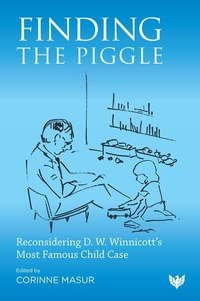
Finding the Piggle
Reconsidering D. W. Winnicott's Most Famous Child Case
Published on 1. February 2021
Book
Paperback/Softback
288 pages
978-1-912691-63-0 (ISBN)
Description
2021 Gradiva Award Winner
The Piggle is one of the most famous and beloved child cases in the history of psychoanalysis. A two-year-old girl suffering from terrible nightmares, depression, and self-harming behaviours, the Piggle, came to Donald Winnicott for treatment. In writing up the case and allowing it to be published (with the posthumous help of his wife Clare and his student, Ishak Ramsey), Winnicott invited the world into his consulting room and allowed the inner world of the very young child to be seen.
Seven psychoanalysts rediscover the Piggle, meeting her as an adult, re-scrutinising the case as it was formulated by Winnicott, and suggesting new understandings of the Piggle's material. Introduced by a foreword from Angela Joyce, the book features an interview with the adult Piggle, discussing her recollections of the treatment and her view of its impact many years on, as well as a meticulous historical overview from an investigation of 'The Piggle' archive revealing previously unknown information, a critical, detailed reappraisal of the case, and reflections from several authors on how modern psychoanalytic technique might be applied to the case were the Piggle to be seen in 2020.
In this age, when the voice of the child needs to be heard more than ever, Finding The Piggle gives new life to this classic piece of psychoanalytic literature in which the importance of the child's feelings and conflicts is made abundantly clear. With this comprehensive exploration, a new generation of clinicians and others can rediscover this important case and think about it anew.
The Piggle is one of the most famous and beloved child cases in the history of psychoanalysis. A two-year-old girl suffering from terrible nightmares, depression, and self-harming behaviours, the Piggle, came to Donald Winnicott for treatment. In writing up the case and allowing it to be published (with the posthumous help of his wife Clare and his student, Ishak Ramsey), Winnicott invited the world into his consulting room and allowed the inner world of the very young child to be seen.
Seven psychoanalysts rediscover the Piggle, meeting her as an adult, re-scrutinising the case as it was formulated by Winnicott, and suggesting new understandings of the Piggle's material. Introduced by a foreword from Angela Joyce, the book features an interview with the adult Piggle, discussing her recollections of the treatment and her view of its impact many years on, as well as a meticulous historical overview from an investigation of 'The Piggle' archive revealing previously unknown information, a critical, detailed reappraisal of the case, and reflections from several authors on how modern psychoanalytic technique might be applied to the case were the Piggle to be seen in 2020.
In this age, when the voice of the child needs to be heard more than ever, Finding The Piggle gives new life to this classic piece of psychoanalytic literature in which the importance of the child's feelings and conflicts is made abundantly clear. With this comprehensive exploration, a new generation of clinicians and others can rediscover this important case and think about it anew.
Reviews / Votes
This thought-provoking, well-written, and well-organized book is a compendium of commentaries regarding a case study by Donald Winnicott [...] I heartily recommend Finding the Piggle to clinicians and others who have a basic knowledge of contemporary psychoanalysis and of course to all those who have read Winnicott's case study itself. It is a powerful statement of what can emerge when you bring two or more people together in a consulting room with an open mind and heart. -- Victor L. Schermer, 'The Psychoanalytic Review' Winnicott's famous "Piggle" (1977), was the Pied Piper that brought riveted readers into child psychotherapy training, more than any course or training advert. Finding the Piggle, with its excellent contributors, dares to bring the iconic work back to contemporary reappraisal as well as providing new relational understanding. a treasure at the heart of the book is that the real grown-up Piggle can be met in a way that respects both her, her analyst and her treatment as a child. Make way for more training places! -- Dr Valerie Sinason, former consultant child psychotherapist, Tavistock Clinic; founder and patron, Clinic for Dissociative Studies It takes a book as intriguing as The Piggle to prompt a book as searching and adventurous as Finding the Piggle. In addition to meticulous accounts of the original case study and supplementary archival material, the chapters cast Winnicott's psychotherapeutic approach in a new light. The reader is invited to re-examine Winnicott's clinical thinking from the viewpoint of attachment theory, contemporary interpersonal perspectives, and relational psychoanalysis. In an ambitious move along these lines, the volume aims above all to situate the Piggle and her family in terms of "shared pathology" and the transgenerational transmission of trauma. -- Steven Groarke, psychoanalyst Dr Masur's Finding the Piggle is a gem that brings us a refreshingly honest, contemporary reappraisal of Winnicott's famous child case. Each contributor brings a unique perspective - including issues of loss and mourning; relational aspects of child analysis; the concept of the analyst as a developmental object; and a family systems approach. It is a particular joy to hear from Gabrielle as she talks with Dr Luepnitz about her therapeutic encounters with Winnicott as a child. Finding the Piggle is a must-read. It accomplishes its mission of demonstrating the aliveness, richness, and complexity of psychoanalytically informed work with children, and their families. -- Jennifer Bonovitz, co-author of 'The Facilitating Partnership: A Winnicottian Approach for Social Workers and Other Helping Professionals' They reappraise the original book from diverse perspectives in the light of developments in theory and practice and expand understanding of Gabrielle's family's history and Winnicott's life at the time. [...] I wholeheartedly recommend Finding the Piggle to anyone interested in the rich life of children, adults and families, as an invaluable companion for anyone reading The Piggle today, whether for the first time or returning to it and in the ongoing understanding and extending of the work of Donald Winnicott. -- Linda Wisheart, Psychoanalytic Psychotherapist, Oxfordshire, for The Squiggle Foundation A magnificent seven eminent therapists offer us their own interpretations of DW Winnicott's 'most famous child case', each one very different from the others. It was a joy to read every perspective and a treat to have the opportunity to follow the thinking of these therapists. It is a rare book that feels like it has always existed. [...] Winnicott's famous legacy is kept alive by these great thinkers.[...] There are valuable theoretical and imaginative insights here that will entertain and educate therapists of all persuasions. -- Gavin Conn, integrative counsellor - Therapy Today, Oct. 2021 '[T]his book is an important and useful addition to the Winnicott literature. [...] We thus owe Masur and her colleagues a debt of gratitude for presenting us with their work. Piggle is, to a large extent, "re-found."' -- Steve Tuber, Journal of the American Psychoanalytical Association, 70:2 'There are also moving accounts of Gabrielle being able to recount what she remembered of the treatment. Particularly poignant is her account of hearing Winnicott's voice for the first time in over fifty years by listening to recordings of Winnicott's radio broadcasts. [...] And this is why this book will be of interest so many and deserves to be widely read.' -- Kate BrownMore details
Language
English
Place of publication
United Kingdom
Publishing group
Karnac Books
Target group
Professional and scholarly
Product notice
Paperback (UK-trade)
Paperback (trade)
Dimensions
Height: 226 mm
Width: 150 mm
Thickness: 16 mm
Weight
402 gr
ISBN-13
978-1-912691-63-0 (9781912691630)
Copyright in bibliographic data and cover images is held by Nielsen Book Services Limited or by the publishers or by their respective licensors: all rights reserved.
Schweitzer Classification
Other editions
Additional editions
E-Book
02/2021
Phoenix Publishing House
€45.49
Available for download
E-Book
02/2021
Phoenix Publishing House
€45.49
Available for download
Person
Dr Corinne Masur is a licensed clinical psychologist, a child and adult psychoanalyst, an associate supervising child analyst, and an adult supervising psychoanalyst at the Psychoanalytic Center of Philadelphia (PCOP). She has been in private practice, seeing mothers and infants, children of all ages, and adults for over thirty-five years. She is the co-director of The Parent Child Center and a founder of the Philadelphia Center for Psychoanalytic Education (PCPE) and The Philadelphia Declaration of Play, an organisation which advocates for the right of all children to have access to free, imaginative play. She is a member of The Difficult Cases Study Group at PCOP and The Child Relational Study Group of The Institute for Relational Psychotherapy and Psychoanalysis (IRPP). She is author of the blog Thoughtful Parenting (www.thoughtfulparenting.org) and she has written, lectured, and taught on a variety of subjects including early childhood bereavement, mourning, the denial of death in psychoanalysts and psychotherapists, child development, the development of trust in childhood, the effect of divorce on children, and she has recently published a book entitled Flirting With Death: Psychoanalysts Consider Mortality. She is on the faculty at PCOP and is a three-time recipient of the J. Alexis Burland Award for excellence in teaching.
Content
Acknowledgements
About the editor and contributors
Foreword by Angela Joyce
Introduction by Corinne Masur
CHAPTER ONE
The name of the Piggle: reconsidering Winnicott's classic case in light of some conversations with adult "Gabrielle"
Deborah Anna Luepnitz
CHAPTER TWO
"The Piggle Papers": an archival investigation 1961 - 1977
Brett Kahr
CHAPTER THREE
Reappraising Winnicott's The Piggle: a critical commentary
Christopher Reeves
CHAPTER FOUR
The Piggle: rivalrous or bereft?
Corinne Masur
CHAPTER FIVE
Child analysis is SHARED: holding the child's relational context in mind
Laurel Silber
CHAPTER SIX
A child analyst looks at The Piggle in 2020
Justine Kalas Reeves
CHAPTER SEVEN
Inviting the Piggle into therapy: a contemporary perspective
Zack Eleftheriadou
Conclusion
Corinne Masur
Index
About the editor and contributors
Foreword by Angela Joyce
Introduction by Corinne Masur
CHAPTER ONE
The name of the Piggle: reconsidering Winnicott's classic case in light of some conversations with adult "Gabrielle"
Deborah Anna Luepnitz
CHAPTER TWO
"The Piggle Papers": an archival investigation 1961 - 1977
Brett Kahr
CHAPTER THREE
Reappraising Winnicott's The Piggle: a critical commentary
Christopher Reeves
CHAPTER FOUR
The Piggle: rivalrous or bereft?
Corinne Masur
CHAPTER FIVE
Child analysis is SHARED: holding the child's relational context in mind
Laurel Silber
CHAPTER SIX
A child analyst looks at The Piggle in 2020
Justine Kalas Reeves
CHAPTER SEVEN
Inviting the Piggle into therapy: a contemporary perspective
Zack Eleftheriadou
Conclusion
Corinne Masur
Index