

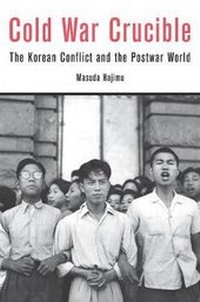
Cold War Crucible
The Korean Conflict and the Postwar World
Published on 10. February 2015
Book
Hardback
400 pages
978-0-674-59847-8 (ISBN)
Description
The end of World War II did not mean the arrival of peace. The major powers faced social upheaval at home, while anticolonial wars erupted around the world. American-Soviet relations grew chilly, but the meaning of the rivalry remained disputable. Cold War Crucible reveals the Korean War as the catalyst for a new postwar order. The conflict led people to believe in the Cold War as a dangerous reality, a belief that would define the fears of two generations.
In the international arena, North Korea's aggression was widely interpreted as the beginning of World War III. At the domestic level, the conflict generated a wartime logic that created dividing lines between "us" and "them," precipitating waves of social purges to stifle dissent. The United States allowed McCarthyism to take root; Britain launched anti-labor initiatives; Japan conducted its Red Purge; and China cracked down on counterrevolutionaries. These attempts to restore domestic tranquility were not a product of the Cold War, Masuda Hajimu shows, but driving forces in creating a mindset for it. Alarmed by the idea of enemies from within and faced with the notion of a bipolar conflict that could quickly go from chilly to nuclear, ordinary people and policymakers created a fantasy of a Cold War world in which global and domestic order was paramount.
In discovering how policymaking and popular opinion combined to establish and propagate the new postwar reality, Cold War Crucible offers a history that reorients our understanding of what the Cold War really was.
In the international arena, North Korea's aggression was widely interpreted as the beginning of World War III. At the domestic level, the conflict generated a wartime logic that created dividing lines between "us" and "them," precipitating waves of social purges to stifle dissent. The United States allowed McCarthyism to take root; Britain launched anti-labor initiatives; Japan conducted its Red Purge; and China cracked down on counterrevolutionaries. These attempts to restore domestic tranquility were not a product of the Cold War, Masuda Hajimu shows, but driving forces in creating a mindset for it. Alarmed by the idea of enemies from within and faced with the notion of a bipolar conflict that could quickly go from chilly to nuclear, ordinary people and policymakers created a fantasy of a Cold War world in which global and domestic order was paramount.
In discovering how policymaking and popular opinion combined to establish and propagate the new postwar reality, Cold War Crucible offers a history that reorients our understanding of what the Cold War really was.
Reviews / Votes
There is no doubt of Masuda's overall achievement. This is a superb work that bridges international and social history, underpinned by highly impressive research, to make arguments of real importance for our understanding of the Cold War. -- Rana Mitter * Diplomatic History * An original and important book, which challenges established truths and significantly adds to our understanding of the early Cold War. Masuda's work is a useful corrective to histories of the Korean War that focus mainly on U.S. perspectives. Cold War history at its best! -- Odd Arne Westad, author of <i>Restless Empire: China and the World since 1750</i> Cold War Crucible builds on both the traditional approach to diplomatic history and the so-called 'cultural turn.' Masuda unearths the roots of social change at the local level in several different societies to show how change impacted reactions to larger events and, in turn, influenced and was influenced by national political elites. An impressive book. -- William Stueck, author of <i>Rethinking the Korean War: A New Diplomatic and Strategic History</i>More details
Language
English
Place of publication
Cambridge, Mass
United States
Target group
Professional and scholarly
Illustrations
32 halftones
Dimensions
Height: 235 mm
Width: 156 mm
ISBN-13
978-0-674-59847-8 (9780674598478)
Copyright in bibliographic data and cover images is held by Nielsen Book Services Limited or by the publishers or by their respective licensors: all rights reserved.
Schweitzer Classification
Other editions
Additional editions
E-Book
01/2015
1st Edition
Harvard University Press
€66.59
Available for download
Person
Masuda Hajimu is Assistant Professor of History at the National University of Singapore.