

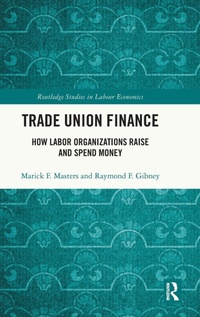
Trade Union Finance
How Labor Organizations Raise and Spend Money
1st Edition
Published on 22. March 2023
Book
Hardback
277 pages
978-1-032-37138-2 (ISBN)
Description
There are few contemporary studies on the finances of unions. Indeed, little research exists on the internal operations of unions in the U.S. This book provides a comprehensive analysis of the financial resources and performance of the largest national unions. It discusses the theoretical and practical relevance of the topic, which goes directly to the formation, maintenance, and potential advancement of labor organizations. Financial capacity and performance create incentives for unions to mobilize at the grassroots level and launch major drives to improve their position in society. Understanding how unions raise and spend money provides insight as to their administrative orientation and organizational capacity.
Given its topical breadth and depth, the book stands apart from the extant literature on unions in society. It is unique in the range of financial information presented, how data are analyzed, and its treatment of such important matters as compensation and benefits; operating budgets; political activism as measured by expenditures from treasury-based funds and political mechanisms funded by members through voluntary donations. The authors show not only the scope of union financial wherewithal and how it varies across labor organizations but also how such indicators compare to corporate entities who employ the rank-and-file.
The book provides a wealth of information on how to analyze the finances of unions and to use this information to prepare for collective bargaining and other aspects of labor-management relations. It informs employers and other observers about how unions are able to represent members and their ability to withstand strikes.
Given its topical breadth and depth, the book stands apart from the extant literature on unions in society. It is unique in the range of financial information presented, how data are analyzed, and its treatment of such important matters as compensation and benefits; operating budgets; political activism as measured by expenditures from treasury-based funds and political mechanisms funded by members through voluntary donations. The authors show not only the scope of union financial wherewithal and how it varies across labor organizations but also how such indicators compare to corporate entities who employ the rank-and-file.
The book provides a wealth of information on how to analyze the finances of unions and to use this information to prepare for collective bargaining and other aspects of labor-management relations. It informs employers and other observers about how unions are able to represent members and their ability to withstand strikes.
More details
Series
Language
English
Place of publication
London
United Kingdom
Publishing group
Taylor & Francis Ltd
Target group
College/higher education
Professional and scholarly
Academic and Postgraduate
Illustrations
21 s/w Zeichnungen, 87 s/w Tabellen, 21 s/w Abbildungen
87 Tables, black and white; 21 Line drawings, black and white; 21 Illustrations, black and white
Dimensions
Height: 240 mm
Width: 161 mm
Thickness: 20 mm
Weight
605 gr
ISBN-13
978-1-032-37138-2 (9781032371382)
Copyright in bibliographic data and cover images is held by Nielsen Book Services Limited or by the publishers or by their respective licensors: all rights reserved.
Schweitzer Classification
Other editions
Additional editions
Book
11/2024
1st Edition
Routledge
€63.60
Shipment within 10-20 days
E-Book
03/2023
1st Edition
Routledge
€55.49
Available for download
E-Book
03/2023
1st Edition
Routledge
€55.49
Available for download
Persons
Marick F. Masters is a Professor of Business at Wayne State University, Detroit, Michigan, USA.
Raymond F. Gibney is an Associate Professor of Management, School of Business Administration, Penn State Harrisburg, Middletown, Pennsylvania, USA.
Raymond F. Gibney is an Associate Professor of Management, School of Business Administration, Penn State Harrisburg, Middletown, Pennsylvania, USA.
Content
Introduction 1. Why Money Matters: The Role of Money in the Formation and Maintenance of Unions 2. Financial Reporting and Analysis 3. The Big Picture 4. How Unions Raise Money: Dues and Other Sources 6. Revenues 7. Disbursements 8. Financial Performance 9. Membership and Money 10. Political Spending 11. Compensation and Benefits 12. Corruption 13. The Top Ten 14. Strikes 15. Funding the New Wave of Unionism 16. Looking at the Future from the Past