

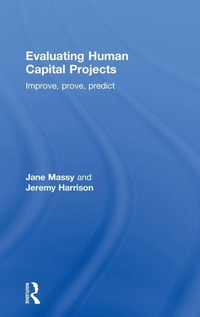
Evaluating Human Capital Projects
Improve, Prove, Predict
1st Edition
Published on 22. April 2014
Book
Hardback
248 pages
978-0-415-66308-3 (ISBN)
Description
How can we be sure that all those projects, programmes and activities that depend for their quality, efficiency and effectiveness on people's performance have met their objectives?
How can we improve the ways in which these projects, programmes and activities are planned so that realistic and useful measurement of their outcomes and value for money becomes possible?
How can we produce from these evaluations data of the quality and a standard required to drive future improvement?
Evaluating Human Capital Projects addresses these issues for professionals in the private, the public and the not-for-profit sectors. It shows them how to plan and track their investments with the professionalism and discipline widely applied to other capital investments. It is also written as a sourcebook for both professional and Masters-level students in business, health and a wide range of socio-economic disciplines.
It addresses effective planning, stakeholder engagement, result-tracking, the identification and removal of barriers to good performance. It provides ideas, theoretical background, extensive references to practice and analysis from the authors' extensive experience or planning, collection of data, analysis of data and attribution, and reporting to drive future improvement.
It is intended to raise the bar on the professionalism with which human capital investments are planned and measured.
How can we improve the ways in which these projects, programmes and activities are planned so that realistic and useful measurement of their outcomes and value for money becomes possible?
How can we produce from these evaluations data of the quality and a standard required to drive future improvement?
Evaluating Human Capital Projects addresses these issues for professionals in the private, the public and the not-for-profit sectors. It shows them how to plan and track their investments with the professionalism and discipline widely applied to other capital investments. It is also written as a sourcebook for both professional and Masters-level students in business, health and a wide range of socio-economic disciplines.
It addresses effective planning, stakeholder engagement, result-tracking, the identification and removal of barriers to good performance. It provides ideas, theoretical background, extensive references to practice and analysis from the authors' extensive experience or planning, collection of data, analysis of data and attribution, and reporting to drive future improvement.
It is intended to raise the bar on the professionalism with which human capital investments are planned and measured.
Reviews / Votes
'This is a well written and much needed book that addresses the 'black hole of accountability' - how we evaluate the huge sums spent on HR each year. It offers a structured and thoughtful approach to understanding and refining the organization through evaluation and implementation. With the inclusion of practical examples and case studies Evaluating Human Capital Projects is recommended reading for those responsible for evaluation - from CEOs to Project managers; from consultants to thinking practitioners.' - Monica Lee, Visiting Professor, Newcastle Business School, University of Northumbria, UK'Harrison and Massy have produced a valuable addition to the evaluation literature with a book that is of practical value to many practitioners in commerce, development, health and local government. The book's strength is its focus on people and their importance in driving change. In particular they recognize the importance of gaining buy-in, learning, and application to the workplace before sustainable change can be achieved. There is no automatic link between spending money and achieving an outcome. The authors provide a practical guide to systematically measure impact based on the logic model of Donald Kirkpatrick and adaptions by Jack Phillips. The book is packed with examples which relate the evaluation process to one of continuous improvement. They successfully distance evaluation from the days when it was seen as a 'one-off' activity taking place long after the original intervention.' - Dr Colin Jacobs, President UK Evaluation Society
More details
Language
English
Place of publication
London
United Kingdom
Publishing group
Taylor & Francis Ltd
Target group
College/higher education
Professional and scholarly
Postgraduate and Professional
Illustrations
52 s/w Tabellen, 56 s/w Abbildungen, 56 s/w Zeichnungen
52 Tables, black and white; 56 Line drawings, black and white; 56 Illustrations, black and white
Dimensions
Height: 240 mm
Width: 161 mm
Thickness: 18 mm
Weight
543 gr
ISBN-13
978-0-415-66308-3 (9780415663083)
Copyright in bibliographic data and cover images is held by Nielsen Book Services Limited or by the publishers or by their respective licensors: all rights reserved.
Schweitzer Classification
Other editions
Additional editions
E-Book
05/2014
1st Edition
Routledge
€77.99
Available for download
E-Book
05/2014
1st Edition
Routledge
€77.99
Available for download
Book
04/2014
1st Edition
Routledge
€83.60
Shipment within 15-20 days
Persons
Jane Massy is the Founder Director and CEO of abdi Ltd.
Jeremy Harrison is a Director of abdi Ltd.
Jeremy Harrison is a Director of abdi Ltd.
Content
1. Introduction: Why and what do we Need to Improve? 2. Planning the Investment for Impact Outcomes 3. Who Needs to do what/to what Standard? 4. Know what, know how, Confidence 5. Engagement: Do they get it? 6. Full Cost: Let's Account for it! 7. Tracking: How to Leverage Data to Improve the Results 8. Measuring the Results: When to go all the Way? 9. So how do you know it was Anything to do with you? 10. Monetising: Proxies are out: Take a Reality Check 11. Proof: It's your Credibility we're Talking about Here 12. Everyone Subject to the same Rules 13. Aggregate, Compare and Contrast 14. Pulling Multiple Strands Together: Groups of Stakeholders, Several Sub-Projects 15. From Proof to Predict 16. A Final Word: Just Do