

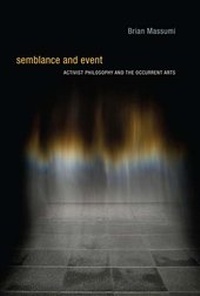
Semblance and Event
Activist Philosophy and the Occurrent Arts
Published on 14. October 2011
Book
Hardback
232 pages
978-0-262-13491-0 (ISBN)
Description
Events are always passing; to experience an event is to experience the passing. But
how do we perceive an experience that encompasses the just-was and the is-about-to-be as much as
what is actually present? In Semblance and Event, Brian Massumi, drawing on the work of William
James, Alfred North Whitehead, Gilles Deleuze, and others, develops the concept of
"semblance" as a way to approach this question. It is, he argues, a question of
abstraction, not as the opposite of the concrete but as a dimension of it: "lived
abstraction." A semblance is a lived abstraction. Massumi uses the category of the semblance to
investigate practices of art that are relational and event-oriented--variously known as interactive
art, ephemeral art, performance art, art intervention--which he refers to collectively as the
"occurrent arts." Massumi argues that traditional art practices, including perspective
painting, conventionally considered to be object-oriented freeze frames, also organize events of
perception, and must be considered occurrent arts in their own way. Each art practice invents its
own kinds of relational events of lived abstraction, to produce a signature species of semblance.
The artwork's relational engagement, Massumi continues, gives it a political valence just as
necessary and immediate as the aesthetic dimension. Massumi investigates occurrent art practices in
order to examine, on the broadest level, how the aesthetic and the political are always intertwined
in any creative activity.
how do we perceive an experience that encompasses the just-was and the is-about-to-be as much as
what is actually present? In Semblance and Event, Brian Massumi, drawing on the work of William
James, Alfred North Whitehead, Gilles Deleuze, and others, develops the concept of
"semblance" as a way to approach this question. It is, he argues, a question of
abstraction, not as the opposite of the concrete but as a dimension of it: "lived
abstraction." A semblance is a lived abstraction. Massumi uses the category of the semblance to
investigate practices of art that are relational and event-oriented--variously known as interactive
art, ephemeral art, performance art, art intervention--which he refers to collectively as the
"occurrent arts." Massumi argues that traditional art practices, including perspective
painting, conventionally considered to be object-oriented freeze frames, also organize events of
perception, and must be considered occurrent arts in their own way. Each art practice invents its
own kinds of relational events of lived abstraction, to produce a signature species of semblance.
The artwork's relational engagement, Massumi continues, gives it a political valence just as
necessary and immediate as the aesthetic dimension. Massumi investigates occurrent art practices in
order to examine, on the broadest level, how the aesthetic and the political are always intertwined
in any creative activity.
More details
Series
Language
English
Place of publication
Cambridge, Mass.
United States
Publishing group
MIT Press Ltd
Target group
Professional and scholarly
College/higher education
Interest Age: From 18 years
Illustrations
5 s/w Abbildungen
5 b&w illus.
Dimensions
Height: 229 mm
Width: 152 mm
Thickness: 0 mm
Weight
454 gr
ISBN-13
978-0-262-13491-0 (9780262134910)
Copyright in bibliographic data and cover images is held by Nielsen Book Services Limited or by the publishers or by their respective licensors: all rights reserved.
Schweitzer Classification
Other editions
Additional editions
Book
08/2013
MIT Press
€27.30
Article exhausted; check different version
E-Book
09/2011
MIT Press
€29.49
Available for download
Person
Brian Massumi is Professor in the Department of Communication Sciences at the University of Montréal. He is the author of Parables for the Virtual: Movement, Affect, Sensation and A User's Guide to Capitalism and Schizophrenia: Deviations from Deleuze and Guattari (MIT Press, 1992).