

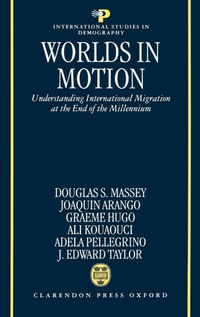
Worlds in Motion
Understanding International Migration at the End of the Millennium
Published on 28. January 1999
Book
Hardback
376 pages
978-0-19-829442-9 (ISBN)
Description
At the end of the 20th century nearly all developed nations have become countries of immigration, absorbing growing numbers of immigrants not only from developed regions, byt increasingly from developing nations of the Third World. Although international migration has come to play a central role in the social, economic, and demographic dynamics of both immigrant-sending and immigrant-receiving countries, social scientist have been slow to construct a comprehensive theory to explain it. Efforts at theoretical explanation have been fragmented by disciplinary, geographic, and methodological boudaries. Worlds in Motion seeks to overcome these schisms to create a comprehensive theory of international migration for the next century.
After explicating the various propositions and hypotheses of current theories, and identifying area of complementarity and conflict, the authors review empirical research emanting from each of the world's principal international migration systems: North America, Western Europe, the Gulf, Asia and the Pacific, and the Southern Cone of South America. Using data from the 1980s, levels and patterns of migration within each system are described to define their structure and organization. Specific studies are then comprehensively surveyed to evaluate the fundamental propositions of neoclassical economics, the new economics of labour migration, segmented labour market theory, world systems theory, social capital theory, and the theory of cumulative causation. The various theories are also tested by applying them to the relationship between international migration and economic development. Although certain theories seem to function more effectively in certain systems, all contain elements of truth supported by empirical research. The task of the theorist is thus to identify which theories are most effective in accounting for international migration in the world today, and what regional and national circumstances lead to a predominance of one theoretical mechanism over another. The book concludes by offering an empirically-grounded theoretical synthesis to serve as a guide for researchers and policy-makers in the 21st century.
After explicating the various propositions and hypotheses of current theories, and identifying area of complementarity and conflict, the authors review empirical research emanting from each of the world's principal international migration systems: North America, Western Europe, the Gulf, Asia and the Pacific, and the Southern Cone of South America. Using data from the 1980s, levels and patterns of migration within each system are described to define their structure and organization. Specific studies are then comprehensively surveyed to evaluate the fundamental propositions of neoclassical economics, the new economics of labour migration, segmented labour market theory, world systems theory, social capital theory, and the theory of cumulative causation. The various theories are also tested by applying them to the relationship between international migration and economic development. Although certain theories seem to function more effectively in certain systems, all contain elements of truth supported by empirical research. The task of the theorist is thus to identify which theories are most effective in accounting for international migration in the world today, and what regional and national circumstances lead to a predominance of one theoretical mechanism over another. The book concludes by offering an empirically-grounded theoretical synthesis to serve as a guide for researchers and policy-makers in the 21st century.
Reviews / Votes
The discussion of four major theoretical traditions associated with the initiation of a migration flow. ... is intelligent and persuasive. ... The analytical treatment of the selected regions is useful and generally enhances one's understanding of the migration processes in each. ... The authors speculations are refreshingly forward-looking and worth reflecting upon regardless of one's predispositions toward theory. ... the language is direct, the theoretical discussion eschews unnecessary jargon, neologisms are kept to a minimum, and the extensive summaries of the relevant bodies of literature are cogent. ... the volume is useful as a single source where many of the most influential migration theories are treated with clarity. ...those interested in having a well-organized and analytically valuable thumbnail sketch of the migration subsystems in five world regions will find plenty to chew on. * Demetrios G. Papademetriou, Population and Development Review, Vol 26, no.1 * This book is an invaluable contribution to the scientific research literature on international migration. ... exemplifies international scientific cooperation as its best. ... The initial theoretical review chapter ... is exemplary by its breadth and clarity of exposition. ... This is a must book for researchers of immigration and for courses on this topic. * Alejandro Portes, Princeton University, IMR Vol 34 * An extremely useful volume... Worlds in Motion displays some of the best features of migration studies. * Nicholas Van Hear, Journal of Refugee Studies Vol. 12, No.4 *More details
Series
Language
English
Place of publication
Oxford
United Kingdom
Publishing group
Oxford University Press
Target group
Professional and scholarly
Illustrations
figures, tables
Dimensions
Height: 240 mm
Width: 161 mm
Thickness: 25 mm
Weight
734 gr
ISBN-13
978-0-19-829442-9 (9780198294429)
Copyright in bibliographic data and cover images is held by Nielsen Book Services Limited or by the publishers or by their respective licensors: all rights reserved.
Schweitzer Classification
Other editions
Additional editions
Douglas S. Massey | Joaquin Arango | Graeme Hugo
Worlds in Motion
Understanding International Migration at the End of the Millennium
Book
02/2005
Oxford University Press
€121.30
Shipment within 15-20 days
Persons
Author
Professor, Population Studies CenterProfessor, Population Studies Center, University of Pennsylvania
, Instituto Universitario Ortgea y Gasset, Spain
, University of Adelaide, Australia
, Lecturer, Department of DemographyUniversity of Montreal
Facultad de Ciencias Sociales, Programa de Poblacion, UruguayFacultad de Ciencias Sociales, Programa de Poblacion, Uruguay
, University of California, Davis
Content
1. New Migrations, New Theories ; 2. Contemporary Theories of International Migration ; 3. Understanding the North American System ; 4. Coming to Terms with European Immigration ; 5. Labour Migration in the Gulf System ; 6. Theory and Reality in the Gulf System ; 7. International Migration in South America ; 8. International Migration and National Development ; 9 ; 10. Conclusions for the Next Century ; References ; Index