

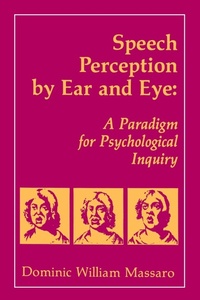
Speech Perception By Ear and Eye
A Paradigm for Psychological Inquiry
1st Edition
Published on 1. April 1987
Book
Paperback/Softback
330 pages
978-0-8058-0062-3 (ISBN)
Description
First published in 1987. This book is about the processing of information. The central domain of interest is face-to-face communication in which the speaker makes available both audible and visible characteristics to the perceiver. Articulation by the speaker creates changes in atmospheric pressure for hearing and provides tongue, lip, jaw, and facial movements for seeing. These characteristics must be processed by the perceiver to recover the message conveyed by the speaker. The speaker and perceiver must share a language to make communication possible; some internal representation is necessarily functional for the perceiver to recover the message of the speak.
Reviews / Votes
"...recommended as a resource for researchers, as well as clinicians and teachers, in speech-language pathology, audiology, and education of the hearing impaired."-The Volta Review
More details
Language
English
Place of publication
Philadelphia
United States
Publishing group
Taylor & Francis Inc
Target group
College/higher education
Professional and scholarly
Dimensions
Height: 229 mm
Width: 152 mm
Thickness: 18 mm
Weight
482 gr
ISBN-13
978-0-8058-0062-3 (9780805800623)
Copyright in bibliographic data and cover images is held by Nielsen Book Services Limited or by the publishers or by their respective licensors: all rights reserved.
Schweitzer Classification
Other editions
Additional editions
E-Book
01/2014
1st Edition
Psychology Press Ltd
€78.99
Available for download
E-Book
01/2014
1st Edition
Psychology Press Ltd
€78.99
Available for download
Person
Dominic William Massaro Program in Experimental Psychology University of California, Santa Cruz
Content
1. Scientific Framework for PsychologicaI Inquiry 2. Single versus Multiple Sources of Speech Information: The Contribution of Visible Speech 3. Integration versus Non integration of Auditory and Visual Information in Speech Perception 4. Categorical versus Continuous Information in Speech Perception: The Relationship between Identification and Discrimination 5. Categorical versus Continuous Information in Speech Perception: Model Tests and Ratings 6. Independent versus Dependent valuation of Sources 7. Additive, Minimization, or Multiplicative Integration 8. Lifespan Changes in Speech Perception by Ear and Eye 9. Specificity versus Generality of the Findings