

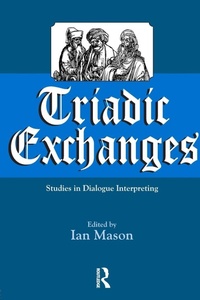
Triadic Exchanges
Studies in Dialogue Interpreting
Published on 1. January 2001
Book
Paperback/Softback
208 pages
978-1-900650-36-6 (ISBN)
Description
Dialogue interpreting is a generic term covering a diverse range of fields of interpreting which have in common the basic feature of face-to-face interaction between three parties: the interpreter and (at least) two other speakers. The interaction consists of spontaneous dialogue, involving relatively short turns at talk, in two languages. It is usually goal-directed in the sense that there is some outcome to be negotiated.
The studies in this volume cover several different fields: courtroom interpreting, doctor-patient interviews, immigration interviews, etc., and involve a range of different languages: Spanish, Portuguese, Polish, More and Austrian Sign Language. They have in common that they view the interpreter as just one of the parties to this three-way exchange, in which each participant's moves can affect each other participant and thus the outcome of the event.
In Part I, new research directions are explored in studies which piece together evidence of the ways dialogue interpreters actually behave and the effects of their behaviour. This is followed by two studies which discuss traditional interpreter roles - the 'King's Linguist' in Burkina Faso and the Oranda Tsuji, official interpreters employed in isolationist eighteenth-century Japan to ensure contact with the outside world. Finally, issues involved in training are the subject of two chapters relating to Austria and the UK. The variety of aspects and approaches represented in the volume - linguistic, cultural, pragmatic, historical - offer a rich and fascinating overview of the field of dialogue interpreting studies as it now stands.
The studies in this volume cover several different fields: courtroom interpreting, doctor-patient interviews, immigration interviews, etc., and involve a range of different languages: Spanish, Portuguese, Polish, More and Austrian Sign Language. They have in common that they view the interpreter as just one of the parties to this three-way exchange, in which each participant's moves can affect each other participant and thus the outcome of the event.
In Part I, new research directions are explored in studies which piece together evidence of the ways dialogue interpreters actually behave and the effects of their behaviour. This is followed by two studies which discuss traditional interpreter roles - the 'King's Linguist' in Burkina Faso and the Oranda Tsuji, official interpreters employed in isolationist eighteenth-century Japan to ensure contact with the outside world. Finally, issues involved in training are the subject of two chapters relating to Austria and the UK. The variety of aspects and approaches represented in the volume - linguistic, cultural, pragmatic, historical - offer a rich and fascinating overview of the field of dialogue interpreting studies as it now stands.
Reviews / Votes
Dialogue interpreting is a generic term covering a diverse range of fields of interpreting which have in common the basic feature of face-to-face interaction between three parties: the interpreter and (at least) two other speakers. The interaction consists of spontaneous dialogue, involving relatively short turns at talk, in two languages. It is usually goal-directed in the sense that there is some outcome to be negotiated. The studies in this volume cover several different fields: courtroom interpreting, doctor-patient interviews, immigration interviews, etc., and involve a range of different languages: Spanish, Portuguese, Polish, More and Austrian Sign Language. They have in common that they view the interpreter as just one of the parties to this three-way exchange, in which each participant's moves can affect each other participant and thus the outcome of the event. In Part I, new research directions are explored in studies which piece together evidence of the ways dialogue interpreters actually behave and the effects of their behaviour. This is followed by two studies which discuss traditional interpreter roles - the 'King's Linguist' in Burkina Faso and the Oranda Tsuji, official interpreters employed in isolationist eighteenth-century Japan to ensure contact with the outside world. Finally, issues involved in training are the subject of two chapters relating to Austria and the UK. The variety of aspects and approaches represented in the volume - linguistic, cultural, pragmatic, historical - offer a rich and fascinating overview of the field of dialogue interpreting studies as it now stands.More details
Language
English
Place of publication
Manchester
United Kingdom
Target group
College/higher education
Professional and scholarly
Dimensions
Height: 234 mm
Width: 156 mm
Thickness: 12 mm
Weight
345 gr
ISBN-13
978-1-900650-36-6 (9781900650366)
Copyright in bibliographic data and cover images is held by Nielsen Book Services Limited or by the publishers or by their respective licensors: all rights reserved.
Schweitzer Classification
Other editions
Additional editions
Book
09/2016
1st Edition
Routledge
€207.50
Shipment within 10-20 days
E-Book
04/2014
1st Edition
Routledge
€78.99
Available for download
E-Book
04/2014
1st Edition
Routledge
€78.99
Available for download
Person
Mason, Ian
Content
Part I Research Directions; Chapter 1 Interpreting Expert Witness Testimony, Cynthia Miguelez; Chapter 2 How are Courtroom Questions Interpreted?, Sandra Hale; Chapter 3 Interactional Pragmatics, Face and the Dialogue Interpreter, Ian Mason, Miranda Stewart; Chapter 4 Interpreting in Crisis, Cecilia Wadensjoe; Chapter 5 How Untrained Interpreters Handle Medical Terms, Bernd Meyer; Part II Traditions; Chapter 6 The Rebirth of the King's Linguist, Pierre Kouraogo; Chapter 7 Oranda Tsujiand the Sidotti Incident, Yukino Semizu; Part III Issues in Training; Chapter 8 First Steps on Firmer Ground, Nadja Grbic; Chapter 9 Teaching Liaison Interpreting, Annalisa Sandrelli;