

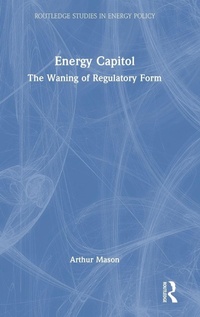
Energy Capitol
The Waning of Regulatory Form
1st Edition
Published on 4. November 2024
Book
Hardback
252 pages
978-1-032-78545-5 (ISBN)
Description
Energy Capitol explores the waning of regulatory politics surrounding large-scale energy systems in the United States at the turn of the millennium.
Throughout the twentieth century, large-scale energy systems in North America and Europe were highly regulated by a national political community whose decision-making authority relied on positions of bureaucratic and capitalist-led industry organization. After restructuring in energy markets such as natural gas and electricity during the 1980s, the culture of power surrounding political decision-making began to decline. Against this backdrop, Arthur Mason examines the struggle by oil companies and federal-state agencies to deliver natural gas from Alaska and Canada's Mackenzie Valley to markets in midcontinental United States, highlighting regulatory collusion to advance their plans. Mason employs perspectives from anthropology, political science, sociology, and science and technology studies to analyze ethnographic data gathered at the Alaska State Legislature and in the Office of the Alaska Governor in Washington, D.C. The focus is primarily on plans for building an estimated $20 billion 3,500 mile pipeline to transport natural gas from the North American Arctic to midcontinental pipeline infrastructure in the United States. By illuminating key aspects of federal-state political decision-making processes on energy transportation infrastructure, Mason highlights the activities of economists, lawyers, and other regulatory intellectuals whose accumulated work impedes Arctic proposals through a reliance on judgments that no longer reflect the conditions in which large-scale projects are increasingly determined.
Written by a leading expert in the field, this book will be of great interest to students and scholars of energy policy, environmental politics, governance, and regulation and risk. It will also be relevant to industry professionals working in environmental NGOs and government departments in energy and climate forecasting.
Throughout the twentieth century, large-scale energy systems in North America and Europe were highly regulated by a national political community whose decision-making authority relied on positions of bureaucratic and capitalist-led industry organization. After restructuring in energy markets such as natural gas and electricity during the 1980s, the culture of power surrounding political decision-making began to decline. Against this backdrop, Arthur Mason examines the struggle by oil companies and federal-state agencies to deliver natural gas from Alaska and Canada's Mackenzie Valley to markets in midcontinental United States, highlighting regulatory collusion to advance their plans. Mason employs perspectives from anthropology, political science, sociology, and science and technology studies to analyze ethnographic data gathered at the Alaska State Legislature and in the Office of the Alaska Governor in Washington, D.C. The focus is primarily on plans for building an estimated $20 billion 3,500 mile pipeline to transport natural gas from the North American Arctic to midcontinental pipeline infrastructure in the United States. By illuminating key aspects of federal-state political decision-making processes on energy transportation infrastructure, Mason highlights the activities of economists, lawyers, and other regulatory intellectuals whose accumulated work impedes Arctic proposals through a reliance on judgments that no longer reflect the conditions in which large-scale projects are increasingly determined.
Written by a leading expert in the field, this book will be of great interest to students and scholars of energy policy, environmental politics, governance, and regulation and risk. It will also be relevant to industry professionals working in environmental NGOs and government departments in energy and climate forecasting.
More details
Series
Language
English
Place of publication
London
United Kingdom
Publishing group
Taylor & Francis Ltd
Target group
College/higher education
Postgraduate and Undergraduate Advanced
Dimensions
Height: 240 mm
Width: 161 mm
Thickness: 19 mm
Weight
567 gr
ISBN-13
978-1-032-78545-5 (9781032785455)
Copyright in bibliographic data and cover images is held by Nielsen Book Services Limited or by the publishers or by their respective licensors: all rights reserved.
Schweitzer Classification
Other editions
Additional editions
E-Book
11/2024
1st Edition
Routledge
€51.49
Available for download
E-Book
11/2024
1st Edition
Routledge
€51.49
Available for download
Book
11/2024
1st Edition
Routledge
€58.70
Shipment within 10-20 days
Person
Arthur Mason is a political anthropologist specializing in energy politics, ecological vulnerability, expertise, aesthetics, and futurity. His publications include two edited volumes titled Arctic Abstractive Industry: Assembling the Valuable and Vulnerable North and Subterranean Estates: Life Worlds of Oil and Gas.
Content
Contents
Acknowledgments
Preface: Millennial Energy
List of Abbreviations
1. Waning Reflection of Status and Collusion
2. Submission and Involvement
3. Events Collective
4. Governor and the New Gas Paradigm
5. Kitchen Cabinet
6. Observation Work
7. Wealth of Knowledge
8. Mexican Standoff
Index
Acknowledgments
Preface: Millennial Energy
List of Abbreviations
1. Waning Reflection of Status and Collusion
2. Submission and Involvement
3. Events Collective
4. Governor and the New Gas Paradigm
5. Kitchen Cabinet
6. Observation Work
7. Wealth of Knowledge
8. Mexican Standoff
Index