

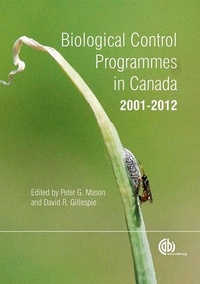
Biological Control Programmes in Canada 2001-2012
Will be published approx. on 21. October 2013
Book
Hardback
544 pages
978-1-78064-257-4 (ISBN)
Description
Canada is a world leader in biological control research. Reporting the status of biocontrol agents released in Canada over the last decade, this book presents case studies by target pest that evaluate the impact of biocontrol and recommend future priorities. In addition to a new chapter on future targets and an appendix listing established agents, this edition contains information of interest to a global audience, and chapters that address effects of invasive species and climate change.
More details
Language
English
Place of publication
Wallingford
United Kingdom
Target group
College/higher education
Product notice
sewn/stitched
Cloth over boards
Dimensions
Height: 241 mm
Width: 178 mm
Thickness: 36 mm
Weight
1293 gr
ISBN-13
978-1-78064-257-4 (9781780642574)
Copyright in bibliographic data and cover images is held by Nielsen Book Services Limited or by the publishers or by their respective licensors: all rights reserved.
Schweitzer Classification
Other editions
Additional editions
Peter Mason | David R. Gillespie
Biological Control Programmes in Canada 2001-2012
E-Book
10/2013
CABI Publishing
€268.99
Available for download
Persons
Charles Vincent works as entomologist at the Horticultural Research and Development Center, Agriculture and Agri-Food Canada, Saint-Jean-sur-Richelieu, Qc, Canada. He is adjunct professor at McGill University, Universite du Quebec a Montreal and Universite de Picardie Jules Verne (Amiens, France).
Editor
Agriculture & Agri-Food Canada
Agriculture and Agri-Food Canada
Contributions
Agriculture & Agri-Food Canada
Agriculture & Agri-Food Canada
Agriculture & Agri-Food Canada
Natural Resources Canada
Natural Resources Canada
University of Montreal, Canada
Department of Biology
Agriculture & Agri-Food Canada
Content
a: Contributors b: Foreword c: Preface d: Acknowledgements 1: Regulation of Biological Control in Canada 2: Access and Benefit Sharing and Biological Control 3: Climate Change and Biological Control in Canada 4: New Tools in Biological Control: Molecular Markers and Mathematical Models 5: A Novel Approach for Developing Microbial Biopesticides 6: Reproductive Parasites: Symbiotic Bacteria for Potential Use in Biological Control 7: Acantholyda erythrocephala L., Pine False Webworm (Hymenoptera: Pamphiliidae) 8: Acrolepiopsis assectella (Zeller), Leek Moth (Lepidoptera: Acrolepiidae) 9: Agrilus planipennis Fairmaire, Emerald Ash Borer (Coleoptera: Buprestidae) 10: Agriotes spp. L., Wireworms and Click Beetles (Coleoptera: Elateridae) 11: Anoplophora glabripennis (Motschulsky), Asian Longhorned Beetle (Coleoptera: Cerambycidae) 12: Aphis glycines Matsumura, Soybean Aphid (Hemiptera: Aphididae) 13: Aphis gossypii Glover, Melon/Cotton Aphid, Aulacorthum solani (Kaltenbach), Foxglove Aphid, and Other Arthropod Pests in Greenhouse Crops 14: Bactericera cockerelli (Sulc), Tomato/Potato Psyllid (Hemiptera: Triozidae) 15: Cephus cinctus Norton, Wheat Stem Sawfly (Hymenoptera: Cephidae) 16: Ceutorhynchus obstrictus (Marsham), Cabbage Seedpod Weevil (Coleoptera: Curculionidae) 17: Choristoneura rosaceana (Harris), Obliquebanded Leafroller (Lepidoptera: Tortricidae) 18: Contarinia nasturtii Kieffer, Swede Midge (Diptera: Cecidomyiidae) 19: Cydia pomonella (L.), Codling Moth (Lepidoptera: Tortricidae) 20: Delia radicum (L.), Cabbage Maggot (Diptera: Anthomyiidae) 21: Drosophila suzukii (Matsumura), Spotted Wing Drosophila (Diptera: Drosophilidae) 22: Enarmonia formosana Scopoli, Cherry Bark Tortrix (Lepidoptera: Tortricidae) 23: Euxoa ochrogaster (Guenee), Redbacked Cutworm, Euxoa messoria (Harris), Darksided Cutworm, and Euxoa auxiliaris (Grote), Army Cutworm (Lepidoptera: Noctuidae) 24: Fenusa pumila Leach, Birch Leaf Miner, Profenusa thomsoni (Konow), Ambermarked Birch Leaf Miner (Hymenoptera: Tenthredinidae) 25: Haematobia irritans L., Horn Fly, Musca domestica L., House Fly, and Stomoxys calcitrans (L.), Stable Fly (Diptera: Muscidae) 26: Harmonia axyridis (Pallas), Multicolored Asian Ladybeetle (Coleoptera: Coccinellidae) 27: Hoplocampa testudinea (Klug), European Apple Sawfly (Hymenoptera: Tenthredinidae) 28: Lambdina fiscellaria (Guenee), Hemlock Looper (Lepidoptera: Geometridae) 29: Lilioceris lilii (Scopoli), Lily Leaf Beetle (Coleoptera: Chrysomelidae) 30: Listronotus oregonensis (LeConte), Carrot Weevil (Coleoptera: Curculionidae) 31: Lygus lineolaris (Palisot), Tarnished Plant Bug (Hemiptera: Miridae) 32: Mamestra configurata Walker, Bertha Armyworm (Lepidoptera: Noctuidae) 33: Oulema melanopus (L.), Cereal Leaf Beetle (Coleoptera: Chrysomelidae) 34: Panonychus ulmi (Koch) European Red Mite (Trombidiformes: Tetranychidae) 35: Phyllonorycter blancardella (Fabricius), Spotted Tentiform Leafminer (Lepidoptera: Gracillariidae) 36: Phyllotreta cruciferae (Goeze), Crucifer Flea Beetle and P. striolata (Fabricius), Striped Flea Beetle (Coleoptera: Chrysomelidae) 37: Plutella xylostella (L.), Diamondback Moth (Lepidoptera: Plutellidae) 38: Sirex noctilio Fabricius, (Hymenoptera: Siricidae) 39: Sitodiplosis mosellana (Gehin), Orange Wheat Blossom Midge (Diptera: Cecidomyiidae) 40: Sitona spp. Germar, Broad Nosed Weevils (Coleoptera: Curculionidae) 41: Synanthedon myopaeformis (Borkhausen), Apple Clearwing Moth (Lepidoptera: Sesiidae) 42: Trichoplusi ni Huebner, Cabbage Looper (Lepidoptera: Noctuidae) 43: Ambrosia artemisiifolia L., Common Ragweed (Asteraceae) 44: Centaurea diffusa Lamarck, Diffuse Knapweed, and Centaurea stoebe subsp. micranthos (S.G. Gmel. ex Gugler) Hayek, Spotted Knapweed (Asteraceae) 45: Convolvulus arvensis L., Field Bindweed (Convolvulaceae) 46: Cynoglossum officinale (L.), Houndstongue (Boraginaceae) 47: Euphorbia esula L., Leafy Spurge (Euphorbiaceae) 48: Fallopia japonica (Houtt.) Ronse Decraene, Japanese Knotweed, Fallopia sachalinensis (F. Schmidt) Ronse Decraene, Giant Knotweed, Fallopia x bohemica (Chrtek & Chrtkova) J. P. Bailey, Bohemian Knotweed (Polygonaceae) 49: Galium spurium L., False Cleavers, and G. aparine L., Cleavers (Rubiaceae) 50: Lepidium draba L., L. chalepense L., L. appelianum Al-Shehbaz, Hoary Cresses (Brassicaceae) 51: Leucanthemum vulgare Lam., Oxeye Daisy (Asteraceae) 52: Linaria dalmatica (L.) Miller, Dalmatian Toadflax (Plantaginaceae) 53: Linaria vulgaris Mill., Yellow Toadflax (Plantaginaceae) 54: Lythrum salicaria L., Purple Loosestrife (Lythraceae) 55: Malva pusilla Smith, Round-leaved Mallow (Malvaceae) 56: Setaria viridis (L.) Beauvois, Green Foxtail (Poaceae) 57: Tanacetum vulgare L., Common Tansy (Asteraceae) 58: Taraxacum officinale F.H. Wigg, Dandelion (Asteraceae) 59: Tripleurospermum inodorum (L.) Sch. Bip., Scentless Chamomile (Asteraceae) 60: Vincetoxicum nigrum (L.) Moench, V. rossicum (Kleopow) Barbar., Swallow-Worts, Dog Strangling Vine (Apocynaceae) 61: Erwinia amylovora (Burrill) Winslow et al., Fire Blight (Enterobacteriaceae) 62: Fusarium graminearum Schwabe (teleomorph Gibberella zeae (Schwein.) Petch.), Fusarium Head Blight Disease (Nectriaceae) 63: Heterobasidion irregulare Garbel. & Otrosina, Annosus Root Rot (Bondarzewiaceae) 64: Monilinia vaccinii-corymbosi (Reade) Honey, Mummy Berry (Monilinia blight) (Sclerotiniaceae) 65: Plasmodiophora brassicae Woronin, Clubroot of Crucifers (Plasmodiophoraceae) 66: Pythium aphanidermatum (Edson) Fitzpatrick and Pythium ultimum Trow (Pythiaceae), Seedling Damping-off and Root and Crown rot 67: Rhizoctonia solani Kuehn [anamorphic state of Thanatephorus cucumeris (A.B. Frank) Donk], Damping-off, Root and Crown Rot, Blight, Leaf Spot, Stem Canker and Tuber Scurf (Ceratobasidiaceae) 68: Streptomyces scabies Lambert and Loria, Common Scab or Potato Scab (Streptomycetaceae), and Verticillium dahliae Klebahn, Verticillium albo-atrum Reinke and Berthhold, Verticillium Wilt (Plectosphaerellaceae) 69: Taphrina deformans (Berk.) Tul., Peach Leaf Curl (Taphrinaceae) 70: Xanthomonas euvesicatoria Jones et al., Xanthomonas perforans Jones et al., Xanthomonas vesicatoria (ex Doidge) Vauterin et al., Xanthomonas gardneri (ex Sutic) Jones et al., Bacterial Spot of Tomato and Pepper (Xanthomonadaceae) 71: Invasive Alien Species and Future Biological Control Targets