

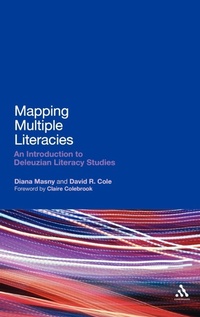
Mapping Multiple Literacies
An Introduction to Deleuzian Literacy Studies
Published on 16. August 2012
Book
Hardback
208 pages
978-1-4411-4920-6 (ISBN)
Description
MappingMultiple Literaciesbrings together the latest theory and research in the fields of literacy studyand European philosophy, Multiple Literacies Theory (MLT) and the philosophicalwork of Gilles Deleuze. It frames the process of becoming literate as a fluidprocess involving multiple modes of presentation, and explains these processesin terms of making maps of our social lives and ways of doing things together.For Deleuze, language acquisition is a social activityof which we are a part, but only one partamongst many others..Masny and Cole draw on Deleuze's thinking to expand the repertoires of literacyresearch and understanding. They outline how we can understand literacy as asocial activity and map the ways in which becoming literate may take hold andtransform communities. The chapters in this book weave together theory, dataand practice to open up a creative new area of literacy studies and to provokevigorous debate about the sociology of literacy.
Reviews / Votes
Rarely does a book capture my attention as this one has done. Mapping Multiple Literacies: An Introduction to Deleuzian Literacy Studies is a treatise of great proportions that is both accessible and useful in terms of what the literacy teacher, researcher, and theorist will find interesting. It is a book that will grace the syllabi of several courses I teach in the Department of Language and Literacy Education at the University of Georgia. * Donna Alvermann, UGA Appointed Distinguished Research Professor in Language and Literacy Education, University of Georgia, USA * [The authors present] a good balance between literacy practices and theories, as well as Deleuzian literacy. Their mapping offers a dynamic illustration of Deleuze's plane of immanence. Deleuzian concepts are strongly re-territorialized within the 'geography' of multiple literacies including text, power, media, affect, groups and pedagogical relationships . A good introduction to how Deleuze operates and a strong contribution to what Deleuze brings to literacy. Teachers and scholars will benefit from this creative articulation. * Jacques Daignault, Professor of Education, University of Quebec at Rimouski, Canada * Masny and Cole offer an innovative and entertaining perspective on literacy studies, from the novel perspective of Gilles Deleuze's philosophy. Deleuze has been more often associated with literary studies, but Masny and Cole mine his theories of affect and difference to illuminate the multiplicity of subjectivities and practices associated with literacy. The result is an intriguing tour amongst the diverse ideas about the field, as their Deleuzian map unfolds. * David Rose, Director, Reading to Learn, Australia *More details
Language
English
Place of publication
New York
United States
Target group
College/higher education
Dimensions
Height: 240 mm
Width: 161 mm
Thickness: 16 mm
Weight
485 gr
ISBN-13
978-1-4411-4920-6 (9781441149206)
Copyright in bibliographic data and cover images is held by Nielsen Book Services Limited or by the publishers or by their respective licensors: all rights reserved.
Schweitzer Classification
Other editions
Additional editions
Diana Masny | David R. Cole
Mapping Multiple Literacies
An Introduction to Deleuzian Literacy Studies
E-Book
06/2012
1st Edition
Continuum Publishing Corporation
€42.99
Available for download
Persons
David R. Cole is Senior Lecturer in Literacy, English Education and Professional Studies at the University of Technology, Sydney, Australia. Diana Masny is Professor of Education and the director of the Multiple Literacies Research Unit at the Faculty of Education at the University of Ottowa, Canada.
Content
1. Introduction to Mapping Multiple Literacies; 2. Cartographies of Multiple Literacies (MLT); 3. Mapping Literacies with Affect; 4. Groups Talking - Collective Enunciation; 5. What is Reading? How Does Reading Happen?; 6. Mapping Power and Literacies; 7. Mapping the Literacy of Digital Futures; 8. Conclusion; References; Index.