

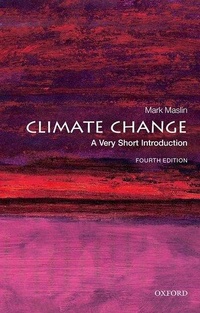
Climate Change
A Very Short Introduction
4th Edition
Published on 19. August 2021
Book
Paperback/Softback
160 pages
978-0-19-886786-9 (ISBN)
Description
Very Short Introductions: Brilliant, Sharp, Inspiring
In the last few years global awareness of climate change has grown very rapidly - through the school strikes led by Greta Thunberg, groups like Extinction Rebellion, the IPCC's recent high impact reports, tv documentaries, and declarations from governments around the world that we are in a climate emergency. This awareness is continuing to grow, as the science shows us that our planet and our species are facing a massive crisis, which we ourselves have caused. Climate change is one of the few scientific theories that make us examine the whole basis of modern society. It is a challenge that has politicians arguing, sets nations against each other, queries individual lifestyle choices, and ultimately asks questions about humanity's relationship with the rest of the planet.
This Very Short Introduction draws on the very latest science from the 2021 IPCC Report, examining the evidence that climate change is already happening, and discussing its potential catastrophic impacts in the future. Mark Maslin also explores the geopolitics of climate change and the win-win solutions we can employ to avoid the very worst effects of climate change. Throughout, he demonstrates how we must develop new modes of thinking for the 21st century at individual, corporate, and government levels to collectively tackle the challenge of climate change.
ABOUT THE SERIES: The Very Short Introductions series from Oxford University Press contains hundreds of titles in almost every subject area. These pocket-sized books are the perfect way to get ahead in a new subject quickly. Our expert authors combine facts, analysis, perspective, new ideas, and enthusiasm to make interesting and challenging topics highly readable.
In the last few years global awareness of climate change has grown very rapidly - through the school strikes led by Greta Thunberg, groups like Extinction Rebellion, the IPCC's recent high impact reports, tv documentaries, and declarations from governments around the world that we are in a climate emergency. This awareness is continuing to grow, as the science shows us that our planet and our species are facing a massive crisis, which we ourselves have caused. Climate change is one of the few scientific theories that make us examine the whole basis of modern society. It is a challenge that has politicians arguing, sets nations against each other, queries individual lifestyle choices, and ultimately asks questions about humanity's relationship with the rest of the planet.
This Very Short Introduction draws on the very latest science from the 2021 IPCC Report, examining the evidence that climate change is already happening, and discussing its potential catastrophic impacts in the future. Mark Maslin also explores the geopolitics of climate change and the win-win solutions we can employ to avoid the very worst effects of climate change. Throughout, he demonstrates how we must develop new modes of thinking for the 21st century at individual, corporate, and government levels to collectively tackle the challenge of climate change.
ABOUT THE SERIES: The Very Short Introductions series from Oxford University Press contains hundreds of titles in almost every subject area. These pocket-sized books are the perfect way to get ahead in a new subject quickly. Our expert authors combine facts, analysis, perspective, new ideas, and enthusiasm to make interesting and challenging topics highly readable.
Reviews / Votes
Teaching climate change ... means choosing the right book by the right person. Enter Mark Maslin, Professor of Earth System Science at University College London and the author of Climate Change: A Very Short Introduction, a slim volume with a big punch ... University instructors ... will appreciate this book for its ambitious sweep and its accessible writing * Donald Wright, Yale Climate Connections *More details
Series
Edition
4th Revised edition
Language
English
Place of publication
Oxford
United Kingdom
Edition type
Revised edition
Illustrations
42 black and white illustrations
Dimensions
Height: 171 mm
Width: 109 mm
Thickness: 13 mm
Weight
179 gr
ISBN-13
978-0-19-886786-9 (9780198867869)
Copyright in bibliographic data and cover images is held by Nielsen Book Services Limited or by the publishers or by their respective licensors: all rights reserved.
Schweitzer Classification
Other editions
Additional editions
E-Book
08/2021
4th Edition
OUP eBook
€9.49
Available for download
E-Book
08/2021
4th Edition
OUP eBook
€9.49
Available for download
Previous edition
Mark Maslin
Climate Change: A Very Short Introduction
Book
10/2014
3rd Edition
Oxford University Press
€11.13
Article exhausted; check for reprint
Person
Mark Maslin FRGS, FRSA is a Professor of Earth System Science at University College London. He is a leading scientist with expertise in past and future climate change. Maslin appears regularly on radio and television, and has written ten books, including The Cradle of Humanity (2017), The Human Planet (2018, co-authored with Simon Lewis), and How to Save Our Planet: The Facts (2021). He is a Royal Society Industrial Fellow, working with Rezatec Ltd, a geoanalytics company he co-founded, and a Royal Society Wolfson Research Merit Scholar.
Content
Preface to the fourth edition xix
Acknowledgements xxi
List of illustrations xxiii
Abbreviations xxvii
1 What is climate change? 1
2 History of climate change 12
3 Evidence for climate change 26
4 Modelling future climate 44
5 Climate change impacts 64
6 Climate surprises 90
7 Politics of climate change 106
8 Solutions 122
9 Changing our future 148
Further reading 157
Index 163
Acknowledgements xxi
List of illustrations xxiii
Abbreviations xxvii
1 What is climate change? 1
2 History of climate change 12
3 Evidence for climate change 26
4 Modelling future climate 44
5 Climate change impacts 64
6 Climate surprises 90
7 Politics of climate change 106
8 Solutions 122
9 Changing our future 148
Further reading 157
Index 163