

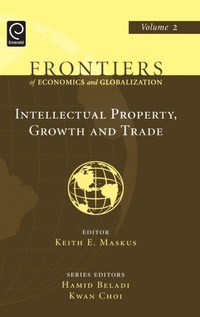
Intellectual Property, Growth and Trade
Published on 1. October 2007
Book
Hardback
782 pages
978-0-444-52764-6 (ISBN)
Description
In recent years intellectual property rights (IPR) took on major significance as an element of global trade regulation. The Agreement on Trade-Related Aspects of Intellectual Property Rights (TRIPS) at the World Trade Organization (WTO) obliges member countries to protect patents, copyrights, trademarks, and trade secrets. This mandate has great impact in developing nations, which had generally weaker IPR standards prior to TRIPS and subsequent agreements. This emerging international regime for protecting IPR raises thorny questions about how the new rules of the game might affect fundamental economic processes, including innovation, trade and economic development. The governments of many developing countries see the new regime as excessively protectionist and an impediment to their development prospects. They perceive potential problems with abusive monopoly practices, high costs for new medicines, and limited access to scientific and educational materials. Indeed, it is ironic that during a time of significant global liberalization of trade and investment barriers, the IPR system may be raising restrictions on access to the very technology flows that could substantiate the gains from greater trading opportunities. However, expansion of the global IPR regime also bears potential for economic gains. It is possible that the new system will encourage additional investments in R&D and innovation. The ongoing internationalization of commercial R&D could be accelerated. Such investments might increasingly meet the medical, agricultural, and educational needs of people in poor countries. The regime could also improve the mechanisms under which new information goods are transferred across borders, expanding the possibilities for fruitful diffusion of technologies. The implications of these reforms will be far-reaching, complex and hard to predict. It is possible, for example, that stronger patents will simply redistribute incomes across nations, generating significant winners and losers without much overall innovation gains. It is also possible that R&D investments could become more concentrated among the developed and newly industrialized economies but bypass the poorer locations. Ultimately, all such questions need close theoretical and empirical scrutiny. In this volume several economists who are closely involved in such analysis offer comprehensive and analytical literature surveys of the central questions regarding the linkages between intellectual property protection, international trade and investment, and economic growth. The authors range widely over their particular areas of inquiry. At the international level the contributions cover such questions as policy coordination in IPR, dispute resolution, markets for technology and technology transfer, international innovation, parallel trade, and economic development. On the regulatory side there are thoughtful reviews of the legal foundations of IPR, knowledge creation and the public domain, networks and standards, competition policy, access to essential medicines, and agricultural research. The contributions are aimed primarily at economists, who will find ambitious and up-to-date treatments of the most central areas of IPR and globalization. The chapters analyze recent literature, discuss shortcomings and key findings, and indicate where additional research is urgently needed. However, scholars of other disciplines, particularly in law, political science, and international relations, will find much of interest as well. The literature reviews also constitute a valuable resource for students in all these fields who wish to learn more about the economics of international IPR. This book brings together fresh insights from top economists. It considers various aspects of IPRs in the global economy from analytical and empirical perspectives. Areas covered include information technology, trade, investment, agriculture, medicine, firm behavior, and development.
More details
Series
Language
English
Place of publication
Kidlington
United Kingdom
Publishing group
Emerald Publishing Limited
Target group
Professional and scholarly
Dimensions
Height: 240 mm
Width: 161 mm
Thickness: 34 mm
Weight
995 gr
ISBN-13
978-0-444-52764-6 (9780444527646)
Copyright in bibliographic data and cover images is held by Nielsen Book Services Limited or by the publishers or by their respective licensors: all rights reserved.
Schweitzer Classification
Other editions
Additional editions
Keith E. Maskus
Intellectual Property, Growth and Trade
E-Book
10/2007
Emerald Publishing Limited
€135.99
Available for download
Persons
Keith E. Maskus is Professor of Economics and Associate Dean for Social Sciences at the University of Colorado, Boulder, USA. He has been a Lead Economist in the Development Research Group at the World Bank. He is also a Research Fellow at the Institute for International Economics, a Fellow at the Kiel Institute for World Economics, and an Adjunct Professor at the University of Adelaide. He has been a visiting professor at the University of Adelaide and the University of Bocconi, and a visiting scholar at the CES-Ifo Institute at the University of Munich and the China Center for Economic Research at Peking University. He serves also as a consultant for the World Bank, the World Health Organization, and the World Intellectual Property Organization. Maskus received his Ph.D. in economics from the University of Michigan in 1981 and has written extensively about various aspects of international trade. His current research focuses on the international economic aspects of protecting intellectual property rights.
Content
Part 1: Overview of IPRs, policy debates, and institutions. 1. The global IPRs regime (K. Maskus). 2. IPRs, innovation and incentives (S. Scotchmer). Part 2: Empirical analysis of IPRs and technology. 3. Intellectual property rights and international innovation (W. Park). 4. Patents and information diffusion (S. Kortum, J. Eaton). Part 3: Theoretical perspectives on international protection. 5. Technology differences and trade (J. Harrigan). 6. Theory of policy coordination in technology protection (E. Lai). 7. Theory of dispute resolution with IPRs (E. Bond). 8. Dynamics of IPRs and Growth (E. Dinopolous). 9. Theory of IPRs and technology transfer (K. Saggi). Part 4: Market behaviour. 10. International markets for technology (A. Arora, A. Fosfuri, A. Gambardella). 11. IPRs, price discrimination, and distribution (Y. Chen). 12. IPRs and competition policy (M. Ganslandt). 13. Information, networks, and intellectual property (J. Putnam). Part 5: IPRs, public goods, and development. 14. The knowledge commons and public versus private science (P. David). 15. Access to essential medicines (J. Lanjouw). 16. Agriculture and genetic resources (R. Evenson). 17. IPRs in an economic development strategy (K. Maskus).