

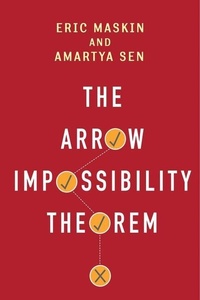
The Arrow Impossibility Theorem
Will be published approx. on 22. July 2014
Book
Hardback
168 pages
978-0-231-15328-7 (ISBN)
Description
Kenneth J. Arrow's pathbreaking "impossibility theorem" was a watershed innovation in the history of welfare economics, voting theory, and collective choice, demonstrating that there is no voting rule that satisfies the four desirable axioms of decisiveness, consensus, nondictatorship, and independence. In this book Eric Maskin and Amartya Sen explore the implications of Arrow's theorem. Sen considers its ongoing utility, exploring the theorem's value and limitations in relation to recent research on social reasoning, and Maskin discusses how to design a voting rule that gets us closer to the ideal-given the impossibility of achieving the ideal. The volume also contains a contextual introduction by social choice scholar Prasanta K. Pattanaik and commentaries from Joseph E. Stiglitz and Kenneth J. Arrow himself, as well as essays by Maskin, Dasgupta, and Sen outlining the mathematical proof and framework behind their assertions.
Reviews / Votes
Without hyperbole, no postwar intellectual of the first rank has done more good for more people-above all, many of the world's poorest-than Amartya Sen. -- Boyd Tonkin The Independent What is Arrow's impossibility theorem? Why is it true? What are its implications for democratic decision making? Is its nihilism justified? These are the kinds of questions addressed in Maskin and Sen's masterful Arrow lectures. These lectures and the accompanying essays provide an accessible introduction to Kenneth J. Arrow's theorem for the neophyte and much food for thought for the cognoscente. -- John A. Weymark, Vanderbilt University How vital it is to understand the ideas behind Kenneth J. Arrow's impossibility theorem if we want to design reasonably fair ways of coming to consensus decisions that take equitable account of individual preferences. This book is a marvelous introduction to the theorem, a keystone in the theory of social choice. We are treated to a discussion of that theory-its origin, background, and the challenges it points to-by some of its great architects. -- Barry Mazur, Harvard University, author of Imagining Numbers The pioneers of social choice theory give us lively, enjoyable, and stimulating lectures and exchanges of ideas. Their views, more than sixty years after the publication of Kenneth J. Arrow's theorem, are of paramount interest to anyone aware of the difficulties of collective decisions. -- Marc Fleurbaey, Princeton UniversityMore details
Series
Language
English
Place of publication
New York
United States
Target group
Professional and scholarly
Product notice
Trade binding
Dimensions
Height: 216 mm
Width: 146 mm
Thickness: 25 mm
Weight
331 gr
ISBN-13
978-0-231-15328-7 (9780231153287)
Copyright in bibliographic data and cover images is held by Nielsen Book Services Limited or by the publishers or by their respective licensors: all rights reserved.
Schweitzer Classification
Other editions
Additional editions
Eric Maskin | Amartya Sen | Kenneth J. Arrow
The Arrow Impossibility Theorem
E-Book
07/2014
1st Edition
Columbia University Press
from
€31.39
Available for download
Persons
Eric Maskin is the Adams University Professor at Harvard University. He received the 2007 Nobel Memorial Prize in Economics (with L. Hurwicz and R. Myerson) for laying the foundations of mechanism design theory. He has also contributed to game theory, contract theory, social choice theory, political economy, and other areas of economics. Amartya Sen is the Thomas W. Lamont University Professor and Professor of Economics and Philosophy at Harvard University. In 1998 he was awarded the Nobel Memorial Prize in Economic Sciences, and in 1999 he was awarded the Bharat Ratna, India's highest civilian award. He is also a senior fellow at the Harvard Society of Fellows; distinguished fellow of All Souls College, Oxford; and a Fellow of Trinity College, Cambridge. His books have been translated into more than thirty languages.
Content
Acknowledgments Introduction, by Prasanta K. Pattanaik Part 1: The Lectures Opening Remarks, by Joseph E. Stiglitz Arrow and the Impossibility Theorem, by Amartya Sen The Arrow Impossibility Theorem: Where Do We Go From Here?, by Eric Maskin Commentary, by Kenneth J. Arrow Part II: Supplemental Materials The Informational Basis of Social Choice, by Amartya Sen On The Robustness of Majority Rule, by Partha Dasgupta and Eric Maskin The Origins of the Impossibility Theorem, by Kenneth J. Arrow Notes on Contributors
Read Amartya Sen's essay "Arrow and the Impossibility Theorem":