

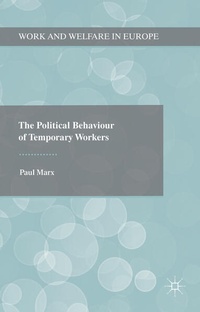
The Political Behaviour of Temporary Workers
Published on 26. August 2015
Book
Hardback
X, 167 pages
978-1-137-39486-6 (ISBN)
Description
Insecure temporary employment is growing in Europe, but we know little about how being in such jobs affects political preferences and behaviour. Combining insights from psychology, political science and labour market research, this book offers new theories and evidence on the political repercussions of temporary jobs.
More details
Series
Edition
1st ed. 2015
Language
English
Place of publication
London
United Kingdom
Target group
Professional and scholarly
Product notice
sewn/stitched
Cloth over boards
With dust jacket
Illustrations
X, 167 p.
Dimensions
Height: 216 mm
Width: 140 mm
Thickness: 11 mm
Weight
354 gr
ISBN-13
978-1-137-39486-6 (9781137394866)
DOI
10.1057/9781137394873
Schweitzer Classification
Other editions
Additional editions
E-Book
08/2015
Palgrave Macmillan
€53.49
Available for download

Book
01/2014
Palgrave Macmillan
€85.59
The article will not be published
Person
Paul Marx is Associate Professor at the Centre for Welfare State Research, University of Southern Denmark, Denmark. His research interests are related to comparative political economy, political sociology, and welfare state research.
Content
1. Introduction
2. Labour Market Change in Europe: Determinants and Effects of Temporary Work Contracts
3. Theoretical Perspectives on the Political Behaviour of Temporary Workers
4. The Policy Preferences of Temporary Workers
5. The Party Preferences of Temporary Workers
6. The Voting Behaviour of Temporary Workers
7. Are Temporary Workers Politically Alienated
8. Conclusions
Appendix
2. Labour Market Change in Europe: Determinants and Effects of Temporary Work Contracts
3. Theoretical Perspectives on the Political Behaviour of Temporary Workers
4. The Policy Preferences of Temporary Workers
5. The Party Preferences of Temporary Workers
6. The Voting Behaviour of Temporary Workers
7. Are Temporary Workers Politically Alienated
8. Conclusions
Appendix