

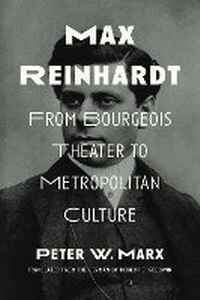
Max Reinhardt
From Bourgeois Theater to Metropolitan Culture
Will be published approx. on 31. August 2024
Book
Hardback
248 pages
978-0-8101-3891-9 (ISBN)
Description
Max Reinhardt was one of the formative directors of modern theater. Starting as an actor, it soon became clear that he wanted more. His vision of a theater "that returns joy to the people" was vast and expansive: It included intimate theatrical arrangement as well as mass production in the circus arena. Reinhardt's aesthetics were not restricted to a single program but indulged in a playful eclecticism. Thus, his career as a director that lasted for almost 40 years comprises a broad variety of artists of various genres as well as many different styles.
At the same time, Reinhardt soon longed for an international range: guest performances throughout Europe and to the US soon made him into a global star - and even a brand. He represents a metropolitan culture that roots in the late nineteenth century but comes to an end when Fasicsm in Europe ended any hopes for an international culture. As a Jew, Reinhardt himself had to flee the Nazis but when he eventually arrived in the US, he could not follow up with his earlier successes. Marx provides a broad panorama of Reinhardt's work, portraying not only his work method and some of his best known productions, but also the cultural conditions of his visionary enterprise.
At the same time, Reinhardt soon longed for an international range: guest performances throughout Europe and to the US soon made him into a global star - and even a brand. He represents a metropolitan culture that roots in the late nineteenth century but comes to an end when Fasicsm in Europe ended any hopes for an international culture. As a Jew, Reinhardt himself had to flee the Nazis but when he eventually arrived in the US, he could not follow up with his earlier successes. Marx provides a broad panorama of Reinhardt's work, portraying not only his work method and some of his best known productions, but also the cultural conditions of his visionary enterprise.
Reviews / Votes
"Attuned to all the paradoxes of a commercially aspiring avant-gardist whose works ripened to a vast scale, Marx provides an unblinking account of a formative theatre artist inseparable from twentieth-century socio-political history."-Tracy C. Davis, Northwestern UniversityMore details
Language
English
Place of publication
Evanston
United States
Illustrations
32 b&w halftones
Dimensions
Height: 229 mm
Width: 152 mm
ISBN-13
978-0-8101-3891-9 (9780810138919)
Copyright in bibliographic data and cover images is held by Nielsen Book Services Limited or by the publishers or by their respective licensors: all rights reserved.
Schweitzer Classification
Persons
Peter W. Marx is professor of theater and media studies at the University of Cologne and director of its Theater Studies Collection.
Robert E. Goodwin is a lecturer in English at Skidmore College. He is the translator of Markus Werner's novel On the Edge and of RUEdiger Safranski's Romanticism: A German Affair.
Robert E. Goodwin is a lecturer in English at Skidmore College. He is the translator of Markus Werner's novel On the Edge and of RUEdiger Safranski's Romanticism: A German Affair.
Content
Introduction
Chapter 1 From Cabaret to the Deutsches Theater
Chapter 2 The Kammerspiele as Bourgeois Salon
Chapter 3 Circus Reinhardt: Giving Shape and Space to the Masses
Chapter 4 "Reinhardt Goes Global!" Tours, Guest Performances, Expansions
Chapter 5 Reinhardt and Film: A Missed Rendezvous?
Chapter 6 Reinhardt & Co.: The Economy of a Theater Concern
Chapter 7 Max Goldmann-Max Reinhardt: Between Participation and Exclusion
Conclusion The Glorious Heyday and Obscure Demise of Reinhardtian Theater as a Historical Lesson
Notes
Works Cited
Chapter 1 From Cabaret to the Deutsches Theater
Chapter 2 The Kammerspiele as Bourgeois Salon
Chapter 3 Circus Reinhardt: Giving Shape and Space to the Masses
Chapter 4 "Reinhardt Goes Global!" Tours, Guest Performances, Expansions
Chapter 5 Reinhardt and Film: A Missed Rendezvous?
Chapter 6 Reinhardt & Co.: The Economy of a Theater Concern
Chapter 7 Max Goldmann-Max Reinhardt: Between Participation and Exclusion
Conclusion The Glorious Heyday and Obscure Demise of Reinhardtian Theater as a Historical Lesson
Notes
Works Cited