

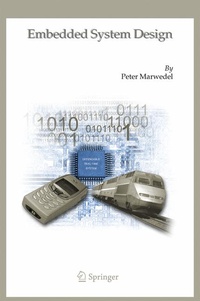
Embedded System Design
1st Edition
Published on 1. December 2005
Book
Paperback/Softback
XVII, 241 pages
978-0-387-29237-3 (ISBN)
Description
Embedded systems can be defined as information processing systems embedded into enclosing products such as cars, telecommunication or fabrication equipment. Such systems come with a large number of common characteristics, including real-time constraints, and dependability as well as efficiency requirements. Following the success of information technology (IT) for office and workflow applications, embedded systems are considered to be the most important application area of IT during the coming years. This importance of embedded systems is so far not well reflected in many of the current curricula.
Embedded System Design is intended as an aid for changing this situation. It provides the material for a first course on embedded systems, but can also be used by PhD students and professors. A key goal of this book is to provide an overview of embedded system design and to relate the most important topics in embedded system design to each other. It should help to motivate students as well as professors to put more emphasis on education in embedded systems. In order to facilitate teaching from this book, slides, exercises and other related material can be downloaded via the author's web page.
Embedded System Design is intended as an aid for changing this situation. It provides the material for a first course on embedded systems, but can also be used by PhD students and professors. A key goal of this book is to provide an overview of embedded system design and to relate the most important topics in embedded system design to each other. It should help to motivate students as well as professors to put more emphasis on education in embedded systems. In order to facilitate teaching from this book, slides, exercises and other related material can be downloaded via the author's web page.
More details
Language
English
Place of publication
New York
United States
Target group
Professional and scholarly
PhD students, professors
Product notice
Paperback (trade)
Illustrations
1
Dimensions
Height: 23.5 cm
Width: 15.5 cm
Thickness: 13 mm
Weight
820 gr
ISBN-13
978-0-387-29237-3 (9780387292373)
DOI
10.1007/0-387-30087-2
Schweitzer Classification
Other editions
New editions
Peter Marwedel
Embedded System Design
Embedded Systems Foundations of Cyber-Physical Systems, and the Internet of Things
Book
01/2021
4th Edition
Springer
€53.49
Shipment within 7-9 days
Book
11/2010
2nd Edition
Springer
€96.29
Article exhausted; check for reprint
Additional editions
Peter Marwedel
Embedded System Design
Book
10/2003
Kluwer Academic Publishers
€144.40
Article exhausted; check different version
Person
Dr. Peter Marwedel received his PhD in Physics from the University of Kiel in 1974. He is one of the early researchers in high level synthesis, working on the MIMOLA system for a number of years. Dr. Marwedel is a professor at the University of Dortmund since 1989. He has served as the chairman of the computer science department, has played a leading role in establishing the Design, Automation and Test in Europe (DATE) conference and is the chairman of the Informatik Centrum Dortmund (ICD), a technology transfer centre.
Content
Preface. Acknowledgements.
1: Introduction. 1.1. Terms and scope. 1.2. Application areas. 1.3. Growing importance of embedded systems. 1.4. Structure of this book.
2: Specifications. 2.1. Requirements. 2.2. Models of computation. 2.3. StateCharts. 2.4. General language characteristics. 2.5. SDL. 2.6. Petri nets. 2.7. Message Sequence Charts. 2.8. UML. 2.9. Process networks. 2.10. Java. 2.11. VHDL. 2.12. SystemC. 2.13.Verilog and System Verilog. 2.14. SpecC. 2.15. Additional languages. 2.16. Levels of hardware modeling. 2.17. Language comparison. 2.18. Dependability requirements.
3: Embedded system hardware. 3.1. Introduction. 3.2. Input. 3.3. Communication. 3.4. Processing units. 3.5. Memories. 3.6. Output.
4: Embedded operating systems, middleware, and scheduling. 4.1. Prediction of execution times. 4.2. Scheduling in real-time systems. 4.3. Embedded operating systems. 4.4. Middleware.
5: Implementing embedded systems: hardware/software codesign. 5.1. Task level concurrency management. 5.2. High-level optimizations. 5.3. Hardware/software partitioning. 5.4. Compilers for embedded systems. 5.5. Voltage scaling and power management. 5.6. Actual design flows and tools.
6: Validation. 6.1. Introduction. 6.2.Simulation. 6.3. Rapid prototyping and emulation. 6.4. Test. 6.5. Fault simulation. 6.6. Fault injection. 6.7. Risk- and dependability analysis. 6.8. Formal verification.
Bibliography. About the Author. List of Figures. Index.