

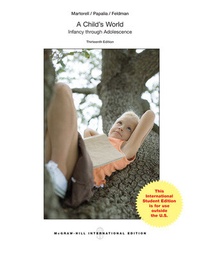
A Child's World: Infancy Through Adolescence
13th Edition
Published on 16. October 2013
Book
Paperback/Softback
640 pages
978-1-259-06074-8 (ISBN)
Description
This fully-revised thirteenth edition continues to provide the extensive cross-cultural and multicultural coverage, the innovative pedagogical learning system, and the balance between research and real-life applications that has made A Child's World a favorite of students and professors alike. The new edition was revised using McGraw-Hill's Heat Map Technology, which gives authors access to real data from real students to create their revisions. This data is anonymously collected from the many students who use LearnSmart, the adaptive learning tool that provides students with an individualized assessment of their own progress. Because virtually every text paragraph is tied to several questions that students answer while using LearnSmart, empirical data showing the specific concepts with which students have the most difficulty is easily pinpointed for the authors to review. In addition to those areas that have been reworked for clarity in the thirteenth edition, "StudySmart" icons are placed in the most important hot spots in the chapter based on student data. These icons lead students to digital assets that enhance their understanding of challenging concepts.
More details
Edition
13th edition
Language
English
Place of publication
OH
United States
Target group
College/higher education
Illustrations
illustrations (black and white, and colour)
Dimensions
Height: 274 mm
Width: 216 mm
Thickness: 20 mm
Weight
1128 gr
ISBN-13
978-1-259-06074-8 (9781259060748)
Schweitzer Classification
Persons
Gabriela Alicia Martorell was born in Seattle, Washington, but moved as a toddler to Guatemala. At eight, she returned to the United States and lived in Northern California until leaving for her undergraduate training at the University of California, Davis. After obtaining her B.S. in Psychology, she earned her Ph.D. in Developmental and Evolutionary Psychology with an interdisciplinary emphasis in Human Development from the University of California, Santa Barbara. She now works as a Full Professor of Psychology at Virginia Wesleyan University and serves as the chair of the Institutional Review Board. Gabi maintains an active teaching schedule and teaches courses in Introductory Psychology, Lifespan Human Development, Infant Development, Child Development, Adolescent Development, Culture and Development, Evolutionary Psychology, Research Methods, Original Research Project and Capstone community-based learning courses in Early Childhood Education and Adulthood and Aging. She is committed to teaching, mentoring, and advising. She recently concluded a 5-year longitudinal National Science Foundation grant focused on the retention of higher education students from traditionally underrepresented groups in science, technology, engineering, and math. She is also a volunteer trainer for Court Appointed Special Advocates, and a group fitness instructor for the YMCA of South Hampton Roads.
As a professor, Diane E. Papalia has taught thousands of undergraduates at the University of Wisconsin-Madison. She received her bachelors degree, majoring in psychology, from Vassar College and both her masters degree in child development and family relations and her Ph.D. in life-span developmental psychology from West Virginia University. She has published numerous articles in such professional journals as Human Development, International Journal of Aging and Human Development, Sex Roles, Journal of Experimental Child Psychology and Journal of Gerontology. Most of these papers have dealt with her major research focus, cognitive development from childhood through old age.
Ruth Duskin Feldman is an award-winning writer and educator. With Diane E. Papalia and Sally Wendkos Olds, she coauthored the fourth and the seventh through the twelfth editions of Human Development and the eighth through the twelfth editions of A Child's World. She also is coauthor, with Dr. Papalia, Harvey Sterns and Cameron J. Camp, of Adult Development and Aging. A former teacher, she has developed educational materials for all levels from elementary school through college and has prepared ancillaries to accompany the Papalia-Olds books. She is author or coauthor of four books addressed to general readers, including Whatever Happened to the Quiz Kids? Perils and Profits of Growing Up Gifted. She has written for numerous newspapers and magazines and has lectured extensively and made national and local media appearances throughout the United States on education and gifted children. She received her bachelor's degree from Northwestern University, where she was graduated with highest distinction and was elected to Phi Beta Kappa.
As a professor, Diane E. Papalia has taught thousands of undergraduates at the University of Wisconsin-Madison. She received her bachelors degree, majoring in psychology, from Vassar College and both her masters degree in child development and family relations and her Ph.D. in life-span developmental psychology from West Virginia University. She has published numerous articles in such professional journals as Human Development, International Journal of Aging and Human Development, Sex Roles, Journal of Experimental Child Psychology and Journal of Gerontology. Most of these papers have dealt with her major research focus, cognitive development from childhood through old age.
Ruth Duskin Feldman is an award-winning writer and educator. With Diane E. Papalia and Sally Wendkos Olds, she coauthored the fourth and the seventh through the twelfth editions of Human Development and the eighth through the twelfth editions of A Child's World. She also is coauthor, with Dr. Papalia, Harvey Sterns and Cameron J. Camp, of Adult Development and Aging. A former teacher, she has developed educational materials for all levels from elementary school through college and has prepared ancillaries to accompany the Papalia-Olds books. She is author or coauthor of four books addressed to general readers, including Whatever Happened to the Quiz Kids? Perils and Profits of Growing Up Gifted. She has written for numerous newspapers and magazines and has lectured extensively and made national and local media appearances throughout the United States on education and gifted children. She received her bachelor's degree from Northwestern University, where she was graduated with highest distinction and was elected to Phi Beta Kappa.
Content
Part 1 Entering a Child's World Chapter 1: Studying A Child's World Chapter 2: A Child's World: How We Discover ItPart 2 Beginnings Chapter 3: Forming a New Life: Conception, Heredity, and Environment Chapter 4: Pregnancy and Prenatal Development Chapter 5: Birth and the Newborn BabyPart 3 Infancy and Toddlerhood Chapter 6: Physical Development and Health During the First Three Years Chapter 7: Cognitive Development during the First Three Years Chapter 8: Psychosocial Development during the First Three YearsPart 4 Early Childhood Chapter 9: Physical Development and Health in Early Childhood Chapter 10: Cognitive Development in Early Childhood Chapter 11: Psychosocial Development in Early ChildhoodPart 5 Middle Childhood Chapter 12: Physical Development and Health in Middle Childhood Chapter 13: Cognitive Development in Middle Childhood Chapter 14: Psychosocial Development in Middle ChildhoodPart 6 Adolescence Chapter 15: Physical Development and Health in Adolescence Chapter 16: Cognitive Development in Adolescence Chapter 17: Psychosocial Development in Adolescence