

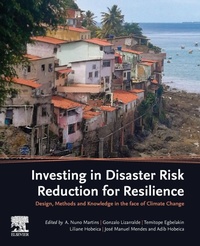
Investing in Disaster Risk Reduction for Resilience
Design, Methods and Knowledge in the face of Climate Change
Published on 17. March 2022
Book
Paperback/Softback
320 pages
978-0-12-818639-8 (ISBN)
Description
Disaster prevention and the mitigation of climate change effects call for global action. Joint efforts are required among countries, economic sectors, and public and private stakeholders. Not surprisingly, international organizations, such as the United Nations agencies, propose policy frameworks aimed at worldwide influence. The 2015-2030 Sendai Framework seeks to create consensus about the need to act for disaster risk reduction and climate adaptation. A key goal is to promote investments in risk reduction and resilience. But how useful is this policy framework? What does it say, and what does it overlook? How can it be implemented among vulnerable communities, in historic sites, and in other sensitive locations affected by disasters?
In this book, prominent scholars and practitioners examine the successes and failures of the Sendai Framework. Their case studies show that, despite its good intentions, the Framework achieves very little. The main reason is that, while avoiding a political engagement, it fails to deal with disasters' root causes and guide the difficult path of effective implementation. The authors bring a fresh look to international policy and design practices, highlighting cross-disciplinary research avenues, and ideas and methods for low-income communities, cities and heritage sites in Portugal, Haiti, the United States, the Philippines, New Zealand, Sri Lanka, Nigeria, among other countries.Global action requires collaboration between heterogeneous stakeholders, but also the recognition of inequalities, power imbalances, and social and environmental injustices.
In this book, prominent scholars and practitioners examine the successes and failures of the Sendai Framework. Their case studies show that, despite its good intentions, the Framework achieves very little. The main reason is that, while avoiding a political engagement, it fails to deal with disasters' root causes and guide the difficult path of effective implementation. The authors bring a fresh look to international policy and design practices, highlighting cross-disciplinary research avenues, and ideas and methods for low-income communities, cities and heritage sites in Portugal, Haiti, the United States, the Philippines, New Zealand, Sri Lanka, Nigeria, among other countries.Global action requires collaboration between heterogeneous stakeholders, but also the recognition of inequalities, power imbalances, and social and environmental injustices.
More details
Language
English
Place of publication
United States
Target group
Professional and scholarly
Academics in disaster management, policymakers, architects, planners, NGO collaborators, humanitarian-aid workers, and risk practitioners in general
Product notice
Paperback (trade)
Illustrations
Approx. 150 illustrations (75 in full color)
Dimensions
Height: 235 mm
Width: 191 mm
Thickness: 17 mm
Weight
554 gr
ISBN-13
978-0-12-818639-8 (9780128186398)
Copyright in bibliographic data and cover images is held by Nielsen Book Services Limited or by the publishers or by their respective licensors: all rights reserved.
Schweitzer Classification
Other editions
Additional editions
A. Nuno Martins | Gonzalo Lizarralde | Temitope Egbelakin
Investing in Disaster Risk Reduction for Resilience
Design, Methods and Knowledge in the face of Climate Change
E-Book
03/2022
Elsevier
€109.00
Available for download
Persons
Since 2013 Dr. Martins has been an integrated researcher of CIAUD, the Research Centre for Architecture, Urbanism, and Design, within the Faculty of Architecture of the University of Lisbon with a project addressing risk, resilience as well as humanitarian architecture for disaster-prone and informal-settlement environments. In the past three years, he has chaired major global conferences and design competitions focused on risk, resilience, and humanitarian architecture. As a project manager of the NGO Building 4Humanity, Design, and Reconstructing Communities Association, he has been leading multidisciplinary teams in projects and missions in Portugal, Africa, and Brazil. The outcomes of the action-research fieldwork have been presented in conferences in the areas of sustainability, urban disaster as well as design in development, and subsequently published in proceedings, books, and journals. His current research interests include the re-visitation of the concept of incremental housing and the introduction of humanitarian architecture into architectural education. Gonzalo Lizarralde is a professor at the School of Architecture of Universite de Montreal. He studies the relationships between planning, design and construction processes. He has a PhD from Universite de Montreal, a Masters in Architecture from McGill University and a post doctorate from the Department of Construction Economics and Management of University of Cape Town, South Africa. He has taught in leading Universities in Canada, Colombia and South Africa. Dr. Temitope Egbelakin is an Associate Professor at the School of Architecture and Built Environment (SABE) and the Executive Director of CIFAL Newcastle at the University of Newcastle in New South Wales, AU. Her research interests include Construction Project Performance, Disaster Resilience, Prefabrication and Affordable Housing, as well as Smart Construction and Informatics. Dr. Temitope is a prolific researcher, having led several funded research projects and has published widely in top international refereed journals. She has been active in several local and international research groups such as QuakeCore, National Science Challenges (NSC), Integrated Research on Disaster Risk (IRDR), and the International Council for Research and Innovation in Building and Construction (CIB). Liliane Hobeica is an architect-urbanist whose research activities have been following a broad disciplinary approach. After three master degrees, in urbanism, human ecology, and risk sciences, she concluded in 2018 a PhD in risk sciences, in which she explored the potentials of spatial design as a flood-adaptation tool within urban-riverfront interventions. She is currently interested in the social dimensions of flood adaptation, community-based resilient design, and risk mainstreaming in architectural practices. Jose Manuel Mendes holds a PhD in Sociology from the School of Economics of the University of Coimbra, where he is an Associate Professor with Aggregation. He is also a researcher at the Centre for Social Studies, where he has been working in the fields of risk and social vulnerability, planning, public policies and citizenship. He is coordinator of the Risk Observatory (OSIRIS) of the Centre for Social Studies and is the Editor of Revista Critica de Ciencias Sociais. Adib Hobeica is an independent consultant and researcher, with Master degrees in international management (ISC Paris) and in risk sciences (University of Coimbra), extensive exposure to the development sphere, and manifold experiences in data collection and analysis, writing and reviewing, gained in both academic environments and assignments with international organizations (ICRC, UNDP, UNIDO and the World Bank).
Editor
Integrated Researcher, CIAUD, the Research Centre for Architecture, Urbanism, and Design, Faculty of Architecture, University of Lisbon, Portugal
Professor, School of Architecture, University of Montreal, Canada
Associate Professor, School of Architecture and Built Environment (SABE), The University of Newcastle, New South Wales, Australia
Environmental Hazard and Risk Assessment and Management (RISKam) research group, Centre of Geographical Studies (CEG), University of Lisbon, Portugal
Associate Professor, University of Coimbra, Portugal
Independent Consultant
Content
Part A Investing in design for disaster risk reduction
1. Investing in community participation for disaster recovery
2. Investing in the social places of heritage towns
3. Investing in contingency in a heritage site
Part B Investing in new methods for resilience
4. Physical services index for flooding hazards
5. Resilience planning in antagonistic communities
6. Systems thinking toward climate resilience
7. Assessing urban resilience to cope with climate change
Part C Building knowledge on disaster risk reduction investment
8. Incentives for retrofitting heritage buildings in New Zealand
9. Dissatisfaction after postdisaster resettlement
10. The media coverage of climate change in Portugal
11. Investing in flood adaptation in Jakarta, Indonesia
1. Investing in community participation for disaster recovery
2. Investing in the social places of heritage towns
3. Investing in contingency in a heritage site
Part B Investing in new methods for resilience
4. Physical services index for flooding hazards
5. Resilience planning in antagonistic communities
6. Systems thinking toward climate resilience
7. Assessing urban resilience to cope with climate change
Part C Building knowledge on disaster risk reduction investment
8. Incentives for retrofitting heritage buildings in New Zealand
9. Dissatisfaction after postdisaster resettlement
10. The media coverage of climate change in Portugal
11. Investing in flood adaptation in Jakarta, Indonesia